A home gym can look spotless and still feel stuffy. Dust on the floor, damp mats and cleaning-product fumes all deserve attention, especially in a garage or basement where airflow may be limited.
A useful air-care routine starts before your first set and continues after you put the weights away. The priorities are simple: reduce the sources of pollution, bring in clean outdoor air when conditions allow, and keep the space dry. An air purifier can help with particles, but it cannot do every job.
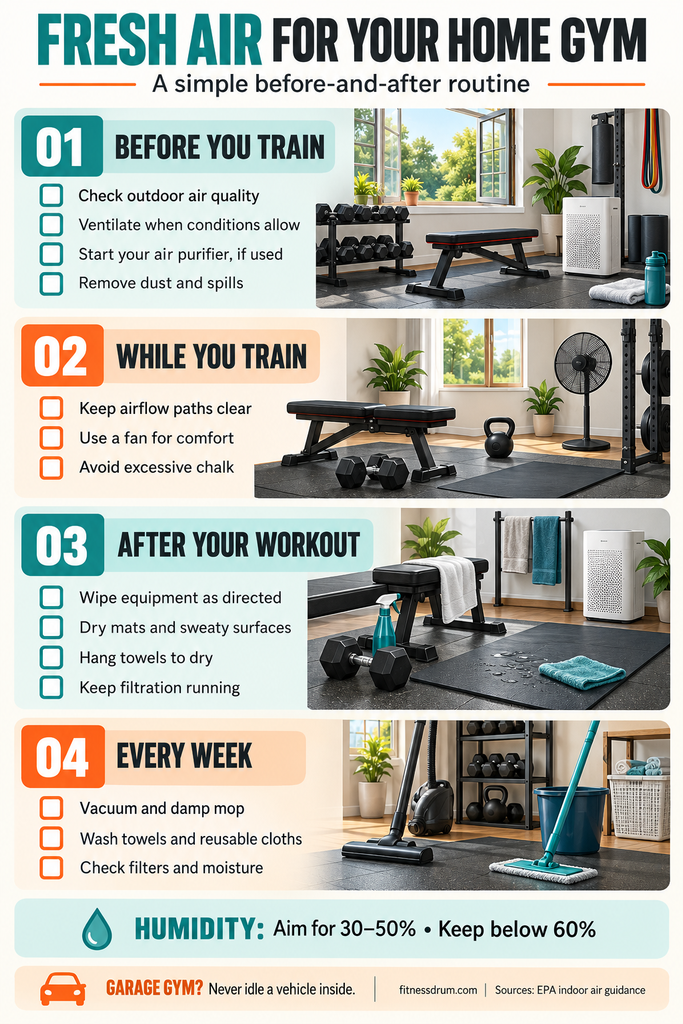
Your Home Gym Air-Care Checklist
Use this as a practical housekeeping routine. There is no single ventilation time that makes every workout room ready: room size, outdoor conditions, pollution sources and equipment all affect the result.
| Stage | What to do | What to check |
|---|---|---|
| Before | Check outdoor air, remove visible dust and spills, and start ventilation or filtration. | Are floors dry and airflow openings clear? |
| During | Maintain suitable ventilation, use a fan for comfort and avoid excessive chalk. | Is the room becoming damp or uncomfortable? |
| After | Wipe touch points, dry equipment and mats, and hang towels. | Have you left anything wet or trapped moisture under a mat? |
| Weekly | Vacuum, damp mop, wash reusable cloths and inspect filters. | Is humidity persistently high, or is there a leak or musty smell? |
Before Your Workout: Check the Air and Clear the Floor
Decide Whether to Open a Window
Check local air quality and the weather before opening up. Outdoor air can help dilute indoor pollutants, but smoke, heavy pollen, extreme temperatures or very humid conditions can make ventilation through open windows a poor choice. The EPA recommends considering outdoor pollution, pollen, temperature and humidity when deciding whether to ventilate.
When conditions are suitable, open exterior windows or doors to create a path through the room. In an attached garage, keep the door into the house closed rather than using your living space as the airflow route.
If you use a purifier, switch it on while setting up. Pairing this habit with your mobility work and ramp-up sets makes it easier to remember. A few minutes of operation is a head start, not proof that the room has been cleared of pollutants.
Deal With Dust Before You Start Moving
Check beneath the bench, around the rack and along mat edges. Pick up debris and wipe spills before training. Save a dusty deep clean for a separate time so you are not starting your workout in the middle of it.
There is a reason to take dust seriously. A study of eight health clubs in Porto found PM10 particle concentrations were 1.1–4.7 times higher during occupied periods than when the clubs were vacant. The study involved commercial facilities under specific occupancy and ventilation restrictions, so those figures do not predict the air quality in your home gym.
Skip the Pre-Workout Scented Spray
Air fresheners can cover an odor without dealing with its source. If a mat smells damp or a bin holds yesterday’s towel, deal with that first.
The Porto researchers also reported elevated total volatile organic compounds, or TVOCs, and linked the findings in part to frequent cleaning and disinfection during the study period. That supports being thoughtful about product use; it does not mean every cleaner creates the same exposure.
During Your Workout: Separate Air Movement From Ventilation
A fan pointed at you can make training more comfortable. Exchanging indoor air with outdoor air is a different job. When outdoor conditions allow, use an exterior opening and a clear airflow path rather than relying only on a fan circulating air around a closed room.
Keep fan cables out of walking routes and leave space around the purifier’s intake and outlet. Avoid directing a strong fan across a dusty floor or an open chalk container.
Use a humidity meter to see how the room changes during longer sessions. If opening a window brings in hot, damp air, air conditioning or a dehumidifier may be more useful for moisture control. A purifier does not dehumidify the room.
After Your Workout: Wipe, Dry and Keep Air Treatment Running
Clean Equipment According to Its Care Instructions
Wipe the surfaces you touched, including handles, bench pads and machine controls. Use the cleaning method approved for each material. Where permitted, apply cleaner to a cloth rather than spraying it into the room or toward electronics.
Do not assume the same damp cloth is suitable for everything. Bare steel, upholstery, screens and rubber can need different care. Dry metal promptly, avoid soaking seams, and keep moisture away from electrical parts.
If you use a disinfectant, follow its label for dilution, surface compatibility, ventilation and contact time. A quick wipe is not automatically disinfection.
For mirrors in your workout space, use a separate, clean cloth and a suitable cleaner. A gritty cloth used on the floor or rack should not be your mirror cloth.
Dry Sweat Before Packing Anything Away
Wipe wet benches and mats, hang towels where air can reach them, and avoid rolling up a damp mat. If moisture gets beneath removable flooring, check underneath and let the affected surfaces dry.
The EPA’s advice to dry water-damaged materials within 24–48 hours concerns leaks and water damage. It is not a reason to leave sweaty equipment wet for a day or two. For your everyday routine, deal with moisture when you finish.
Do Not Treat a Timer as an Air-Quality Test
Keep filtration running after the session and continue ventilation while outdoor conditions remain suitable. The EPA notes that longer purifier run times increase the amount of air filtered.
There is no universal 30-minute clearance time for a home gym. A persistent odor or recurring condensation needs investigation, even if your usual timer has finished.
How to Size an Air Purifier for a Home Gym
Look for a clean air delivery rate, or CADR, appropriate for the room. CADR describes particle filtration performance and is usually measured at the unit’s highest speed.
The EPA provides these approximate sizing figures for rooms with an 8-foot ceiling:
| Room area | Minimum CADR (cfm) |
|---|---|
| 100 sq ft | 65 |
| 200 sq ft | 130 |
| 300 sq ft | 195 |
| 400 sq ft | 260 |
| 500 sq ft | 325 |
| 600 sq ft | 390 |
Choose a higher CADR for taller ceilings. For an open-plan workout area, account for the connected space the unit will serve. Check performance at a speed you will actually use, since lower settings filter less air.
- Particles and gases need different filters. HEPA filtration targets particles. Substantial activated carbon can help with some gases and odors; CADR does not rate gas removal.
- Avoid intentional ozone generation. The EPA identifies ozone as a lung irritant and warns that some electronic air-cleaning technologies can emit it.
- Follow the unit’s filter schedule. Check the manual and filter indicator. There is no universal 60–90-day replacement rule for portable purifier filters.
Extra Precautions for a Garage Workout Space
Never idle a vehicle inside the garage, even with the garage door open. The EPA warns that carbon monoxide can build up to deadly levels. An ordinary home air purifier is not protection against vehicle exhaust.
Store fuel, paints and solvents according to their labels, away from the training area and ignition sources. If chemical or exhaust odors persist, stop using the space for exercise until the source has been addressed.
Purpose-designed garage ventilation can help: in a Health Canada study of 33 homes, installed exhaust fans reduced pollutants in both garages and adjoining homes. That finding does not make running an engine indoors safe or show that a portable workout fan provides equivalent protection.
Install carbon monoxide alarms according to manufacturer instructions and local requirements. The CDC recommends battery-operated or battery-backup alarms near every sleeping area. Do not assume an alarm rated for indoor living space is suitable for a garage’s temperature range.
Weekly and Monthly Jobs That Keep the Routine Working
Use this weekly checklist as a starting point, then adjust it to how often you train and how quickly the space gets dirty:
- Vacuum floors, mat edges and accessible areas beneath equipment, preferably with a well-sealed, HEPA-filtered vacuum.
- Damp mop suitable flooring with a manufacturer-approved cleaner. Avoid leaving water in seams or beneath tiles.
- Wash towels, reusable cleaning cloths and washable covers according to their care labels.
- Inspect the purifier’s pre-filter and service it as directed. Check the main filter’s replacement guidance separately.
- Empty and clean the dehumidifier as instructed, or check that its drain is working.
- Look for condensation, leaks, damp corners and recurring musty smells.
Once a month, clean behind equipment where it is safe to reach. Avoid shifting a heavy rack just to dust behind it. Persistent dampness needs a fix to its source; adding fragrance or another purifier will not repair a leak.
Home Gym Air-Care FAQ
How Often Should You Clean a Home Gym?
Wipe used surfaces and dry sweat after each workout. Use a weekly floor clean as a starting point, with extra attention after muddy shoes, visible chalk buildup or heavier use.
Do You Need Both a Fan and an Air Purifier?
They serve different purposes. A fan moves air, while a purifier filters it. Whether you need either depends on the room, its ventilation and its pollution sources. Neither replaces keeping the space clean and dry.
Should You Leave the Window Open All the Time?
No. Adjust to outdoor air quality, weather and security. Reassess when smoke, pollen or humidity rises instead of following a fixed open-window rule.
What Should You Do if the Room Still Smells Musty?
Check underneath mats, behind stored items and around walls or pipes for dampness. Address leaks and moisture sources. A recurring musty smell warrants investigation, even when the floor looks clean.