

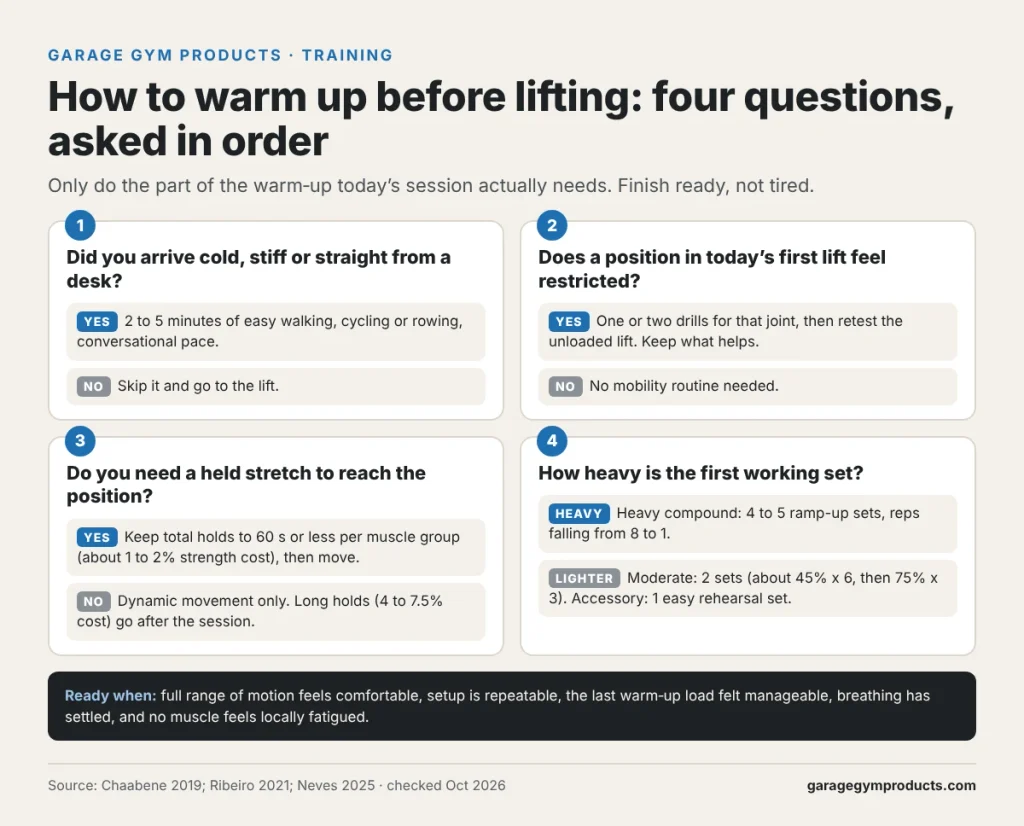
How to warm up before lifting comes down to three decisions: whether you need a few minutes of general movement, whether a specific drill or stretch helps you reach the position the lift requires, and how many ramp-up sets to take before your working weight. If your warm-up leaves you tired before the first working set, it is worth rethinking your approach. The goal is to prepare for the exercise while saving your effort for training. In a study of 34 resistance-trained men, lift-specific warm-ups improved first-set movement velocity during squats and bench presses.
Start by deciding whether you need general movement, work on the range of motion your lifts require, then build toward your working weight. The templates below show how we can adapt that process for heavy lifts, moderate sessions, and accessories.
Quick answer: a lifting warm-up that does not cost you the workout
- General movement: two to five minutes of easy walking, cycling, or rowing if you arrive cold or stiff. Skip it if you are already warm.
- Mobility and stretching: only for a restriction you can identify in the lift. Static holds totaling 60 seconds or less per muscle group reduce strength and power by about 1 to 2%, a trivial amount; longer holds cost 4 to 7.5%.
- Ramp-up sets for a heavy lift: very light, then about 40%, 60%, and 80% of your working weight, reducing repetitions as the load rises, with an optional single at 90%.
- Evidence: in 34 resistance-trained men, two sets of six at 40% and 80% of the training load raised first-set bar speed in both the squat (0.64 to 0.68 m/s) and the bench press (0.47 to 0.52 m/s).
- Changing exercises: a brief re-warm-up improved squat performance after bench pressing in a 2025 study, so repeat a short progression before the next heavy lift.
- Time: most lifters can cover all of this in 8 to 15 minutes. That is a coaching estimate, not a research-established figure.
What an Evidence-Based Warm-Up Protocol for Lifters Should Do
A useful warm-up lets you rehearse the planned movement, check how you are moving, and approach the working load gradually. Each component has a different job. You do not need to spend equal time on all four before every session.
| Component | Purpose | When To Use It | Evidence and Limitations |
|---|---|---|---|
| General movement | Begin moving before loaded exercise | When you arrive cold, sedentary, or sluggish | The lifting research cited here does not establish a mandatory duration or intensity |
| Dynamic mobility | Practice the range of motion needed for the lift | When a specific movement feels restricted | Choose drills by their effect on the planned movement; no universal sequence is established |
| Static stretching | Address a specific range-of-motion need with a held stretch | When it helps you reach the required position comfortably | Duration and placement affect subsequent strength and power |
| Lift-specific ramp-up sets | Rehearse technique with progressively heavier loads | Before demanding working sets or a substantially different exercise | Direct squat and bench-press evidence supports immediate performance benefits, but no single progression is established as optimal |
Sources: Ribeiro et al. 2021 (Journal of Men’s Health), Chaabene et al. 2019 (Frontiers in Physiology), Neves et al. 2025 (Sports). Checked October 2026.
In the 34-man study, participants completed two warm-up sets of six repetitions at 40% and 80% of their training load. Their working sets used 80% of one-repetition maximum, making the warm-up loads equivalent to 32% and 64% of maximum. Those percentages describe different things. Mixing them up can make your preparation substantially heavier than intended.
The study supports including relevant practice before loading the bar heavily. It does not show that two sets of six are ideal for every exercise, lifter, or workout. The outcomes concerned immediate performance, not long-term strength gains or injury rates.
Build Your Warm-Up Around the First Main Lift
1. Assess Readiness With Easy Movement
Begin with an unloaded or lightly loaded version of your first exercise. For squats, try a few comfortable bodyweight repetitions. For pressing, use a manageable bar or light dumbbells to check your setup and movement.
Check whether you can reach the intended position comfortably, stay in control, and repeat the movement consistently. Pain is a reason to stop and reassess, not a signal to keep adding weight until the sensation disappears. Seek qualified medical assessment for new, persistent, or worsening pain, especially after an injury.
2. Add General Movement When It Serves a Purpose
If you have been sitting for hours or your garage is cold, start with easy walking, cycling, or rowing. Keep the effort conversational and finish feeling ready to lift. A hard conditioning interval adds another demand before the work you came to do. An air bike at a gentle pace works well for this because the resistance is only what you put into it.
As a practical starting point, try two to five minutes of easy movement, then reassess with the planned lift. This is an adaptable coaching template, not a research-established minimum. If you arrive active and your early rehearsal sets feel comfortable, you can go straight into lift-specific preparation.
3. Choose Mobility Drills for a Specific Restriction
Choose mobility work to address a restriction you can identify in the movement. Controlled ankle rocks, for example, may be worth trying when ankle movement limits your squat position. Gentle shoulder movements may help you assess a comfortable pressing position.
Some options, matched to the lift they tend to help, are listed below. Treat them as things to test, not a routine to complete.
- Squat: ankle rocks against a wall, a bodyweight squat held at the bottom for a few breaths, hip circles.
- Bench press: band pull-aparts, slow shoulder circles, a few push-ups to find the shoulder-blade position you want on the bench.
- Deadlift: an unloaded hip hinge with a dowel or empty bar, hamstring sweeps, and a few bodyweight good mornings.
Do a small amount, then repeat the unloaded or light exercise. Keep a drill if the movement becomes more comfortable or controlled. If it makes no useful difference, move on. A drill does not need to stay in your warm-up just because it has always been there.
Mobility work cannot solve every setup problem, either. For bench-focused sessions, review your bench-press setup and shoulder considerations alongside your preparation.
4. Progress the Load While Reducing Repetitions
Use light sets to establish your stance, grip, bracing, and movement path. As you approach your working weight, reduce repetitions so the warm-up does not turn into an extra hard set.
Keep warm-up repetitions comfortably away from failure. A demanding final warm-up can use effort you need for the prescribed work. If that last rehearsal feels unexpectedly difficult, take more rest and reconsider the planned load.
Practical Warm-Up Templates for Strength Training
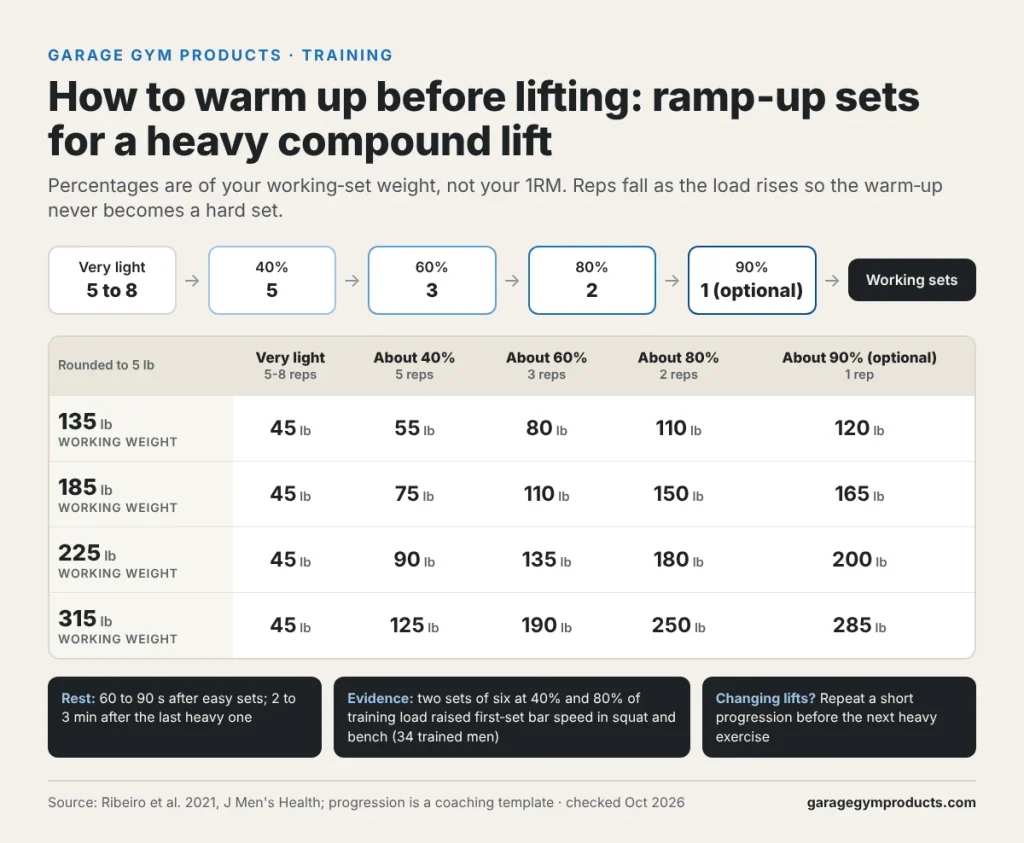
The examples below are adaptable starting points, not proven optimal prescriptions. Every percentage refers to the planned working-set weight, not your one-repetition maximum. Round to sensible loads and use lighter equipment when an empty bar is already too heavy; our guide to barbell types can help you compare bar options.
Heavy Compound Lift
For a heavy squat, bench press, or deadlift, work through several progressively heavier sets. One possible progression is:
- Very light load: five to eight controlled repetitions.
- About 40% of working weight: five repetitions.
- About 60%: three repetitions.
- About 80%: two repetitions.
- About 90%: one repetition, if that additional rehearsal is useful.
- Rest, then begin the working sets.
Here is that progression worked out for four common working weights, rounded to the nearest 5 lb with a 45 lb bar as the floor.
| Working weight | Very light (5 to 8 reps) | About 40% (5 reps) | About 60% (3 reps) | About 80% (2 reps) | About 90% (1 rep, optional) |
|---|---|---|---|---|---|
| 135 lb | 45 lb | 55 lb | 80 lb | 110 lb | 120 lb |
| 185 lb | 45 lb | 75 lb | 110 lb | 150 lb | 165 lb |
| 225 lb | 45 lb | 90 lb | 135 lb | 180 lb | 200 lb |
| 315 lb | 45 lb | 125 lb | 190 lb | 250 lb | 285 lb |
Percentages are of the working-set weight, not 1RM. At 135 lb the first two steps are close enough to combine. Checked October 2026.
Some lifters can combine the first two steps. Others benefit from smaller increases as the bar gets heavier. The optional single should feel controlled and leave you confident about the next load.
For rest, a practical starting point is roughly 60–90 seconds after easy sets and two to three minutes after the final heavier set. Take longer if your breathing, concentration, or muscular readiness has not recovered. These intervals are coaching starting points; the cited studies do not establish a universal rest schedule.
Moderate-Load Session
For a familiar exercise with a moderate working load, start at about 40–50% of working weight for six easy repetitions, then use 70–80% for three repetitions. Add another brief step only if the jump to working weight feels too large or your technique needs more rehearsal.
Track how your first working set feels across sessions. If you regularly need that set to find your position, add a little preparation. If your muscles already feel tired when training begins, reduce warm-up repetitions or unnecessary drills. If you log sessions in an app, the Alpha Progression guide shows how to keep warm-up sets separate from the working sets that drive your progression.
Accessory Exercise
For a familiar cable curl, lateral raise, or similar accessory after related training, one easy rehearsal set may be enough. Start clearly below your working weight and perform a handful of controlled repetitions to check the setup and range of motion.
A new exercise, unfamiliar machine, or movement targeting muscles you have not used deserves more preparation. Set the equipment carefully and increase the load in manageable steps. Being comfortable with one exercise does not automatically make you ready for another.
Should You Stretch Before Lifting?
Static stretching is not automatically incompatible with strength training. A review of acute stretching research found that stretch duration and warm-up context affect performance: short holds totaling no more than 60 seconds per muscle group generally produced trivial strength and power reductions, while longer durations were associated with larger declines. Some studies that included brief stretching within a complete warm-up found no subsequent impairment.
The numbers behind that summary: the review puts the loss from holds of 60 seconds or less at roughly 1 to 2%, against 4 to 7.5% for longer holds. In one of the studies it cites, 30 and 60 seconds of stretching per muscle group inside a full warm-up (aerobic activity, dynamic movement, then sport-specific work) increased range of motion with no loss of strength or power, and only 120 seconds reduced performance.
The 60-second mark describes a research category, not a precise biological cutoff. Stretching intensity, the task being tested, and the activity performed afterward also make comparisons more complicated. A brief, tolerable stretch followed by movement and ramp-up sets is different from prolonged stretching immediately before a maximal effort.
- Use a specific stretch when it helps a needed position. Recheck the lift afterward.
- Keep pre-lifting stretches comfortable; do not force a painful position.
- Follow stretching with active movement and lift-specific rehearsal.
- Put prolonged flexibility work elsewhere in the session when immediate strength or power is the priority. A yoga strap and block set makes longer post-session stretching easier to control.
Dynamic mobility means controlled movement through a range of motion, while static stretching involves holding a position. Neither needs to become a compulsory full-body routine before every workout.
Adjust Your Warm-Up as the Session Changes
When You Are Short on Time
Keep the preparation most closely connected to your first demanding exercise. Cut unrelated drills and lengthy general activity before removing every ramp-up set. If you cannot fit both preparation and the planned workload into the available time, shorten the workout.
Consistent programming also makes preparation easier to repeat. For bench-focused home sessions, coordinate your warm-up with your broader bench-press strength training plan.
When You Change Exercises
Feeling warm overall does not mean you are ready for every movement. In a study of 22 recreationally trained men, re-warming improved squat performance after bench pressing, but did not significantly improve bench-press mechanical performance after squats. The effect depended on exercise order. The re-warm-up in that study was two sets of six at 32% and 64% of 1RM, the same loads as the earlier warm-up study, and without it the third bench-press set after squats showed greater velocity loss even though first-set speed was unchanged.
Use a brief, specific progression before a new heavy lift, especially when switching body regions or returning after a long interruption. A closely related, lighter accessory may need only a rehearsal set. The study does not establish that lower-body exercises always need re-warming or that upper-body exercises never do.
When You Feel Unusually Stiff or Fatigued
Add easy movement or another light rehearsal, then reassess. If movement improves, continue gradually. If light loads still feel unusually difficult, adjust the session’s load or volume. More warm-up is not a guaranteed fix for poor recovery or pain.
Check Readiness Before the First Working Set
- You can perform the intended range of motion comfortably.
- Your setup and technique are repeatable.
- The final warm-up load feels manageable.
- Your breathing has settled enough to brace and concentrate.
- Your muscles feel prepared without substantial local fatigue.
- Your planned working weight still fits how you are performing.
Common mistakes include turning light preparation into high-repetition fatigue, making a large final jump in weight, and adding drills without checking whether they help. Treat the first working set as feedback for next time, and record a warm-up sequence that consistently prepares you well.
Warm-Up Questions for Lifters
How Long Should a Warm-Up Before Lifting Take?
Usually 8 to 15 minutes, including ramp-up sets, for a session built around one heavy compound lift. Lifters who arrive warm and train familiar exercises can be ready in 5 minutes; cold mornings, long interruptions, or a new movement push toward the longer end. These are coaching estimates; the cited studies did not test total warm-up duration.
How Many Warm-Up Sets Should You Do Before Squats or Bench Press?
Three to five, with the count rising as the working weight gets heavier. A 135 lb working set needs little more than the bar and one intermediate set; a 315 lb working set is better approached through four or five steps. The study that improved first-set velocity used just two sets of six, so more is not automatically better.
Should You Do Cardio Before Lifting Weights?
Only as easy movement to raise body temperature when you arrive cold, stiff, or sedentary: a few conversational-pace minutes, not a conditioning session. If you are already warm from activity, go straight to lift-specific rehearsal.
Is Dynamic Stretching Better Than Static Stretching Before Lifting?
Dynamic movement through the lift’s range of motion is the safer default because it does not carry the strength and power penalty associated with long static holds. Short static stretches of 60 seconds or less per muscle group cost about 1 to 2% in the research, which is small enough to accept when a held stretch is what gets you into position.
Does Warming Up Prevent Lifting Injuries?
A warm-up cannot guarantee injury prevention. The resistance-training studies discussed here measured immediate performance, so their results do not establish a reduction in long-term lifting injuries.
Do Beginners and Experienced Lifters Need Different Protocols?
The cited lifting studies involved trained or recreationally trained men and do not establish separate optimal protocols by experience level. Beginners can focus on comfortable technique practice, while every lifter should adjust preparation to the exercise, load, familiarity, and readiness.
Should You Use Heavy Potentiation Sets Before Working Sets?
Heavy conditioning efforts intended to improve subsequent performance are an advanced option with extra fatigue and recovery considerations. They are not necessary for a basic warm-up. Establish a repeatable progression before experimenting with extra heavy efforts.

