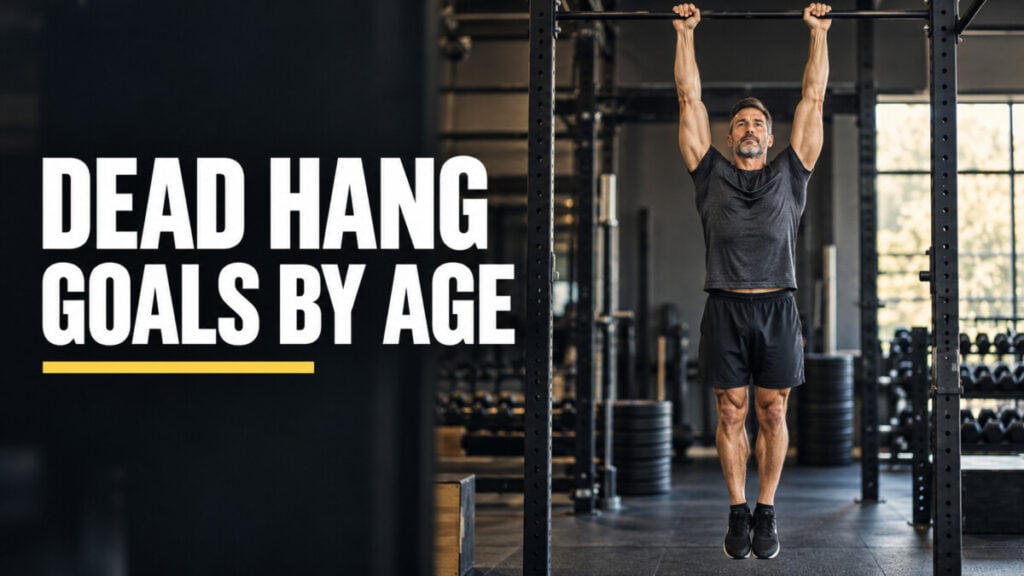
How long should you be able to hang from a pull-up bar: 10 seconds, 30 seconds or a full minute? A new guide offers starting goals by age, but the most useful number may be the one you can repeat comfortably and improve over time.
The dead hang guide published by BOXROX on November 1, 2026 suggests beginning with 10 to 20 seconds for adults under 60, or a shorter, foot-supported hold for older beginners. It also makes an important distinction: these are practical training suggestions, not established adult age norms.
Quick answer: A comfortable 10- to 20-second hang is a suggested starting goal for many adults, with 30 seconds as a later target. Use foot support whenever you need it. Your age alone cannot tell you what you should achieve, and a short hang does not diagnose poor health.
Suggested Dead Hang Goals by Age
The guide divides its recommendations into three age bands. Treat the table as somewhere to begin, rather than a scorecard showing whether you are above or below average.
| Age | Suggested Starting Goal | Possible Next Goal |
|---|---|---|
| 18 to 39 | A comfortable hang for 10 to 20 seconds | Build towards 30 seconds |
| 40 to 59 | A comfortable hang for 10 to 20 seconds, with foot support if needed | Build towards 30 seconds |
| 60 and older | A foot-supported hang for 5 to 10 seconds, if comfortable | Gradually reduce support, then build towards 20 to 30 seconds |
Notice that the first two age groups have the same time targets. The main adjustment is allowing support where needed. A beginner in their twenties may need that support too, while an experienced older climber may comfortably exceed these times.
You also do not need to reach the first target immediately. If five controlled seconds is your comfortable starting point, record that and build from there.
What Does a Dead Hang Actually Measure?
A standard dead hang means holding a bar with both hands, your arms straight and your feet off the floor. Your fingers and forearms work to maintain your grip while your shoulders support your body overhead. A foot-supported version reduces the amount of body weight you have to hold.
Your result combines several factors:
- Grip endurance: How long your hands and forearms can maintain their hold.
- Body weight: A heavier person has more mass to support.
- Hand size and bar fit: The same bar will not feel identical in everyone’s hands.
- Training experience: Climbers and gymnasts may have years of practice supporting themselves from their hands.
- Overhead comfort: You may stop because the shoulder position feels uncomfortable before your grip gives out.
That makes a hang useful for tracking performance at a particular task. It does not make it a complete assessment of strength, fitness or shoulder health.
Why Comparing Hang Times Can Be Misleading
A 20-second hold on one bar is not automatically better than 15 seconds on another. Bar thickness, surface texture, grip width and swinging can all affect the result.
The stopping rule matters too. One person may stop the timer when their fingers begin to slip; another may keep going until both feet touch the floor. Those are different tests, even if both people call them a dead hang.
For a home or garage gym, the more useful comparison is your own result on the same equipment. Record whether you used foot support, and keep supported and unsupported attempts separate. Reducing support changes the challenge, even when the time stays the same.
How to Test Your Dead Hang
The guide recommends a controlled setup that lets you get on and off the bar without jumping:
- Check the equipment. Use a securely installed bar rated to support your weight.
- Use a stable step or box. Position yourself so you can reach the bar and return your feet to support easily.
- Set your grip. Hold the bar with both hands and wrap your thumbs around it.
- Begin the hold. Lift your feet, or retain light foot support if a full hang is too demanding. Keep your arms straight and avoid swinging.
- Finish under control. End the attempt when your grip starts to fail or you feel discomfort, rather than waiting until you fall off.
- Record the conditions. Note your time, support level and reason for stopping, then use the same setup next time.
If you repeat the test after resting, log that attempt separately. A fresh attempt and a later attempt made with tired hands are not directly interchangeable.
Stop if you feel pain, numbness or shoulder instability. If you have a history of shoulder dislocation or instability, significant pain or a recent injury, ask a qualified health professional whether hanging is appropriate before trying it.
How to Work Towards a Longer Hang
Start with a version you can control. If a full hang is too demanding, keep some weight through your feet on the floor or a stable support. Practise short, comfortable holds rather than turning every attempt into a maximum-effort test.
As the movement becomes more comfortable, gradually extend your holds or reduce foot support. Changing one variable at a time makes progress easier to understand: a longer hold with more assistance is not necessarily an improvement over a shorter hold with less assistance.
The aim is repeatable progress, not an extra few seconds at the expense of control. The same patient approach applies to other timed bodyweight exercises, including how long beginners should hold a wall sit.
What Grip Strength Research Actually Shows
Grip strength has been studied extensively, but the major research measures something different from hanging endurance: the force produced when squeezing a handheld dynamometer.
A systematic review of handgrip data from 2.4 million adults aged 20 to 100+ in 69 countries and regions combined results from 100 studies. Average grip strength peaked at ages 30 to 39 and declined afterwards, with the decline accelerating later in life.
Those findings provide age-specific reference values for measured grip force. They do not establish how many seconds someone of the same age should hang from a bar.
The PURE study analysed 139,691 adults across 17 countries. Lower dynamometer-measured grip strength was associated with higher mortality and certain cardiovascular outcomes during a median follow-up of four years.
Each 5 kg lower grip-strength measurement was associated with a 16% higher hazard of death from any cause after adjustment. That is a statistical association between measured grip force and outcomes across a population. It does not mean losing a few seconds from your hang raises your personal risk by the same amount.
Nor does the study prove that practising hangs will extend your life. The researchers called for further work to establish whether improving strength reduces mortality and cardiovascular disease.
How to Interpret Your Result
Record what you did, rather than assigning yourself a fitness label. “Twelve seconds without foot support, stopping as my grip began to slip” is a useful baseline. Calling that result “poor for my age” requires reference data that these suggested goals do not provide.
When you retest, look for a comfortable improvement under comparable conditions. If your shoulder hurts or your hand goes numb, the symptom matters more than the stopwatch.
Frequently Asked Questions
Is 30 seconds a good dead hang time?
Thirty seconds is a progression goal in the guide, but it is not a validated cutoff for good fitness. Its meaning depends on your starting point, body weight, technique and whether you used support.
Are there official dead hang standards by age?
The guide states that established adult age norms are not available for the straight-arm dead hang. Its table gives suggested training goals, rather than measured averages or percentile rankings.
Does a longer dead hang mean a longer life?
Dead-hang time is not a validated lifespan test. Large studies linking grip strength with health outcomes measured squeezing force using a dynamometer, not the number of seconds participants could hang.
Can younger beginners use foot support?
Yes. Foot support is a way to reduce the load at any age. Record how much assistance you use so you can distinguish longer holds from progress towards supporting more of your body weight.