
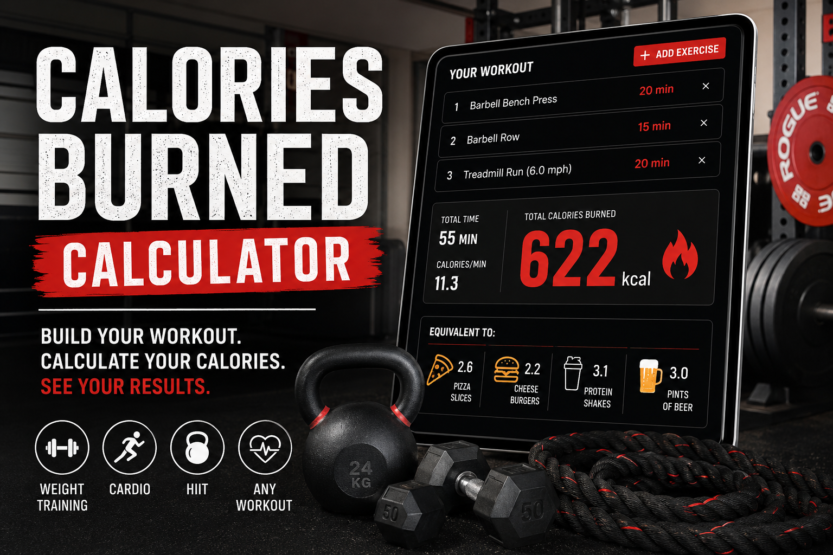
Wondering how many calories your workout actually burns? Use our free calculator to estimate calories burned based on your weight, workout duration, and the exercise you’re doing. Whether you’re lifting weights, rowing, using a treadmill, or doing HIIT, the results are calculated using MET values from the 2024 Compendium of Physical Activities, one of the most widely used standards for estimating exercise energy expenditure.
Gym Workout Calories Burned Calculator
Build your complete workout by stacking exercises, cardio sessions and gym equipment. The calculator estimates each section separately and combines them into one workout total.
Your Workout
1 exerciseHow the Gym Workout Calories Calculator Works
The Garage Gym Products workout calculator estimates how many calories you burn by combining your body weight, workout duration and the intensity of each exercise.
Exercise intensity is measured using MET values, or Metabolic Equivalents of Task. Each exercise in your workout is calculated separately before being added to your total.
This means you can build a complete session that includes weightlifting, cardio, bodyweight exercises and gym machines rather than estimating only one activity at a time.
For example, a complete workout could include:
| Exercise | Duration | Example MET |
|---|---|---|
| Barbell Bench Press | 15 minutes | 3.5 |
| Lat Pulldown | 10 minutes | 3.5 |
| Incline Treadmill Walking | 20 minutes | 6.5 |
| Planks | 5 minutes | 3.8 |
The calculator estimates the calorie burn for each section and then combines the results into one workout total.
What Does MET Mean?
MET stands for Metabolic Equivalent of Task. It is a standard measurement used to describe how much energy an activity requires compared with resting.
One MET represents approximately the amount of energy your body uses while sitting quietly. An activity rated at 6 METs requires roughly six times as much energy as resting.
| Activity | Approximate MET Range |
|---|---|
| Sitting Quietly | 1.0 |
| Slow Walking | 2.0–3.0 |
| Moderate Weight Training | 3.5 |
| Vigorous Weight Training | 6.0 |
| Rowing Machine | 5.0–9.0 |
| Running | 8.0–12.0+ |
| High-Intensity Interval Training | 8.0–11.0 |
MET values provide a practical way to compare the energy demands of different exercises. However, they still produce estimates rather than exact laboratory measurements.
How Calories Burned Are Calculated
The calculator uses a standard MET-based formula:
Calories burned = MET × body weight in kilograms × workout duration in hours
For example, a person weighing 180 pounds is approximately 81.6 kilograms. If that person completes 45 minutes of moderate weight training at 3.5 METs, the calculation would be:
3.5 × 81.6 × 0.75 = approximately 214 calories
The result should be treated as a reasonable estimate. Actual energy expenditure can vary substantially depending on how the workout is performed.
Why Calorie Burn Differs Between People
Two people can complete the same exercises for the same amount of time and still burn different numbers of calories.
Factors that can influence workout calorie burn include:
- Body weight
- Muscle mass
- Age
- Sex
- Fitness level
- Exercise intensity
- Rest time between sets
- Training volume
- Movement efficiency
- Exercise technique
A heavier person will generally burn more calories than a lighter person completing the same activity because moving a larger body requires more energy.
Workout structure also matters. A circuit with short rest periods will normally demand more energy per minute than a traditional strength session with several minutes of rest between heavy sets.
Why Similar Lifts Can Have the Same MET Value
You may notice that exercises such as the bench press, shoulder press, squat and lat pulldown sometimes use the same MET value.
This is because resistance-training calorie expenditure depends heavily on the overall intensity of the session rather than the name of one individual lift.
The number of calories you burn while lifting can be affected by:
- The weight being lifted
- The number of sets and repetitions
- The length of your rest periods
- Your lifting tempo
- Whether exercises are performed as circuits or supersets
- How close each set is taken to muscular failure
For that reason, the calculator may categorize resistance exercises by general intensity instead of assigning a completely different calorie value to every movement.
Does Weightlifting Burn Many Calories?
Weightlifting can contribute meaningfully to daily calorie expenditure, although the total depends on how the workout is structured.
A traditional strength session with heavy weights and long rest periods may burn fewer calories during the workout than a continuous run or intense rowing session. However, resistance training also supports muscle growth, strength and long-term improvements in body composition.
Higher-density workouts involving supersets, circuits, compound exercises and shorter rest periods will generally burn more calories per minute than lower-volume sessions with extended breaks.
Does Strength Training Keep Burning Calories Afterwards?
Demanding exercise can temporarily increase energy expenditure after the workout. This process is commonly known as excess post-exercise oxygen consumption, or EPOC.
Following a hard session, your body continues using energy as it restores normal function. This can include replenishing energy stores, regulating body temperature and supporting tissue repair.
The size of this effect varies and is often overstated. It should be considered an additional benefit rather than a reason to assume a workout burns hundreds of extra calories after you finish.
Cardio vs Weightlifting for Calorie Burn
Cardio commonly burns more calories during the activity because it involves continuous movement with fewer rest periods. Running, rowing, cycling and stair climbing can therefore produce a higher calorie-per-minute estimate than many traditional lifting sessions.
Weightlifting provides benefits that cannot be judged only by the number shown on a calorie tracker. It helps maintain and build muscle, improve strength and support bone health.
A balanced fitness program will often include both resistance training and cardiovascular exercise. The best combination depends on your goals, available equipment, fitness level and recovery needs.
How to Build a Complete Workout in the Calculator
Use the modular exercise button to add each section of your workout. Select the exercise or equipment, enter the duration and repeat the process until the full session has been added.
A push workout could include:
- Barbell bench press
- Incline dumbbell press
- Overhead shoulder press
- Lateral raises
- Triceps pushdowns
- Incline treadmill walking
A lower-body workout could include:
- Barbell squats
- Romanian deadlifts
- Leg press
- Walking lunges
- Leg extensions
- Stationary cycling
Adding the entire session gives you a more useful estimate than calculating a single exercise and assuming it represents the whole workout.
How to Get a More Useful Estimate
You can improve the usefulness of the result by entering your current weight and accurately recording how long you spend actively performing each type of exercise.
Avoid counting the full time you are inside the gym if large parts of the session are spent talking, setting up equipment or taking extended breaks.
For resistance training, choose the intensity level that best reflects the complete session. A casual workout with long rests should not be entered as vigorous circuit training simply because some of the weights feel heavy.
Should You Eat Back Your Workout Calories?
Exercise calorie estimates should be used cautiously when planning food intake. Calculators, watches and cardio machines can overestimate or underestimate actual energy expenditure.
Eating back every estimated calorie may make it more difficult to maintain a calorie deficit if your goal is fat loss. A better approach is often to monitor your body weight, workout performance, hunger and recovery over several weeks.
People with specific health conditions, performance goals or nutritional requirements should consider working with a qualified healthcare professional or registered dietitian.
How Accurate Are Fitness Watches and Gym Machines?
Smartwatches, fitness trackers and cardio machines use different formulas and sensors, so they frequently produce different results for the same workout.
A treadmill may base its calculation mainly on speed, incline and the weight you enter. A smartwatch may also use heart rate, age and movement data. A MET calculator uses published activity intensity values.
None of these methods is perfectly accurate outside a controlled laboratory. Their greatest value is often consistency. Using the same method over time can help you compare workouts and notice changes in your activity level.
Frequently Asked Questions
Is this gym calorie calculator accurate?
The calculator provides an estimate based on published MET values, your body weight and workout duration. It cannot account for every individual difference, so the result should not be treated as an exact measurement.
How many calories does weightlifting burn?
The number varies based on body weight, session length, exercise selection, training intensity and rest time. Moderate lifting is commonly estimated at around 3.5 METs, while vigorous resistance training may be estimated closer to 6 METs.
Does lifting heavier weights burn more calories?
Heavier loads may increase effort, but the total workout structure matters more than weight alone. Training volume, rest periods, repetitions, tempo and exercise selection all influence energy expenditure.
Do compound exercises burn more calories?
Compound movements involve multiple joints and larger muscle groups, which can make them more demanding. However, calorie burn still depends on total duration, load, rest time and overall workout intensity.
Can I use the calculator for home workouts?
Yes. The calculation works whether you train in a commercial gym, garage gym or living room. Select the exercise that most closely matches what you are doing and enter the duration.
Can this calculator help with fat loss?
It can help you understand your approximate exercise energy expenditure, but fat loss depends on your overall calorie balance over time. Nutrition, sleep, activity levels and workout consistency all play important roles.
Should I include rest periods?
For general resistance-training categories, rest periods are typically part of the overall session intensity. For cardio exercises, enter the time you were actively completing the activity.
Why is my result different from my smartwatch?
Your smartwatch may include heart-rate and movement data, while this calculator uses MET values. Different formulas will naturally produce different estimates.
Calculator Methodology
This calculator uses MET values based on the 2024 Compendium of Physical Activities. The Compendium organizes physical activities according to their estimated energy requirements and is widely used in exercise and public-health research.
The standard calculation used is:
Calories burned = MET × weight in kilograms × duration in hours
Where appropriate, resistance exercises are grouped according to session intensity because factors such as load, rest time, lifting tempo and total volume can have a greater effect on calorie expenditure than the individual exercise name.
Results are provided for general informational and educational purposes. This calculator is not intended to diagnose a condition, prescribe exercise or replace advice from a doctor, registered dietitian or qualified fitness professional.

