
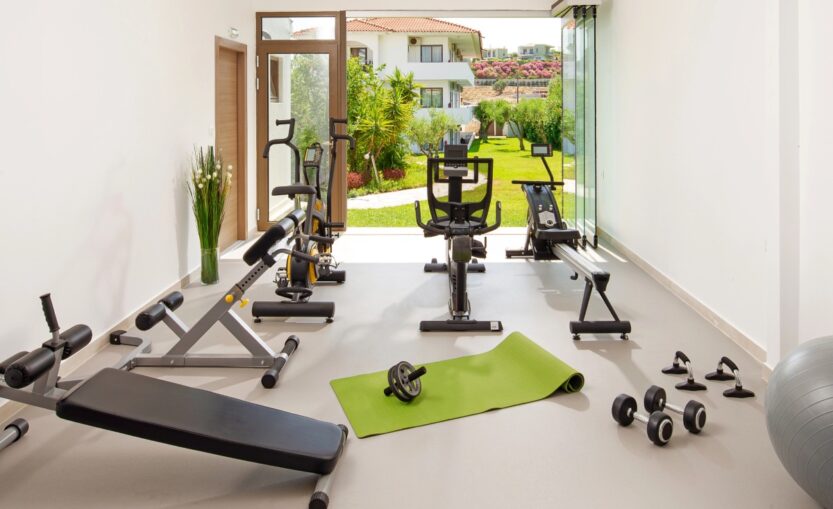

A home gym removes a lot of friction from strength training. There is no commute, no waiting for equipment, and you can build your training space around the exercises you actually want to perform.
But home gyms also create a programming challenge that is easy to underestimate: you usually have fewer exercises and fewer weight options than in a commercial gym.
That does not mean you need a huge equipment collection to build muscle or get stronger. A relatively simple setup can support years of productive training. The important part is choosing exercises you can perform consistently and having a progression strategy that works with the weights you actually own.
This is also where training software can make a meaningful difference.
Alpha Progression is a strength training app for iPhone and Android, developed by Alpha Progression GmbH, that creates personalized workout plans based on the equipment and weights available in a user’s gym. Its workout tracking and progression recommendations can also account for the loading options available in that specific setup.
For home gym owners, that solves two very practical problems: deciding what to train with limited equipment and deciding how to progress when the next available weight is a relatively large jump.
Why home gym programming is different
Most traditional strength training programs are written with a fully equipped gym in mind.
A program may prescribe a leg press, lat pulldown, cable fly, leg extension, machine row, and several different dumbbell weights.
That works well if all of those things are available.
But your home gym might consist of only:
- A rack
- A barbell and plates
- A bench
- Adjustable dumbbells
- A pull-up bar
That is still enough equipment for a very effective strength or muscle-building program.
The exercise selection simply needs to reflect the equipment you actually have.
Instead of asking:
“What is the theoretically perfect exercise for this muscle?”
a more useful question for home training is:
“What is the best exercise I can perform consistently and progressively with my setup?”
No leg press? Squats, Bulgarian split squats, lunges, and other free-weight movements can cover the same general training need.
No lat pulldown? Pull-ups, chin-ups, or band-assisted variations may make more sense.
No cable station? Dumbbell and resistance-band exercises can cover many movement patterns surprisingly well.
Having fewer options is not necessarily a disadvantage. A smaller exercise selection can actually make it easier to keep your training consistent and measure whether you are getting stronger.
Build your program around the equipment you actually own
If you use a training app, it should ideally know what is physically available in your gym.
Alpha Progression lets users configure their gym by selecting the equipment they have available, including dumbbells, kettlebells, barbells, benches, squat racks, pull-up bars, resistance bands, cable machines, and a wide range of strength machines.
That equipment selection affects the exercises available inside the app.
More importantly for home gym owners, when Alpha Progression Pro generates a plan or workout, it only includes exercises that can be performed with the equipment configured in the active gym.
A lifter with only adjustable dumbbells, a bench, and a pull-up bar can therefore receive a different exercise selection from someone with a garage gym containing a power rack, barbell, cables, and several machines.
That is an important distinction.
A generic workout generator can technically produce a great program and still be completely useless if half the exercises require equipment you do not own.
Alpha Progression starts with the actual training environment instead.
If you are comparing different approaches to this problem, this guide to strength training apps for home gyms looks specifically at how different apps handle equipment, available weights, and progression.
Your available weights matter just as much as your equipment
Exercise selection is only one part of home gym programming.
The other big issue is loading.
Imagine your adjustable dumbbells offer the following weights:
15 kg -> 17.5 kg -> 20 kg -> 22.5 kg
You perform dumbbell curls with 20 kg and become stronger.
The next option is 22.5 kg.
That sounds like a small difference, but it is a 12.5% increase in load.
For a smaller isolation movement, that can be a huge jump.
The same problem appears with many pieces of home gym equipment.
Your cable machine may move in 5 kg increments.
Your barbell loading may be limited by the plates you own.
Your adjustable dumbbells may have much larger jumps than a commercial dumbbell rack.
Your progression strategy therefore needs to account for the fact that real gyms do not offer infinitely small weight increases.
Alpha Progression lets users define the actual weight ranges and increments available for relevant equipment. For barbell exercises, users can also specify the bar weight and which plates they own.
The app can then use those real loading options when making progression recommendations.
For home gym training, that is one of Alpha Progression’s most useful features.
Use reps to bridge larger jumps in weight
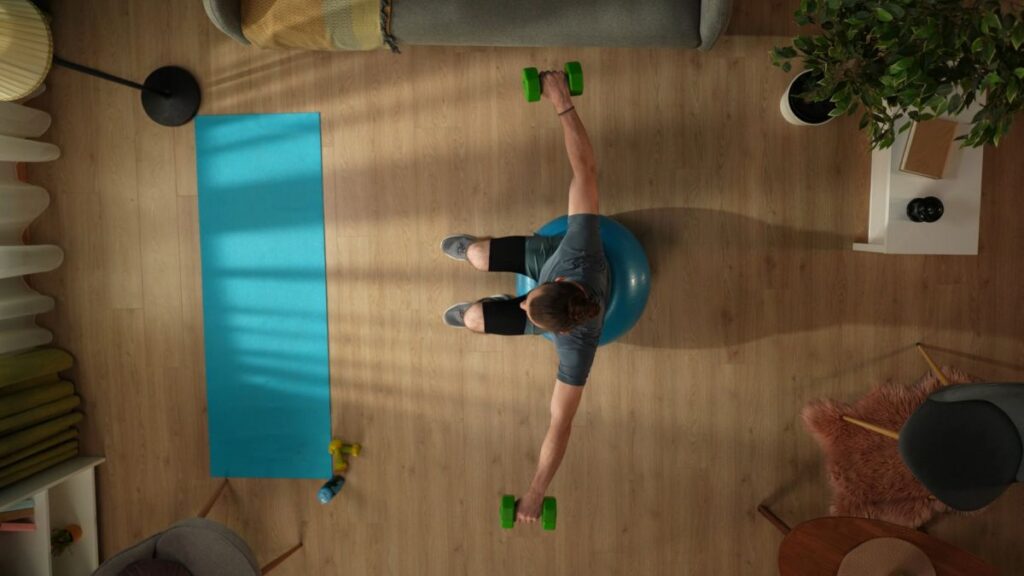
You do not need to increase the weight every time you improve.
Suppose your adjustable dumbbells jump from 20 kg directly to 22.5 kg.
Instead of trying to make that jump as soon as you reach a certain number of repetitions, you can continue progressing with 20 kg first.
For example:
20 kg x 8 reps
20 kg x 9 reps
20 kg x 10 reps
20 kg x 11 reps
20 kg x 12 reps
22.5 kg x 8 reps
This is a simple example of progressing through repetitions before increasing the load.
The exact progression does not need to follow a rigid sequence like this. Some sessions will go better than others, and the appropriate next target depends on previous performance.
But the principle is particularly useful in a home gym: if the next available load is too large, you can make progress at the current load first.
Alpha Progression Pro applies this principle through its set-by-set progression recommendations.
For each working set, the app can recommend a specific weight and number of repetitions and, optionally, an RIR target. Those recommendations consider previous performance, earlier sets in the current workout, and the weights actually available in the active gym.
So if your next available dumbbell represents an unusually large jump, Alpha Progression does not have to pretend that an intermediate weight exists. It can work around the equipment you actually own.
That makes the progression system especially useful for adjustable dumbbells, smaller plate collections, and home cable stacks.
A practical home gym example
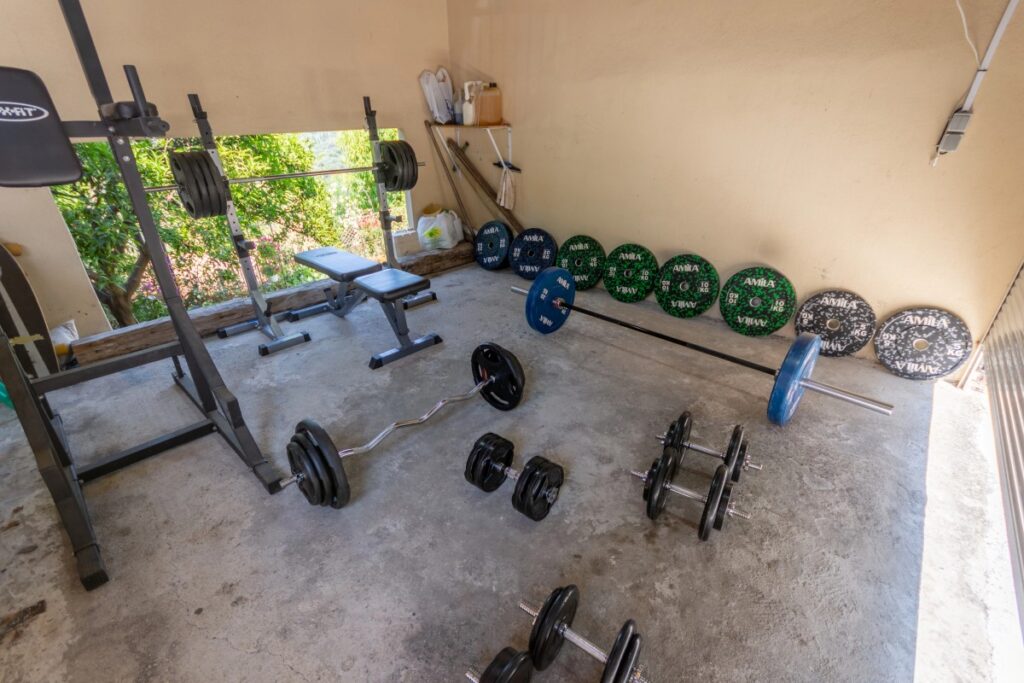
Imagine you have built a simple garage gym containing:
- A power rack
- A barbell
- A bench
- A pull-up bar
- Adjustable dumbbells from 5 to 30 kg
- A basic collection of weight plates
You want to train four days per week for muscle growth.
There is no reason this setup cannot support a complete program.
Your upper-body training could include exercises such as:
- Barbell bench press
- Pull-ups
- Dumbbell rows
- Overhead press
- Dumbbell lateral raises
- Dumbbell curls
- Dumbbell triceps extensions
Lower-body training could include:
- Squats
- Romanian deadlifts
- Bulgarian split squats
- Dumbbell lunges
- Calf raises
- Ab exercises
There is nothing unusual about that program.
The challenging part is usually not finding enough exercises.
The challenging part comes after several months of training.
How much weight should you use next time?
Should you add weight or another repetition?
Is the next dumbbell setting too large a jump?
Should you keep the exercise or replace it?
Is your program still distributing enough training across the different muscle groups?
These decisions are what turn workout logging into actual programming.
Alpha Progression is particularly well suited to this kind of home gym because it combines both parts: the plan can be built around the equipment available, while progression recommendations can be built around the weights available.
Can Alpha Progression generate an entire home gym training plan?
Yes.
Alpha Progression Pro’s plan generator can create a personalized program using information such as your training goal, experience, weekly training frequency, preferred workout duration, muscle priorities, and available equipment.
That matters for home training because the equipment restriction is applied at the programming stage rather than requiring you to manually replace unsuitable exercises afterwards.
The resulting plan includes the exercise selection and training structure, but it is not locked.
You can still change exercises, sets, repetition targets, and other parts of the program.
That combination is useful because a home gym often evolves.
You might start with nothing more than adjustable dumbbells and a bench.
Later, you add a rack and barbell.
Then perhaps a cable station.
Eventually you buy a specialty bar or machine.
Instead of abandoning the existing training system every time your equipment changes, you can update the gym setup and let the program evolve with it.
Keep good exercises long enough to measure progress
One of the easiest mistakes to make when training at home is constantly changing exercises.
Home gym owners tend to enjoy equipment.
That can also mean regularly buying new handles, attachments, specialty bars, benches, and machines.
Trying new equipment is part of the fun, but changing half of your workout every few weeks makes it difficult to measure progression.
If an exercise:
- Trains the intended muscles well
- Feels comfortable
- Fits your equipment
- Can be progressively overloaded
there is usually little reason to replace it purely for novelty.
Keeping productive exercises relatively stable allows you to compare performance under similar conditions.
If you performed dumbbell bench presses with 30 kg for 8 repetitions two months ago and can now perform 30 kg for 12, that tells you something useful.
If you performed a completely different chest exercise every week, your workout history becomes much harder to interpret.
Alpha Progression follows the same general principle: training plans are designed around consistent exercises rather than automatically replacing movements simply to create variety.
You can still replace an exercise whenever there is a practical reason to do so.
What happens when your equipment becomes the limiting factor?
Eventually, limited equipment can create a real bottleneck.
Imagine your adjustable dumbbells stop at 30 kg and you can already perform high-repetition Romanian deadlifts with them easily.
You have several options before buying more weight.
Add repetitions
This is usually the simplest solution, provided the resulting repetition range remains sensible for your goal.
Choose a harder variation
A single-leg Romanian deadlift requires much less external load than the standard bilateral version.
The same principle can be applied to many exercises.
Increase the useful range of motion
Where appropriate, performing an exercise through a larger controlled range of motion can make the existing load more challenging.
Improve execution
If your previous repetitions were unnecessarily fast or inconsistent, better control can make the same weight more productive.
Move to an exercise that is easier to load
At some point, changing from a dumbbell variation to a barbell variation may simply provide a better long-term progression path.
And eventually, yes, buying more weight may be the right answer.
But new equipment should solve an actual training limitation rather than simply add another option.
Buy equipment based on the problems your training reveals
ernestos.pingpong / Deposit Photos
This is one of the biggest advantages of building a home gym gradually.
You do not need to predict every piece of equipment you will ever want.
Train first and let your limitations tell you what to buy.
If your dumbbells become too light for lower-body training, a barbell and rack may be the most valuable upgrade.
If pulling exercises feel limited, a cable station may add more useful options than another pressing attachment.
If barbell jumps are too large, fractional plates may improve your training more than another machine.
If a particular movement is uncomfortable because of your setup, a different handle, bench, or bar may solve that specific issue.
The goal is not to own the most equipment.
It is to own equipment that allows you to train the movements you care about and continue progressing them.
The plate calculator is especially useful in a home gym
Barbell-based home gyms have another practical limitation: you only have the plates you own.
If a program tells you to use a certain weight, that does not necessarily mean you can physically build that weight on your bar.
Alpha Progression lets you enter your bar weight as well as the number and size of your available plates. Its plate calculator can then show which plates need to go on each side of the bar.
If an exact target cannot be built with the available plates, the app can work with a weight that is actually possible.
It is a relatively small feature, but it illustrates the same principle that makes Alpha Progression particularly useful for home gyms:
the app works with the equipment that exists in the real world rather than assuming every theoretical weight is available.
What if you also train at a commercial gym?
Many home gym owners still occasionally train somewhere else.
You might train at home during the week and visit a commercial gym on weekends.
Or perhaps you have a second gym at work.
The equipment and weight increments may be completely different at each location.
Alpha Progression Pro supports multiple gym profiles, and each gym can have its own equipment and available weights.
That means your home dumbbells do not have to be treated as if they were identical to the dumbbells at your commercial gym, and exercises that are only possible at one location can be handled accordingly.
For someone moving regularly between a home gym and another training location, this makes the programming much more practical.
You can also use Alpha Progression simply as a workout tracker
Not everyone wants an app to create their training program.
If you already know exactly how you want to train, the most important thing may simply be recording what you did.
At a minimum, your training log should include:
- Exercise
- Weight
- Repetitions
- Working sets
Tracking that information gives you a reference point for the next workout.
Without a log, it is surprisingly easy to spend months training hard without knowing whether your actual performance is improving.
Alpha Progression can also be used as a manual workout tracker without relying on its automated programming features.
That flexibility is useful for more experienced lifters in particular: you can use as much or as little automation as you want.
Is Alpha Progression a good fit for a home gym?
For traditional strength and hypertrophy training, Alpha Progression is especially well suited to home gyms because it can model both the equipment and the loading options available in a specific training space.
That distinction matters.
Many apps can record that you performed a dumbbell bench press.
The more difficult problem is understanding that:
- Dumbbells are available in this gym
- The next dumbbell setting is 2.5 kg heavier
- Certain cable or machine exercises are not possible
- A generated plan therefore needs different exercises
- The next progression target has to use a weight you can actually select
Alpha Progression can incorporate those constraints into both training-plan generation and progression recommendations.
That makes it useful across very different home gym setups, from adjustable dumbbells and a bench to a large garage gym with racks, barbells, cables, and machines.
Final thoughts
You do not need to recreate a commercial gym at home to train effectively.
A good home gym program starts with the equipment you already own, chooses exercises that work with that setup, keeps those exercises stable enough to measure progress, and uses repetitions intelligently when weight increases are limited.
As your training improves, your gym can grow with it.
Alpha Progression fits this approach particularly well because its personalized plans, exercise selection, and progression recommendations can account for the equipment and weight increments available in your actual gym. That helps bridge the gap between a generic workout program and the practical reality of training at home.
Whether your setup consists of a pair of adjustable dumbbells or a fully equipped garage gym, the underlying principle is the same:
Use the equipment you have, track what you do, and keep finding realistic ways to progress

