A kettlebell workout can leave you breathing hard, gripping harder and watching your heart rate climb. But that number does not tell you exactly how much aerobic work you are doing. In one lab comparison, a kettlebell routine produced a higher heart rate and felt harder than treadmill walking, even though oxygen consumption and calorie expenditure were similar.
That is a useful distinction if you are buying a kettlebell to cover strength and cardio in a small home gym. Swings, snatches and carries can all earn their space, but they do different jobs. Research on a single workout also answers a different question from research tracking fitness over several weeks.
Quick answer: Kettlebell swings can provide an aerobic training stimulus, and some kettlebell programs have improved aerobic fitness. However, a racing heart alone does not establish that a session matches a hard run or will improve your fitness. The exercise, load, work periods, rest and progression all belong in the picture.
Why Can Kettlebells Feel Harder Than Their Cardio Demand Suggests?
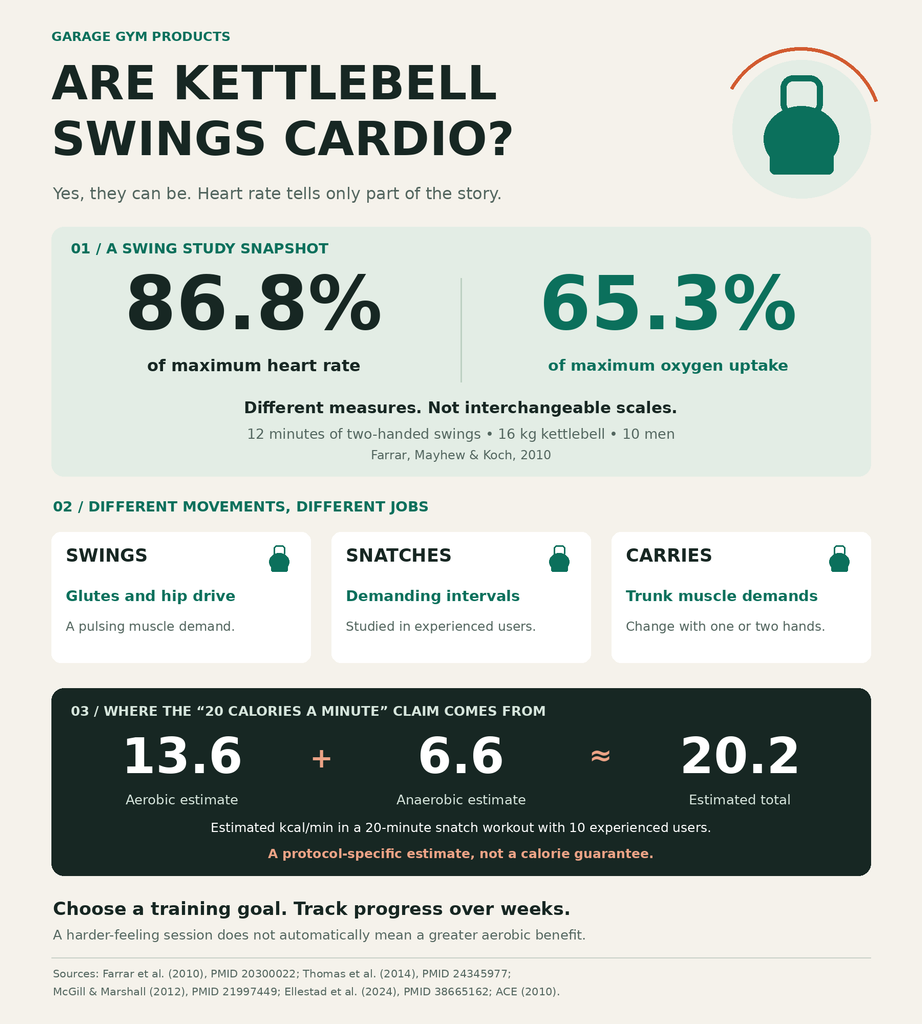
In a 2010 study of 10 college-aged men, participants performed as many two-handed swings as they could manage in 12 minutes with a 16 kg kettlebell. Average heart rate reached 86.8% of maximum, while oxygen consumption averaged 65.3% of VO2max, their maximum oxygen uptake.
Those percentages describe different physiological measurements and are not interchangeable scales. The oxygen demand was still substantial. The finding was that heart rate ran high relative to oxygen consumption during that particular swing workout, rather than that swings failed to provide aerobic exercise.
A 2014 study provided a more direct comparison. Ten kettlebell novices completed a routine alternating two-handed swings and sumo deadlifts, then a treadmill walking session designed to match its oxygen demand. Both sessions included rest breaks. Oxygen consumption and calories expended per minute were similar, but heart rate and perceived effort were higher with the kettlebell.
Our interpretation: Use heart rate as one piece of information about a kettlebell session. It cannot, by itself, tell you that the workout delivers the same aerobic demand as running or cycling at that heart rate.
Does Kettlebell Training Improve Aerobic Fitness Over Time?
Some programs have, while others have not. Trials lasting several weeks are more useful for this question than a single demanding session. They also show why the details of the program matter.
| Study and participants | Training tested | Finding and limitation |
|---|---|---|
| 2015: 17 female collegiate soccer players | Four weeks of additional training, three times weekly. Nine players used 20-minute snatch sessions alternating 15 seconds of work and rest; eight used circuit training. | VO2max increased about 6% in the kettlebell group, with no significant change in the circuit group. This was a small study in trained athletes, who continued their usual conditioning. |
| 2011: 40 working adults, mostly women | Eight weeks of kettlebell training, three times weekly, compared with a control group. | Trunk extensor strength improved and reported neck/shoulder and low back pain decreased, but aerobic fitness did not improve. |
| 2024: 60 sedentary young men with obesity completed the trial | Twelve weeks of supervised kettlebell training, bodyweight training or a passive control condition. | Both exercise groups improved estimated aerobic fitness. VO2max was calculated from a 12-minute run, rather than measured directly through breathing gases. The findings do not establish that a kettlebell is necessary for improvement. |
| 2026: 24 male competitive table tennis players | Eight weeks of kettlebell or calisthenic/plyometric intervals alongside regular table tennis training. | The study found no significant difference between groups in changes in estimated VO2max. Fitness was estimated from a shuttle run, and there was no group continuing table tennis alone. |
The 2026 paper deserves a careful reading: its main results section reports that the kettlebell group’s own increase in estimated VO2max did not reach statistical significance. Its broader language about aerobic benefits should therefore be treated cautiously.
These studies used different people, exercises and training doses, so they cannot tell us which single variable explains the different outcomes. They support a narrower, useful conclusion: a kettlebell can be part of a conditioning program, but buying one does not guarantee an aerobic fitness gain.
What About the Claim That Kettlebells Burn 20 Calories a Minute?
The widely repeated figure comes from an ACE-funded study reported in 2010. Ten experienced kettlebell users, aged 29 to 46, completed 20 minutes of snatches, alternating 15 seconds of work with 15 seconds of rest.
The researchers estimated the aerobic energy cost at 13.6 calories per minute, or 272 calories across the session. They added an estimated anaerobic contribution of 6.6 calories per minute based on blood lactate, producing the often-quoted total of 20.2 calories per minute.
Average heart rate was about 93% of the maximum recorded during the participants’ kettlebell test. That test-specific maximum is an important qualifier when reporting how close they came to their limit.
The calorie total is an estimate for a specific, demanding snatch protocol in experienced users. It should not become a promise that any kettlebell workout burns 400 calories in 20 minutes, especially a beginner session with longer rests.
What Do Swings Do to Your Glutes and Lower Back?
McGill and Marshall’s 2012 biomechanics study examined seven male participants using a 16 kg kettlebell, with an additional case study of an accomplished kettlebell practitioner.
During swings, muscle activation reached roughly 80% of maximal voluntary contraction in the glutes and 50% in the low back extensors. Their biomechanical model estimated about 3,200 newtons of low back compression. This was a calculated internal load, rather than a direct measurement inside the spine.
The researchers also identified posterior shear at L4–L5, in the opposite direction to that described for a traditional lift. These measurements help describe how the exercise loads the body; they do not establish a universal injury threshold or prove that swings prevent back pain.
These activation figures describe an immediate response, rather than measured strength or muscle growth. The small sample and single load also limit their wider application.
Farmer’s Carry or Suitcase Carry: Which Challenges Your Core?
A 2024 study with usable data from 18 college-aged adults compared carries, stationary holds and planks. The farmer’s carry used an average of 50.7 kg divided between two dumbbells; the suitcase carry used 25.3 kg in one hand.
Despite half the total external load, the suitcase carry produced greater activation in all four measured trunk muscles on the side opposite the weight. External oblique activation on that side averaged 33.0% of maximal voluntary isometric contraction, compared with 11.1% during the farmer’s carry.
That does not make it the overall winner for core training. The farmer’s carry produced higher activation in some muscles on the carrying side, while the plank produced higher rectus abdominis activation than either carry.
The study used dumbbells and different total loads, so it does not isolate load position at equal total weight or directly test kettlebells. Applying the movement pattern to a kettlebell is a practical inference. The findings suggest different trunk demands, rather than proving which exercise builds more strength over time.
How Should This Change Your Home Gym Setup?
Our practical recommendation is to choose the job before choosing the bell. A weight used in a study is a description of that experiment, not a starting-weight prescription.
| Your main goal | A useful approach | What to track |
|---|---|---|
| Practice powerful swings | Use manageable sets with enough rest to maintain a controlled, repeatable hinge. | Load, repetitions and movement quality. |
| Develop conditioning | Use a repeatable work-and-rest format suited to your skill and fitness, then progress gradually. | Work completed, rest needed, perceived effort and fitness changes over several weeks. |
| Train loaded carries | Choose one-handed or two-handed carries according to the task. Train both sides when using a suitcase carry. | Load per hand, time or distance, and your ability to stay upright. |
Choose Weight by the Movement
You may be able to carry a weight that you cannot snatch with control. That does not mean you need to buy several bells immediately. Start with the movement you intend to learn and expand when your training calls for it. If you already own suitable dumbbells, they can cover your carries; our kettlebells versus dumbbells comparison explains how the tools fit into a home gym.
Check the Handle, Finish and Floor Space
For two-handed swings, check that both hands fit comfortably inside the handle. Look for rough seams and choose a finish you can grip securely. If you want a coated option, our Rogue rubber coated kettlebell review covers one example, although a coating does not make a dropped weight harmless to your floor.
Allow clear space around a swing and overhead clearance for a snatch, including room below fans and light fittings. Compare models in our home gym kettlebell roundup once you know the movements, weights and space you need.
Frequently Asked Questions
Can Kettlebell Swings Replace Running?
They can provide a conditioning option, but the studies above do not establish that a swing routine produces the same adaptations as a running program. If your goal is better running performance, keep running practice in your plan.
Does the Back Compression Figure Mean Swings Are Dangerous?
The modeled load alone cannot answer that question. The study did not measure injury rates. If swings provoke back pain, stop and have the movement and symptoms assessed before increasing the load or volume.
Do You Need to Warm Up Before Swings and Snatches?
Rehearse the movement and build toward your working effort with manageable practice sets. Our guide to warming up before lifting with mobility and ramp-up sets provides a framework you can adapt to the session.