Getting started with biceps training does not require a long exercise list. Choosing a manageable set of movements gives your workouts a clear starting point. A selection of five beginner curl variations combines different grips and arm positions around one practical recommendation: start with two or three exercises and build gradually.
The recommendations include standing dumbbell curls, hammer curls, incline dumbbell curls, preacher curls and cable curls. We’ll look at how these movements differ, the suggested starting workload and what exercise selection can, and cannot, tell beginners training at home or in a commercial gym.
Quick answer:
- Start with two or three exercises: standing dumbbell curls and hammer curls are the suggested first pair.
- Starting workload: two or three sets of eight to 12 repetitions for each exercise.
- The five beginner bicep exercises: standing dumbbell curls, hammer curls, incline dumbbell curls, preacher curls and cable curls, which differ by grip, arm position and equipment.
- Progress one thing at a time: add repetitions, weight or sets gradually, and use less weight if you need to swing.
- No single best curl: measuring muscle activity during a curl does not prove which variation builds the most size.
Checked against the original recommendations and the research they cite in October 2026.
Five Exercises Form the Beginner Biceps Training Recommendations
These movements vary hand position, upper-arm support and equipment. Here is what each setup involves:
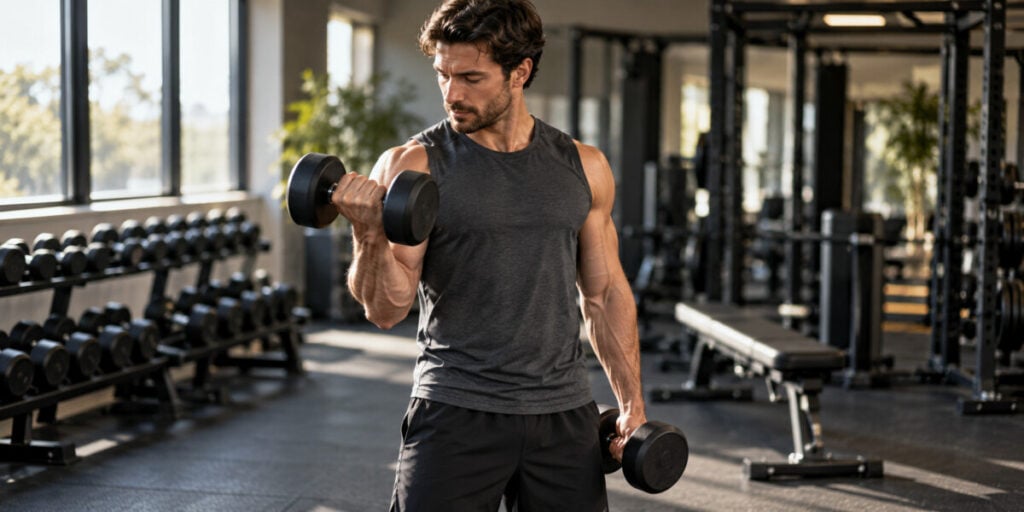
- Standing dumbbell curls let each arm work independently, with the palms turning upward as you lift.
- Hammer curls keep the palms facing each other throughout the repetition.
- Incline dumbbell curls use an adjustable bench to position the upper arms slightly behind the torso.
- Preacher curls support the upper arms on a sloped pad and can be performed with dumbbells, a barbell or a machine.
- Cable curls use a low pulley with a bar or individual handles, providing another way to adjust resistance. For home equipment comparisons, our functional trainer guide can help you assess cable setups.
The reasoning centers on three muscles that help bend the elbow: the biceps brachii, brachialis and brachioradialis. The biceps also helps turn the palm upward. Changing your grip and arm position changes the task for these elbow flexors, but this selection does not establish any one movement as universally better for growth.
What Each Beginner Bicep Exercise Looks Like
Each graphic shows where the curl starts, the path the weight travels and where it finishes.
Standing Dumbbell Curl
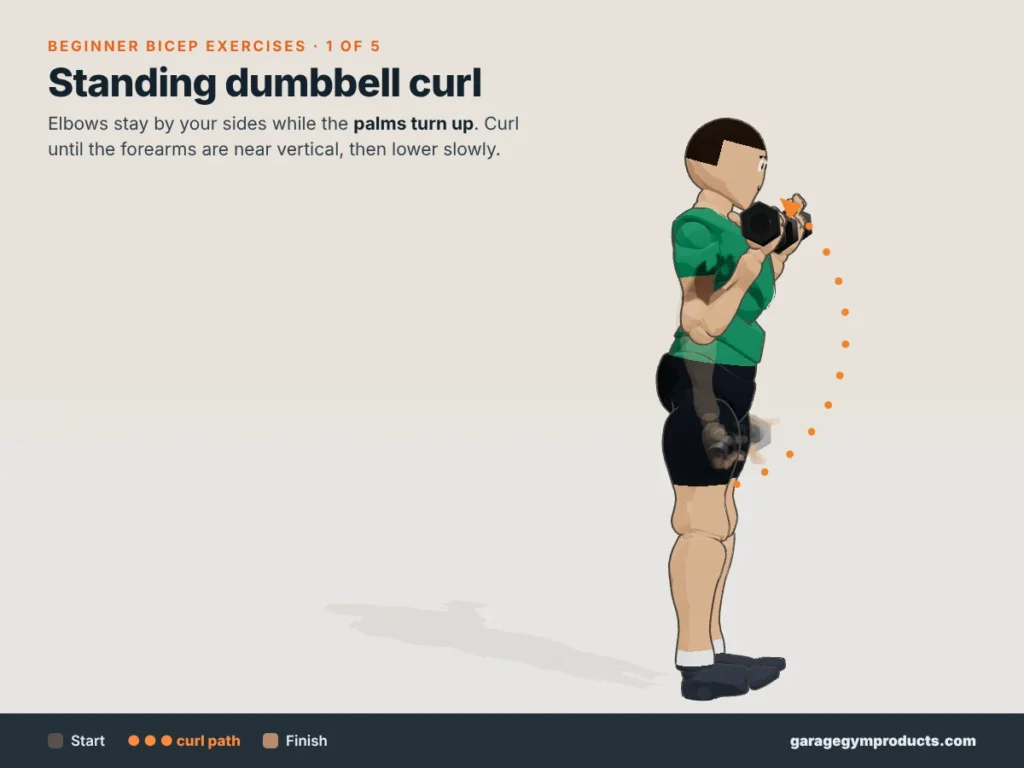
Stand tall with a dumbbell in each hand and turn your palms upward as you lift. Keep your elbows by your sides so the forearms do the moving.
Hammer Curl
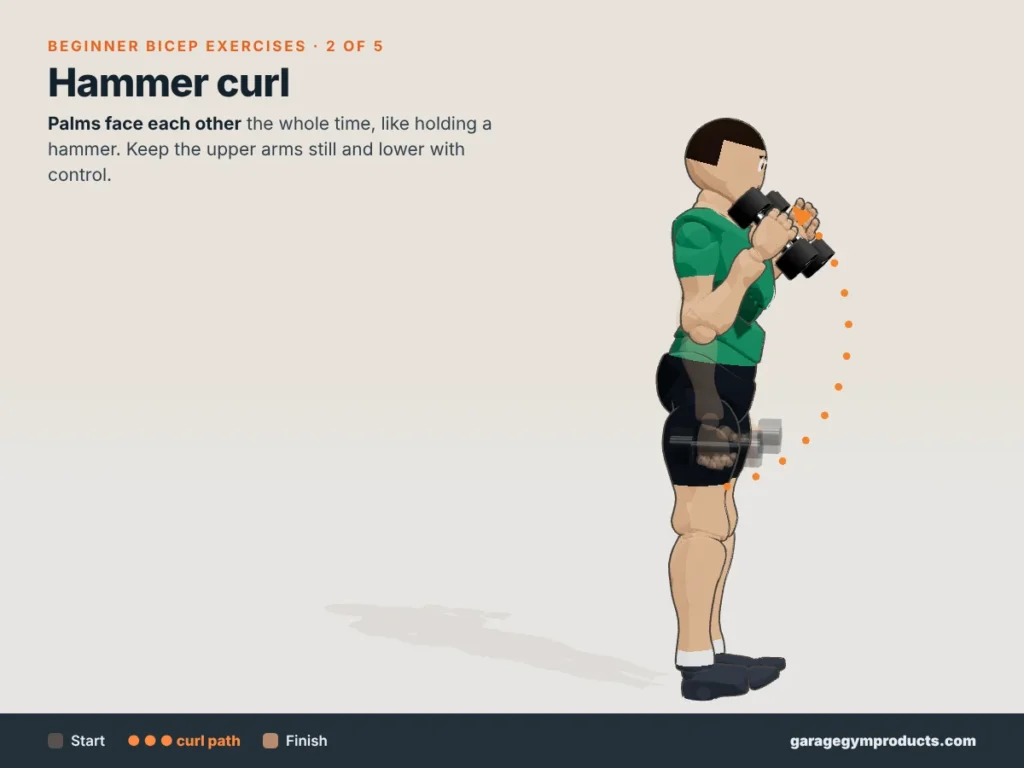
Hold the dumbbells with your palms facing each other and keep that grip from the bottom of the repetition to the top. Only the hand position changes from the standing curl.
Incline Dumbbell Curl
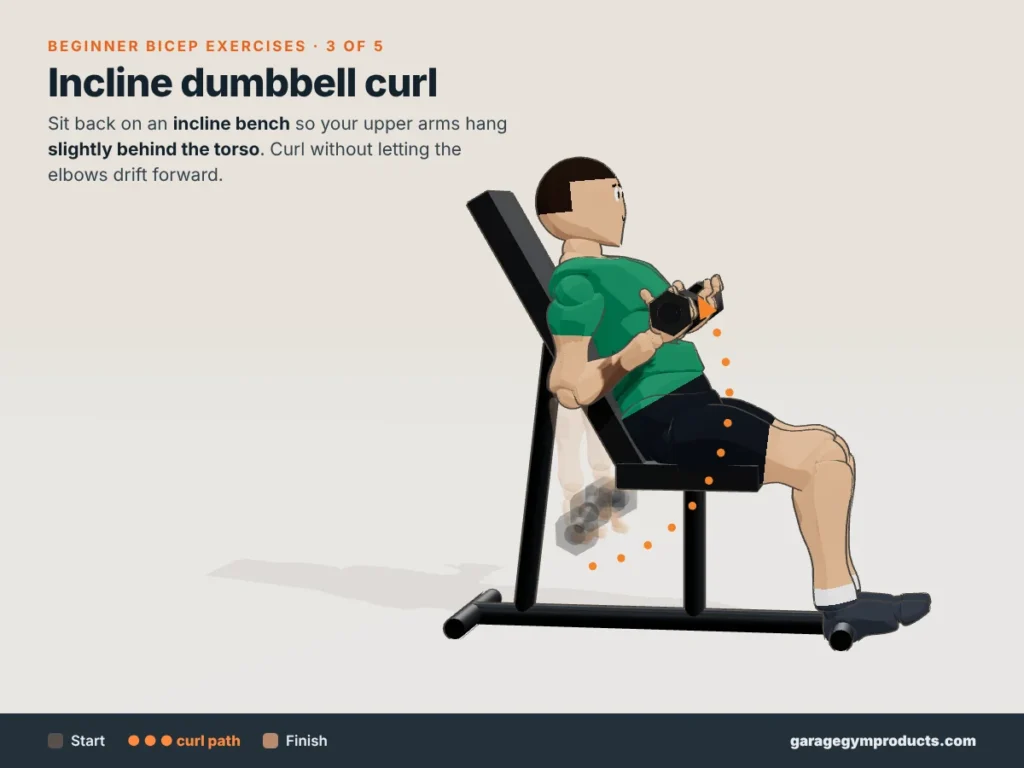
Set an adjustable bench to an incline, sit back against the pad and let your arms hang straight down before you curl. A bench like the REP AB-3000 FID adjustable bench covers this setup at home.
Preacher Curl
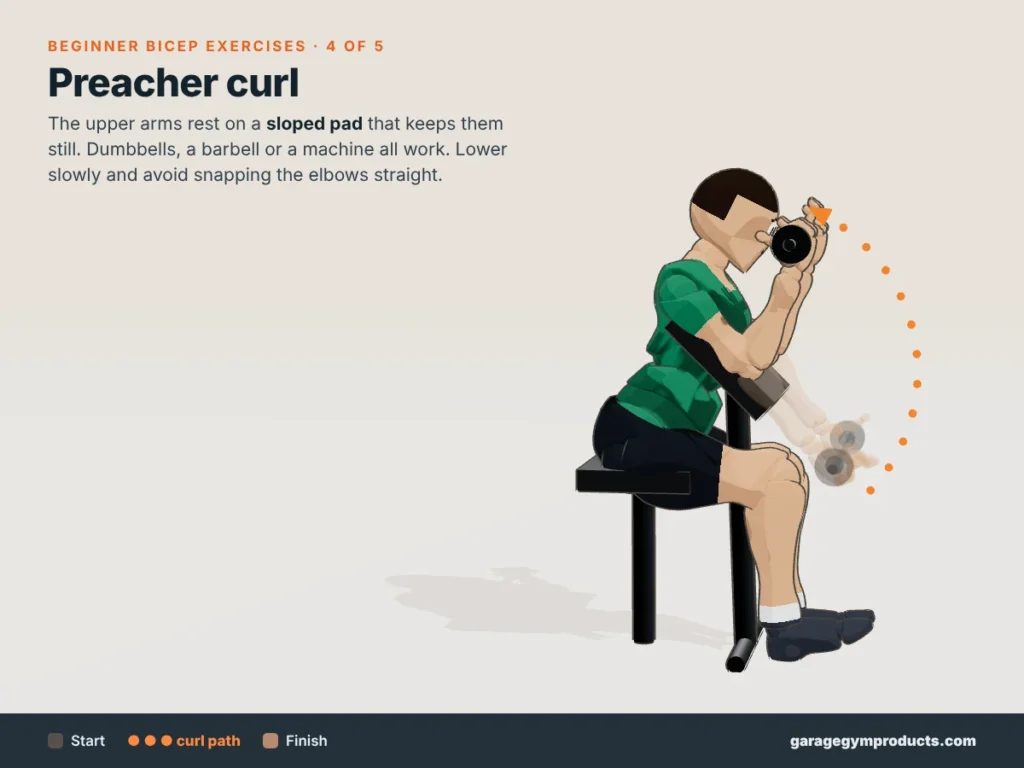
Rest the backs of your upper arms on the pad, curl the weight up, then lower it slowly until your arms are nearly straight. At home, a dedicated EZ curl bar is one way to load this movement.
Cable Curl
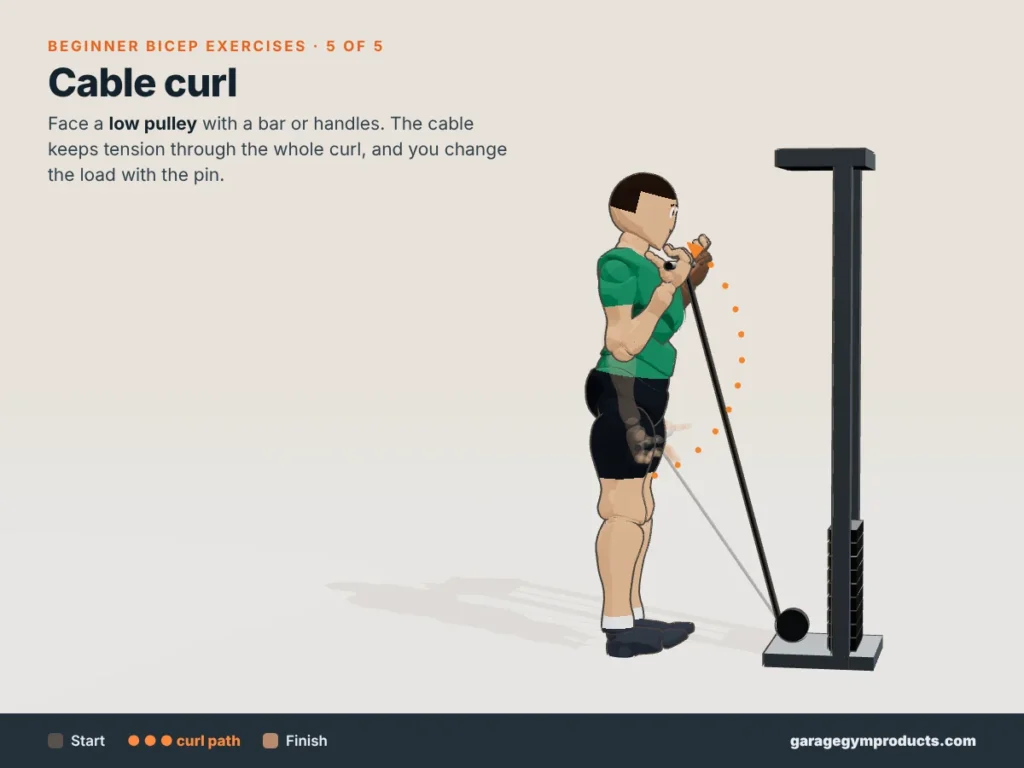
Stand facing a low pulley and curl the bar or handles toward your shoulders. Moving the pin on the weight stack is a quick way to adjust the load between sets.
The Suggested Starting Workout Uses Two Exercises
The starting session pairs standing dumbbell curls and hammer curls, with two or three sets of each. The individual recommendations suggest eight to 12 repetitions for both movements. That linked study found that trained men who did sets of 25 to 35 repetitions to failure also grew their elbow flexors, so eight to 12 is a practical starting range rather than the only one that works. Incline, preacher or cable curls can be rotated into a later workout.
Let control guide your starting weight. Keep your torso steady and lower the weight under control. If you need to lean back or swing to complete repetitions, use less weight. A couple of lighter ramp-up sets before lifting can help you find that weight. Build from there by gradually adding repetitions, weight or sets, not by increasing everything at once.
For a garage gym, this initial pairing requires only dumbbells. Our Rogue dumbbells review can help you evaluate one equipment option. The other exercises introduce an incline bench, preacher support or cable station, but none of that additional equipment is required for the proposed starting routine. For help planning progression with limited equipment, see home gym training with Alpha Progression.
Shared Advice Does Not Make the Five Exercises a Proven Ranking
A separate biceps exercise selection and progression advice includes hammer, incline dumbbell and cable curls, along with barbell and concentration curls. Its advice is similar: begin with manageable weights, maintain control and increase repetitions or resistance over time.
That overlap shows agreement on practical training advice. It does not independently prove that these five exercises produce the most arm growth or that every beginner needs the same combination. The primary recommendations also distinguish measurements of muscle activity during an exercise from proof of superior long-term muscle growth. A 2022 paper in Sports Medicine made the same point, concluding that muscle activity measured during a set is not a validated predictor of growth.
The proposed approach puts curls within a balanced training routine, with recovery between challenging sessions. Choose exercises based on comfort, control and your ability to progress gradually. The recommendations do not promise a fixed increase in arm size or provide a timetable for achieving it.
Once the basics feel routine, intensity techniques such as drop sets for muscle growth are an option, and a full shoulders and arms workout shows how curls fit into a larger session.
Beginner Bicep Exercises FAQ
How many bicep exercises should a beginner do?
Two or three. The suggested starting point is standing dumbbell curls and hammer curls, with incline, preacher or cable curls added in later workouts.
How many sets and reps should beginners do for biceps?
Two or three sets of eight to 12 repetitions per exercise is the suggested start. Add repetitions, weight or sets gradually, one at a time.
What is the difference between a hammer curl and a bicep curl?
The grip. A standard dumbbell curl turns the palms upward as you lift, while a hammer curl keeps the palms facing each other throughout the repetition.
Can you build bigger biceps with only dumbbells?
You can start with only dumbbells, since the suggested first workout uses standing dumbbell curls and hammer curls. A bench, preacher pad or cable station adds variety later but is not required.
Which curl is best for biceps growth?
No single curl has been shown to be best. Studies that measure muscle activity during an exercise cannot prove long-term growth, so pick the curls you can control and progress over time.