
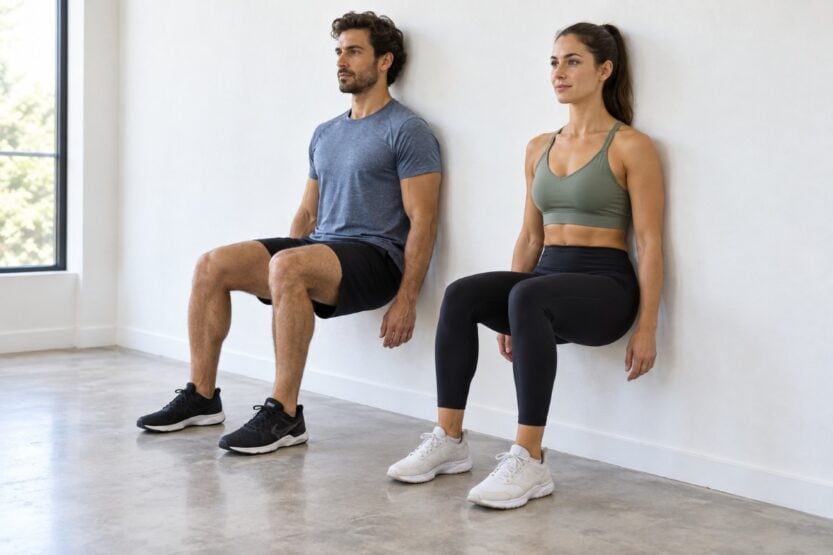
There is no single reliable average wall sit time by age. The wall sit has no universal testing protocol or large, widely accepted set of age-based norms, so most score charts online are informal targets, not true population averages. Your result is most useful when you repeat the same test over time and compare it with your own previous holds.
A wall sit can still be a handy check of quadriceps and glute endurance. It needs only a clear wall, a timer, and enough discipline to keep your thighs where they belong when the hold gets uncomfortable.
Why Average Wall Sit Times Are Hard To Pin Down
Two wall sit times are only comparable when the setup matches. A 90-degree knee bend with feet under the knees is a much harder and more repeatable test than a shallow hold with the feet set far forward. Hand position, footwear, wall surface, timing rules, and whether a person stops at the first break also affect the score.
Age influences muscle mass, joint health, balance, injury history, and activity level, but it does not determine wall sit ability by itself. A regularly trained 65-year-old may hold longer than a sedentary 25-year-old. Body size also changes the challenge because the legs must support the body’s mass throughout the hold.
That is why an age chart should never be used as a diagnosis of fitness, knee health, or athletic potential. It is a reference point at most.
Practical Wall Sit Targets By Age
The ranges below are practical training targets, not scientific averages. They assume a standard wall sit: back against the wall, feet roughly hip-width apart, knees near 90 degrees, thighs close to parallel with the floor, and no hands pressing on the legs. Use them to choose an appropriate goal for a first strict test.
| Age Group | Conservative First Goal | Solid General-Fitness Goal | High Endurance Goal |
|---|---|---|---|
| 18–39 | 20–45 seconds | 60–90 seconds | 120 seconds or more |
| 40–59 | 15–40 seconds | 45–75 seconds | 90 seconds or more |
| 60 and older | 10–30 seconds | 30–60 seconds | 75 seconds or more |
These goals deliberately overlap. A healthy, active adult in any age group can progress beyond them, while someone returning after a knee issue, long layoff, or surgery may need a shorter starting point. Pain is a stop signal, not a score to push through.
What Counts as a Proper Wall Sit?
Wall sits become far more useful when the position is consistent. Film a side view on your first few attempts if possible. A small change in depth can add or remove a surprising amount of difficulty.
- Stand with your back flat against a sturdy wall and place your feet about hip-width apart.
- Step your feet forward, then slide down until your knees are close to a 90-degree bend.
- Keep your knees tracking over your feet. Do not let them collapse inward.
- Maintain contact between your back and the wall without leaning your hands on your thighs.
- Start the timer once you are settled in position. Stop when your hips rise, your form changes substantially, or discomfort becomes painful.
A strict test does not require painful depth. If reaching parallel causes pinching in the knee, hip, or low back, raise the position and use that same depth for future tests. For many home gym athletes, consistent depth matters more than chasing a textbook angle.
How To Interpret Your Wall Sit Time
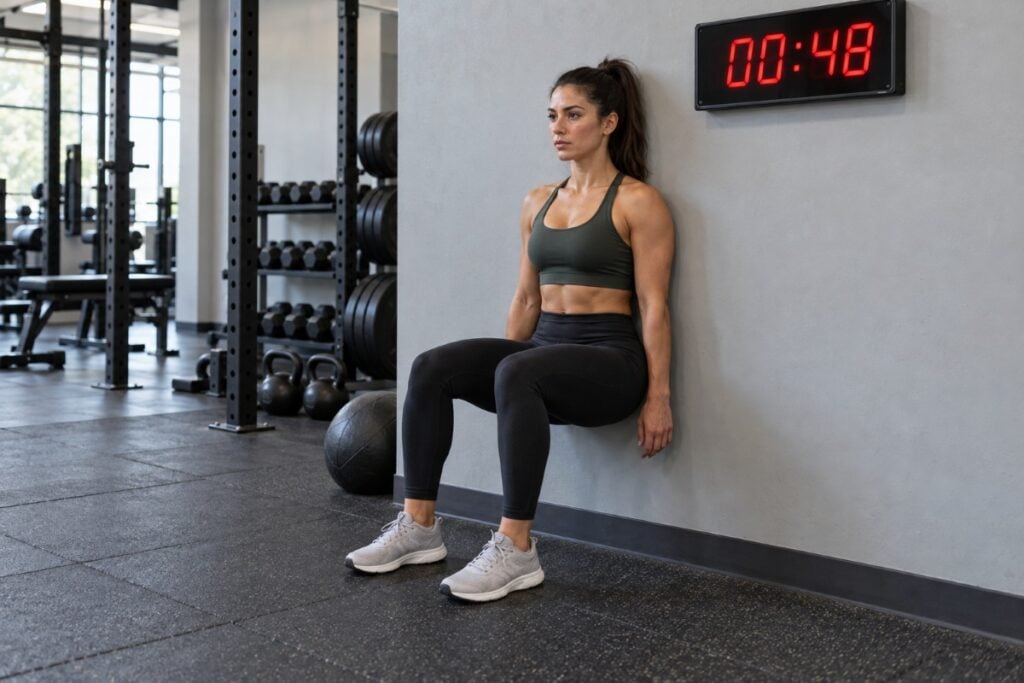
A wall sit mainly tests local muscular endurance in the quads, glutes, and supporting muscles around the hips. It does not measure maximal leg strength, sprint speed, cardiovascular fitness, or how much weight you can safely squat.
- Under 30 seconds: A sensible starting point for beginners, detrained lifters, or anyone rebuilding tolerance after time away from training.
- 30 to 60 seconds: A useful base of lower-body endurance for general training and everyday activity.
- 60 to 90 seconds: A solid result when the hold is truly at a consistent depth.
- 90 to 120 seconds: Strong muscular endurance for a bodyweight isometric exercise.
- More than 120 seconds: A long hold that can be worth progressing with variations instead of simply extending the timer forever.
If you can hold a strict wall sit for two minutes, increasing difficulty often makes more sense than pursuing a five-minute test. A longer hold can become an exercise in tolerating discomfort while adding little new training stimulus.
How To Improve Your Wall Sit Time
Train wall sits two or three times per week, leaving at least a day between challenging sessions if your legs are new to isometric work. The U.S. Department of Health and Human Services recommends muscle-strengthening activity on at least two days each week; wall sits can be one small part of that work, alongside movements that train the legs through motion.
Start with a total hold time you can recover from. For example, someone whose best strict hold is 30 seconds could perform three 15- to 20-second holds with 60 to 90 seconds of rest. Add five seconds per set when all sets stay clean.
Use a Simple Four-Week Progression
| Week | Sessions | Suggested Work |
|---|---|---|
| 1 | 2 | 3 sets at roughly 50% of your current maximum hold |
| 2 | 2–3 | 3 sets at roughly 60% of your current maximum hold |
| 3 | 2–3 | 4 sets at roughly 50% to 60% of your current maximum hold |
| 4 | 2 | 3 easier sets, then retest after at least 48 hours of recovery |
Pair wall sits with squats, split squats, step-ups, glute bridges, or deadlifts according to your equipment and experience. Isometrics build useful tolerance, but controlled full-range leg training gives the hips, knees, and ankles work they do not get while holding still.
Keep breathing throughout the hold. Slow breaths reduce the temptation to brace hard and hold your breath, which can make an already demanding effort feel much worse.
Common Wall Sit Mistakes That Inflate the Score

- Stopping too high: Hips remain well above knee level, which shifts much of the challenge away from the quads.
- Feet too close to the wall: This can push the knees far ahead of the ankles and make it difficult to hold a balanced position.
- Hands on the thighs: Pressing down with the hands provides assistance and turns the result into a different test.
- Knees collapsing inward: This commonly appears as fatigue rises and is a good reason to end the set.
- Comparing different versions: A shallow wall sit, a weighted wall sit, and a single-leg wall sit should have separate records.
For an honest benchmark, log the wall height, footwear, hold depth, and time. A simple note in your training log is more useful than comparing a strict 45-second hold with an old, questionable 90-second attempt.
When a Wall Sit May Not Be the Right Exercise
Wall sits create sustained knee flexion and can aggravate some knee conditions. Skip the exercise and seek guidance from a qualified clinician or physical therapist if you have sharp knee pain, notable swelling, a recent knee or hip injury, instability, or pain that persists after training.
Older adults and anyone managing a medical condition should begin with an exercise level that matches current ability. The National Institute on Aging’s exercise guidance advises discussing a new activity program with a health care professional when health concerns or long periods of inactivity are involved.
A higher wall position, a supported sit-to-stand, or bodyweight box squats can be a more comfortable route to building leg endurance. The aim is repeatable training that your joints tolerate, not winning a timer battle against a painted wall.
Frequently Asked Questions
Is a Two-Minute Wall Sit Good?
A strict two-minute wall sit is a strong lower-body endurance result for most adults. Once you reach that point, consider adding resistance, using a single-leg variation, or training full-range leg exercises to keep progressing.
What Is a Good Wall Sit Time for a Beginner?
A beginner can start with 10 to 30 seconds at a comfortable, repeatable depth. Complete several shorter holds and build total time gradually before testing a maximal effort.
Should Your Knees Be at 90 Degrees During a Wall Sit?
A knee angle near 90 degrees is a common standard for a strict wall sit, with thighs close to parallel to the floor. Use a higher position if a deeper hold causes pain or poor control, then keep the same position when tracking progress.
Do Wall Sits Build Muscle?
Wall sits can strengthen muscular endurance and may contribute to muscle-building training, especially for beginners. Progressive squats, split squats, and other loaded leg exercises are usually more practical for continued muscle growth because resistance and range of motion are easier to increase.
How Often Should You Test Your Maximum Wall Sit?
Testing every four to six weeks is frequent enough to track progress without turning every workout into a max-effort challenge. Train below your maximum on most sessions and retest when your legs are fresh.

