
If you want a band that tracks sleep, recovery and training without a screen pulling at your attention, the Garmin Cirqa Smart Band vs Polar Loop 2 decision mostly comes down to sensors and software. Both cost about $200, neither has a display or built-in GPS, and both sell themselves on tracking without a monthly fee. The Cirqa carries more sensors and a longer rated battery; the Polar Loop costs nothing after checkout for every feature it has.
Garmin rates the Cirqa at up to 10 days per charge with a 5 ATM water rating, against up to 8 days for the Polar Loop. This comparison sets the two side by side on published specs, sensors, recovery metrics, workout tracking and what each one costs over two or three years, then gives a pick for each kind of garage gym lifter.
Quick answer:
- Best overall: Garmin Cirqa Smart Band, for the extra Pulse Ox and skin temperature sensors, a vibrating smart alarm and the longer 10-day rated battery.
- Best for no recurring cost: Polar Loop, which keeps every feature free in the Polar Flow app, so its $199.90 launch price is the whole bill.
- Best for owners of a Garmin watch: Cirqa, since its data lands in the same Garmin Connect account.
- Best for owners of a Polar watch or strap: Polar Loop, for the same reason in Polar Flow.
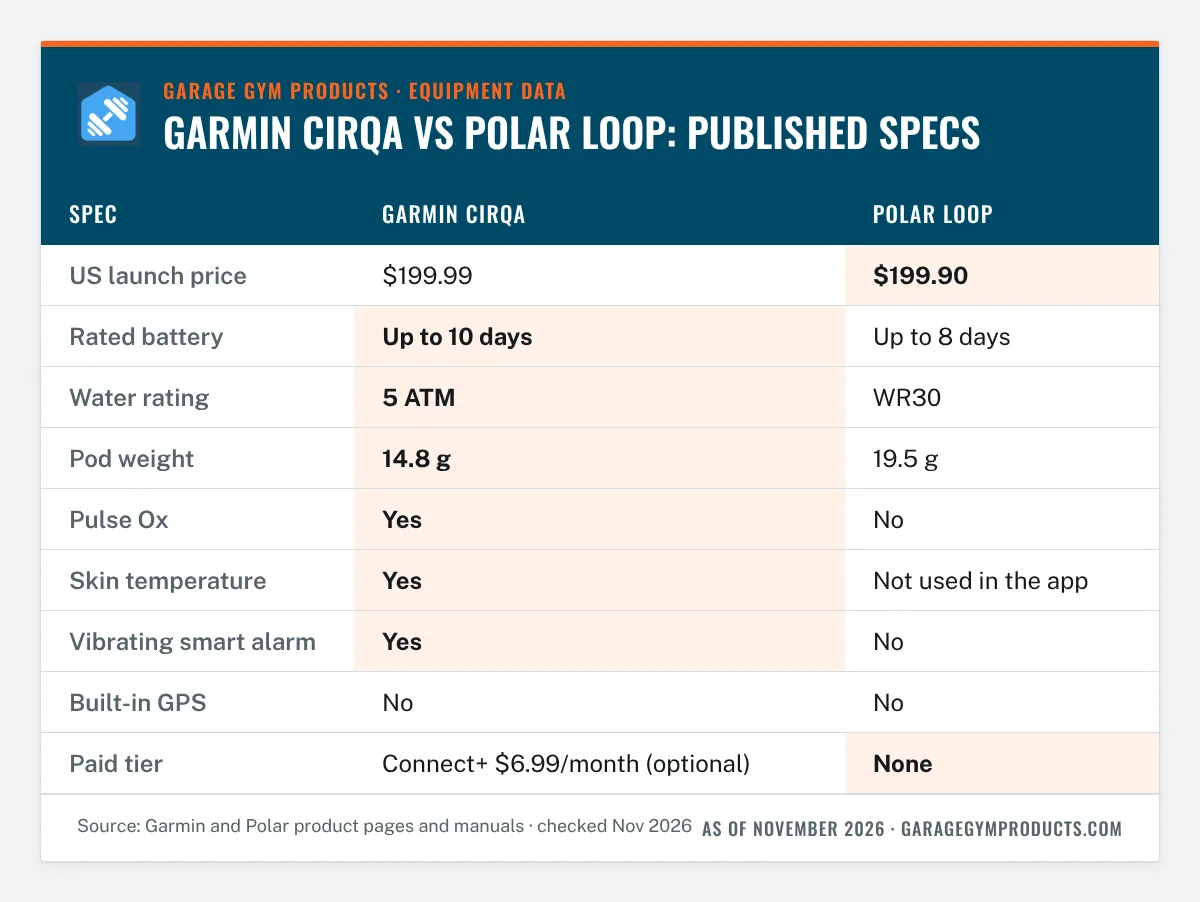
| Spec | Garmin Cirqa Smart Band | Polar Loop |
|---|---|---|
| US launch price | $199.99 | $199.90 |
| Rated battery | Up to 10 days | Up to 8 days (170 mAh) |
| Water rating | 5 ATM | WR30, suitable for swimming |
| Weight | 14.8 g module | 19.5 g module, 29 g with band |
| Heart rate and HRV | 24/7 heart rate, HRV status | 24/7 heart rate, nightly HRV |
| Pulse Ox (SpO2) | Yes | No |
| Skin temperature | Yes, used for cycle predictions | Sensor fitted, not used in the app |
| Vibration / smart alarm | Yes, wakes you up to 30 minutes early in light sleep | No vibration motor |
| Built-in GPS | No, uses your phone | No, uses your phone |
| Paid tier | Optional Connect+ at $6.99/month | None |
Garmin Cirqa vs Polar Loop 2: Which Polar Band Is This?
Polar sells its screenless band simply as the Polar Loop. It went on pre-order on 3 September 2025 and shipped from 10 September. Retailers and Polar’s own app release notes call it the Loop Gen 2, which is where the “Polar Loop 2” search comes from, and it is the band compared here.
That naming trips up shoppers on resale sites. Polar also made an older band called the Loop 2, an activity tracker with a small LED display, a tiny battery and an accelerometer for its only sensor, with no optical heart rate. If a listing shows a band with lit-up digits on top, it is the old model and none of the recovery features below apply to it.
The Garmin Cirqa is newer. Garmin announced it on July 21, 2026 as a screen-free smart band, and it is sold for $199.99 in black, blue, beige and red, in two sizes.
1. Garmin Cirqa Smart Band: Best for Sensors and Garmin Users
The Cirqa is a small pod, 27 x 47 x 9 mm and 14.8 g, on a fabric strap. Two strap sizes cover wrists from 120 to 200 mm (S-M) and 145 to 240 mm (L-XL), and the band can also sit on the upper arm, which suits lifters who find a wrist unit gets in the way of front rack and clean grip.
Its sensor list is the longest of the two. Garmin pairs optical heart rate with Pulse Ox and a skin temperature sensor, and the band turns those into training readiness, HRV status and VO2 max insights, alongside Body Battery, stress, a sleep score and nap detection. Skin temperature during sleep feeds period predictions and past ovulation estimates in Garmin Connect.
The Cirqa does vibrate. A smart alarm wakes you in a light sleep phase up to 30 minutes before the set time, which makes it the only one of these two bands that can replace a phone alarm on early training mornings. A side button can be customised to start an activity.
For workouts, the Cirqa tracks more than 80 activity types and detects many automatically. There is no GPS in the pod: runs and rides pick up distance from your phone’s GPS through Garmin’s Connected GPS. Garmin lists the operating range as -4 to 140°F (-20 to 60°C), which covers an unheated garage in January and a hot one in August.
The weak points are price and software. Engadget scored the Cirqa 7.4 out of 10, praising battery life and Garmin’s accuracy while noting that cheaper Garmin trackers with screens, such as the $150 Vivosmart, do more for less money. The bigger issue for anyone buying it as a subscription-free band is Connect+, covered below.
2. Polar Loop: Best for Zero Ongoing Cost
The Polar Loop is a slightly larger pod at 19.5 g, or 29 g with the wristband, built around a 170 mAh battery that Polar rates at up to 8 days. Polar’s service centre can replace that battery, a detail most wearables at this price do not offer. Extra wristbands cost $29.90, and Polar makes woven, leather, magnetic silicone and arm-band options in several sizes.
The Loop measures heart rate with Polar’s Precision Prime optical sensor (OHR Gen 3.5) plus an accelerometer. From that it builds Nightly Recharge, nightly HRV and Training Load, along with sleep stages, Daily Alertness, Activity Benefit and automatic training detection. Nightly Recharge combines sleep, overnight heart rate, HRV and breathing into one morning recovery read, which is the closest thing either band has to a Whoop-style recovery score.
What it does not have matters too. There is no Pulse Ox, the skin temperature sensor is fitted but only reachable by developers, and Polar sells the Loop on “No buzzing. No beeping.” That means no vibration motor, so no silent alarm and no nudges to move. The band stores about four weeks of data on board, which helps if you sync only now and then.
Polar’s software has moved on since launch. A February 2026 firmware update let owners edit sleep in the Flow app and see energy sources for automatically recorded sessions, and a later Flow update added trend views. Polar also includes trials of Strava, TrainingPeaks and Clue with purchase.
Sleep and Recovery Tracking Compared
Both bands are built for overnight wear, so recovery data is where most owners spend their time. The Cirqa leans on Garmin’s established metrics: Body Battery for energy across the day, a sleep score, HRV status trended over weeks and training readiness each morning. Pulse Ox adds blood oxygen during sleep, which some owners like to watch at altitude.
The Polar Loop answers with Nightly Recharge, which rates how well your autonomic nervous system recovered overnight and pairs it with a sleep charge. HRV here is nightly, and Daily Alertness estimates when you will feel sharpest. Without Pulse Ox or skin temperature, the Loop has fewer inputs, so its recovery picture rests on heart rate, HRV and breathing.
For lifters who already compare HRV across devices, our look at Apple Health’s daily readiness score and HRV tracking shows how these morning scores are built and why single readings swing. The same caution applies to both bands: watch the weekly trend, not one bad night.
Workout Tracking for Garage Gym Training
Neither band shows live data on your wrist, so during a session everything happens in the phone app or after the fact. That is fine for steady cardio on an air bike or rower, less so for lifters who want to pace rest periods by heart rate.
The Cirqa offers manual starts for more than 80 activities from the button or Garmin Connect, automatic detection for common ones, and VO2 max estimates. At launch, viewing live heart rate during a workout in the app, heart rate zones during training and structured workouts all sat behind Connect+; Garmin then promised an app update to make live heart rate free.
The Polar Loop tracks sessions automatically and reports Training Load and Activity Benefit afterwards. If accurate heart rate during intervals is the priority, a chest strap still beats both, and our guide to the best heart rate monitors for different workout types covers straps such as the Polar H10 and Garmin HRM-Dual.
Subscription Terms: What Each Band Costs Over Time
This is the clearest difference between the two. Polar charges nothing after purchase: Polar Flow is free on iOS and Android and every Loop feature works on day one, with a USD 199.90 launch price and $29.90 spare wristbands.
Pick an ownership period and toggle Connect+ to see what each band costs in total.
Garmin markets the Cirqa as working without a subscription, and its sleep, recovery and activity tracking do. Several features do not. At launch, nutrition tracking, guided workouts and structured workouts needed Connect+ at $6.99 per month, along with guided meditations and live heart rate and heart rate zones during a workout. Garmin has said an update will make live heart rate free; zones and structured workouts stay paid. Garmin is also building out its paid training software, as its acquisitions in training software show.
Here is what each band costs if you add Connect+ to the Cirqa, using the launch prices above:
| Ownership period | Garmin Cirqa, no Connect+ | Garmin Cirqa with Connect+ | Polar Loop |
|---|---|---|---|
| 12 months | $199.99 | $283.87 | $199.90 |
| 24 months | $199.99 | $367.75 | $199.90 |
| 36 months | $199.99 | $451.63 | $199.90 |
Connect+ adds $83.88 a year at the monthly rate. If you only want sleep, recovery and step data, the Cirqa costs the same as the Polar. If you want Garmin’s coached and structured workouts on a screenless band, budget close to $368 over two years.
Battery Life and Charging
Garmin’s 10-day rating against Polar’s 8 days works out to roughly 37 charges a year for the Cirqa and 46 for the Loop if each reached its rated life. Both figures are maximums. Running Pulse Ox overnight shortens the Cirqa’s battery, and reviewers have reported real-world life below the rating, so plan on charging each band about once a week.
The Cirqa charges over USB-C, with the cable in the box. The Loop uses a magnetic USB cable, and its battery can be replaced through Polar’s service centre when it wears out, which extends the band’s usable life past the point where a sealed battery would end it.
Which Screenless Tracker Should You Buy?
Choose the Garmin Cirqa if you already wear a Garmin watch, want blood oxygen and skin temperature, or need a vibrating alarm that will not wake the rest of the house. It is also the better pick for women who want temperature-based cycle predictions.
Choose the Polar Loop if you want one payment and no further costs, already train with a Polar watch or H10 strap, or prefer a band that never buzzes. Its Nightly Recharge score is a strong recovery metric for lifters who programme heavy days around how they slept.
If neither suits, the wider field includes Whoop, which bundles the hardware into a yearly membership, and the Oura ring with its own subscription. Our analysis of how Oura and Whoop are moving beyond recovery scores explains where those two are heading.
How We Chose
We compared the two bands on published figures only: Garmin’s product page and owner’s manual, Polar’s product page, technical specifications and launch release, and coverage of Garmin’s Connect+ terms. The picks weigh sensors, recovery metrics, alarm and vibration, battery life and the full cost over 12 to 36 months. We did not test either band, and figures such as battery life are the makers’ ratings.
Frequently Asked Questions
Can the Garmin Cirqa or Polar Loop Track Distance Without a Phone?
No. Neither band has built-in GPS, so both need your phone with you to record the distance and route of a run or ride.
Are the Garmin Cirqa and Polar Loop Waterproof Enough for Swimming?
Yes. The Cirqa carries a 5 ATM rating and the Polar Loop a WR30 rating that Polar describes as suitable for swimming and bathing.
Can I Wear Either Band on My Upper Arm?
Yes. Garmin says the Cirqa can be worn on the wrist or upper arm, and Polar sells a sport armband for the Loop.
Does the Polar Loop Work With Polar Chest Straps?
Yes, through the shared app: the Loop syncs to Polar Flow, the same app Polar watches and the H10 strap use, so sleep, recovery and training data sit in one place.
