If you train alone in a garage, the best strength and conditioning coaches are the ones whose methods you can actually run without a team weight room behind you. The nine coaches below have the records to back their reputations, from Al Vermeil’s championship rings in both the NFL and the NBA to Cal Dietz’s work with 16 Olympic and World Champions, and each one has a method you can copy with a rack, a barbell or a single kettlebell.
What separates them is what they are best at: building raw barbell strength, making athletes faster, keeping throwers healthy, or building the engine for a long workout. Each entry below covers the coach’s track record, the method, and the minimum kit you need to follow it at home.
Quick answer:
- Best overall track record: Al Vermeil, the first strength coach for the San Francisco 49ers (1979) and the NBA’s first, with the Chicago Bulls (1985).
- Best for a small garage gym: Dan John, who created the goblet squat, a lift that needs one dumbbell or kettlebell.
- Best for beginner barbell strength: Mark Rippetoe, whose Starting Strength program runs on five barbell lifts.
- Best for long-term barbell progress: Jim Wendler, creator of the 5/3/1 program, with a 2,375 lb best powerlifting total.
- Best for speed and explosive power: Cal Dietz, head strength coach for the U.S. Women’s National Hockey Team since 2021.
- Best for conditioning: Joel Jamieson, founder of 8 Weeks Out and author of Ultimate MMA Conditioning.
Strength and Conditioning Coaches Compared: Method and Home Gym Kit
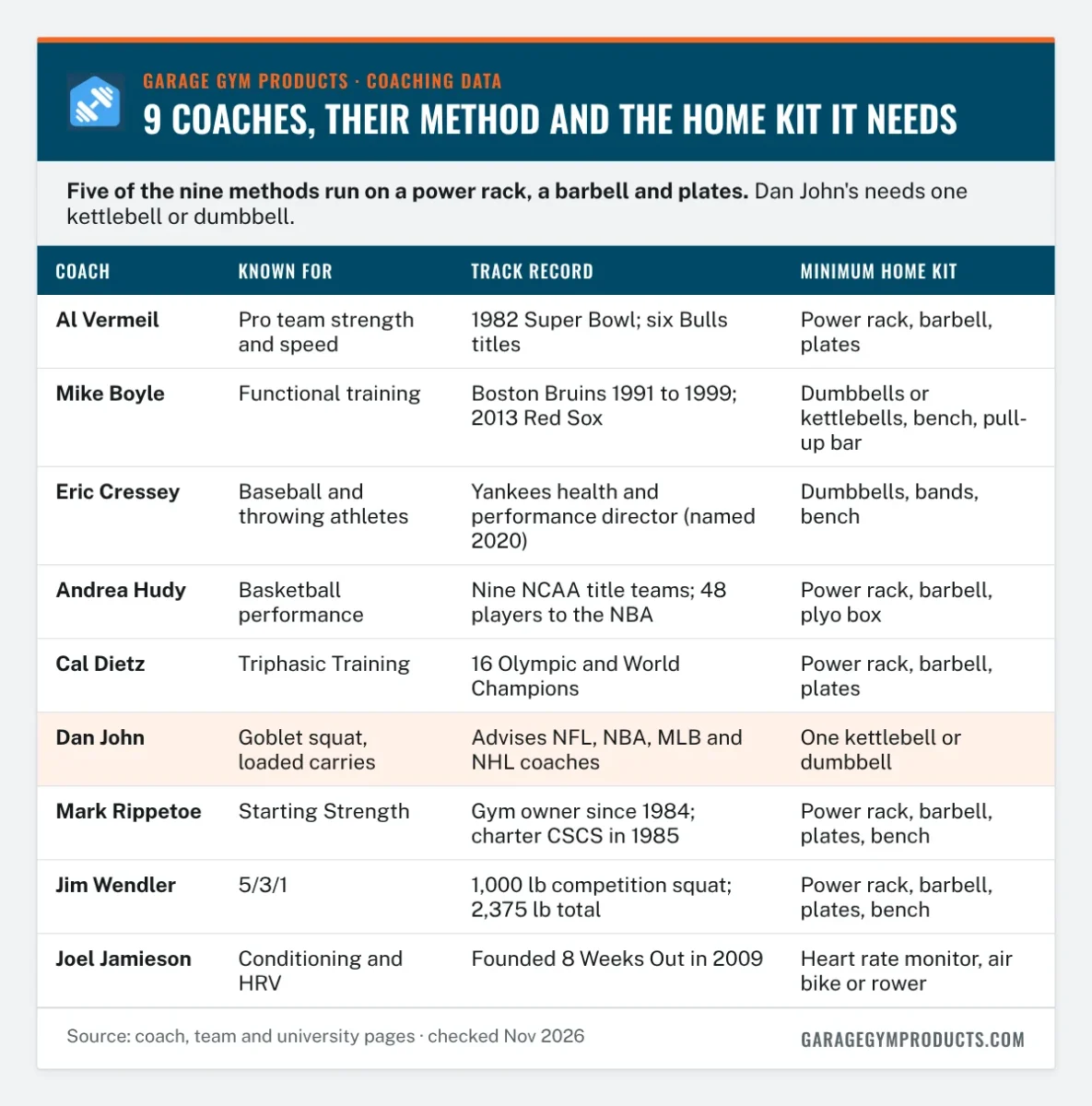
The table lines up each coach’s best-known method with the smallest set of equipment you need to follow it at home. The kit column is our reading of what each method’s core lifts require, so treat it as a starting list, and add to it as your training grows.
| Coach | Known for | Track record | Minimum home kit |
|---|---|---|---|
| Al Vermeil | Pro team strength and speed | 1982 Super Bowl; six Bulls titles | Power rack, barbell, plates |
| Mike Boyle | Functional training | Boston Bruins 1991 to 1999; 2013 Red Sox | Dumbbells or kettlebells, bench, pull-up bar |
| Eric Cressey | Baseball and throwing athletes | Yankees health and performance director (named 2020) | Dumbbells, bands, bench |
| Andrea Hudy | Basketball performance | Nine NCAA title teams; 48 players to the NBA | Power rack, barbell, plyo box |
| Cal Dietz | Triphasic Training | 16 Olympic and World Champions | Power rack, barbell, plates |
| Dan John | Goblet squat, loaded carries | Advises NFL, NBA, MLB and NHL coaches | One kettlebell or dumbbell |
| Mark Rippetoe | Starting Strength | Gym owner since 1984; charter CSCS in 1985 | Power rack, barbell, plates, bench |
| Jim Wendler | 5/3/1 | 1,000 lb competition squat; 2,375 lb total | Power rack, barbell, plates, bench |
| Joel Jamieson | Conditioning and HRV | Founded 8 Weeks Out in 2009 | Heart rate monitor, air bike or rower |
Five of the nine methods run on the same core: a power rack, a barbell and plates. If you already own those, most of this list is open to you without buying anything else.
1. Al Vermeil, San Francisco 49ers and Chicago Bulls: Best Overall Track Record
Al Vermeil became the San Francisco 49ers’ first strength and conditioning coach in 1979, and the team won the 1982 Super Bowl. In 1985 he became the NBA’s first strength and conditioning coach with the Chicago Bulls, who went on to win six championship titles. The Chicago White Sox were among his early clients, looking to make their players faster.
No other strength coach on this list has rings from two different major leagues. His work centers on the barbell and on speed, the same tools a garage lifter with a rack and plates already has. If you want to train for speed and power like a pro athlete, Vermeil’s career shows what that approach can deliver.
The catch: Vermeil’s methods are spread across clinics, interviews and coaching education, so you will not find one tidy program to buy. Start with his emphasis on fast, crisp barbell reps and build from there.
2. Mike Boyle, Boston: Best for Functional Training
Mike Boyle co-founded Mike Boyle Strength and Conditioning in 1996 and spent 15 years as head strength and conditioning coach at Boston University. He coached the Boston Bruins from 1991 to 1999, worked with the 2013 Boston Red Sox when they won the World Series, and trained the 1998 U.S. Women’s Olympic Ice Hockey Team that won gold in Nagano.
His book, Functional Training for Sports, published by Human Kinetics, is the clearest entry point to his approach. MBSC now runs gyms in Woburn and Middleton, Massachusetts. For a home gym, Boyle’s style fits well with dumbbells, kettlebells, a bench and a pull-up bar, which keeps the footprint small. If you are deciding which free weights to buy first, our comparison of kettlebells vs dumbbells for muscle and strength covers the trade-offs.
3. Eric Cressey, Hudson and Palm Beach Gardens: Best for Baseball and Throwing Athletes
Eric Cressey founded Cressey Sports Performance, which has facilities in Hudson, Massachusetts, and Palm Beach Gardens, Florida. In early 2020 he was named the New York Yankees’ director of health and performance while continuing to run his own business. In 2020 he estimated that about 80% of his clients were baseball players.
Cressey’s work matters most if you throw, swing or play an overhead sport and want to lift without beating up your shoulders and elbows. His methods lean on dumbbells, bands and careful exercise selection more than maximal barbell work, which suits a smaller garage. He was named to that role in February 2020.
4. Andrea Hudy, UConn Women’s Basketball: Best for Basketball
Andrea Hudy has spent more than 25 years in the profession and has been part of nine NCAA national championship teams, with 48 of her athletes going on to the NBA. The NSCA named her National College Strength and Conditioning Coach of the Year in 2013 and gave her its Impact Award in 2017. She has coached under three Hall of Fame basketball coaches.
Hudy spent years at Kansas, moved to Texas in 2019 to lead basketball strength and conditioning, and is now listed as UConn’s director of sports performance for women’s basketball. Her work is a useful model if you are a basketball player or a parent of one: jumping, landing and staying durable across a long season. Parents should also read our piece on how youth fitness and sports training are moving closer together.
5. Cal Dietz, University of Minnesota: Best for Speed and Explosive Power
Cal Dietz has been the University of Minnesota’s head Olympic strength and conditioning coach since 2000, with men’s and women’s hockey among his programs. He has been head strength and conditioning coach for the U.S. Women’s National Team since 2021, including the 2022 Olympic Winter Games, and has trained 16 Olympic and World Champions plus athletes with 543 All-American honors.
He co-wrote Triphasic Training, a book on building speed and explosive strength by training each phase of a lift: the lowering, the pause and the lift itself. You can run the basics with a rack, a barbell and plates. A stopwatch or a training app helps, because tempo and pause length are part of the program.
6. Dan John, Murray, Utah: Best for a Small Garage Gym
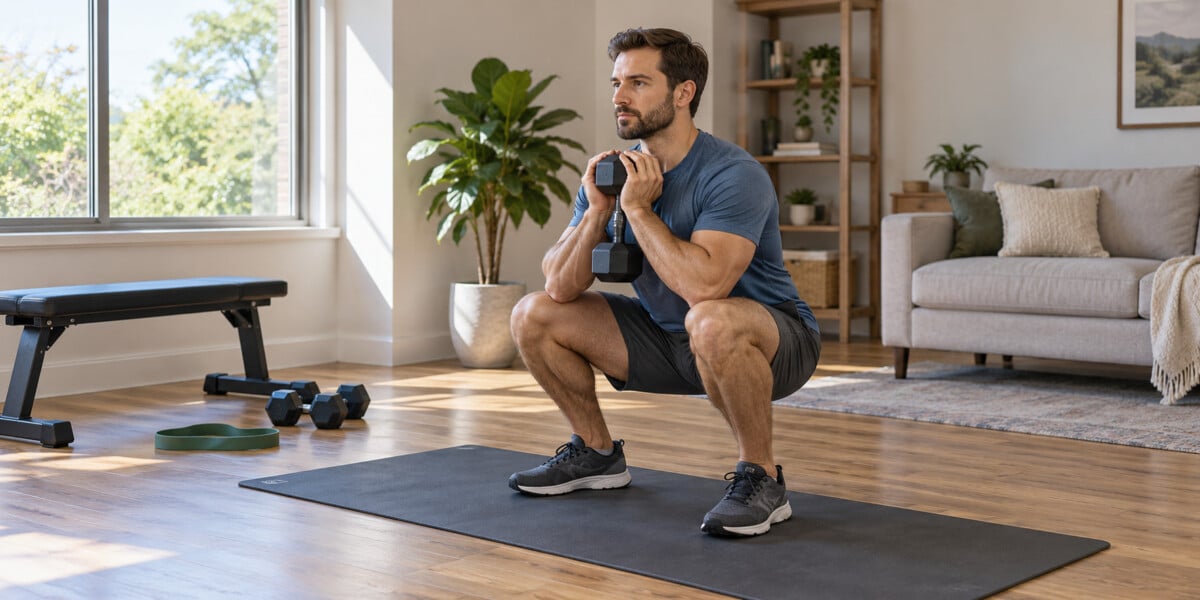
Dan John trains in a garage gym at his home in Murray, Utah, stocked with kettlebells, barbells, a TRX strap and pull-up bars, and no machines. He created the goblet squat to fix poor squat technique: you hold a dumbbell or kettlebell against your chest, which keeps the chest up and the hips back. He also developed loaded carries as a training staple.
He coached track and taught at high schools in Utah, advises coaches in the NFL, NBA, MLB and NHL, and had written five books by 2014, starting with Never Let Go. “If you know your stuff, it’s a world-class gym; if you don’t, it’s a dump,” he told the Deseret News. For a home lifter on a budget, that is the most encouraging line on this page: one bell gets you started. Our guide to comparing adjustable kettlebell weights and designs helps if you want one bell that grows with you.
7. Mark Rippetoe, Wichita Falls, Texas: Best for Beginner Barbell Strength
Mark Rippetoe bought a gym in Wichita Falls, Texas, in 1984 and renamed it the Wichita Falls Athletic Club. His book Starting Strength, first published in 2005 with Lon Kilgore, built a program around five barbell lifts: the squat, deadlift, press, bench press and power clean, plus a few assistance moves such as chin-ups. He was in the charter group to earn the NSCA’s CSCS credential in 1985 and gave it up in 2009.
Starting Strength is a simple fit for a garage: a power rack, a barbell, plates and a bench cover every lift. It suits a true beginner who wants to add weight to the bar session by session. Once those linear gains slow down, the next coach on the list picks up where Rippetoe leaves off. If you also want help structuring the rest of the week, see our full body split routine for training at home.
8. Jim Wendler: Best for Long-Term Barbell Progress
Jim Wendler is the creator of the 5/3/1 training program, and his own numbers back it: he squatted 1,000 pounds in competition and posted a 2,375 lb best total as an Elite powerlifter. He earned three letters playing football at the University of Arizona.
5/3/1 is built around the squat, bench press, deadlift and overhead press, with small, steady increases over monthly cycles. That slower pace is the point: it suits a lifter past the beginner stage who wants years of progress without burning out. The kit is the same as Rippetoe’s, so a garage built for Starting Strength already runs 5/3/1. Bench-focused lifters can pair it with our guide to increasing bench press strength at home.
9. Joel Jamieson, 8 Weeks Out: Best for Conditioning
Joel Jamieson founded 8 Weeks Out in the spring of 2009, wrote Ultimate MMA Conditioning, and has trained combat-sports athletes since 2004. He has consulted for the Navy SEALs and Life Time Fitness, and his BioForce HRV system is used by teams in the NFL, NBA, MLS and NCAA.
Jamieson’s specialty is the engine: how well your heart and lungs keep up with hard work, and how to read recovery with heart rate variability (HRV). At home, that means a chest-strap heart rate monitor and a machine you can push hard on. Our roundups of the best heart rate monitors and the best air bikes for home gym owners cover both.
Which Strength Coach’s Method Fits Your Garage Gym?
Match the coach to your goal first, then to the equipment you own. If you want to get strong on the barbell for the first time, start with Rippetoe and move to Wendler when progress stalls. If your space or budget only allows one bell, Dan John’s goblet squats and carries give you a full program from a single kettlebell.
Pick your goal to see which coaches fit it and the smallest set of equipment each method needs.
Athletes should look at the coach closest to their sport: Cressey for baseball and throwing, Hudy for basketball, Dietz for speed and hockey, Vermeil for team-sport power. Boyle suits anyone who wants functional training with dumbbells and bodyweight work. If conditioning is your weak link, Jamieson’s heart rate approach pairs well with any of the strength programs above.
How to Hire a Certified Strength and Conditioning Coach
Following a famous coach’s method is free or close to it. Hiring a coach of your own costs more, and the credential to look for is the NSCA’s Certified Strength and Conditioning Specialist (CSCS). To sit the exam, a candidate needs at least a bachelor’s degree, or to be enrolled as a college senior, plus current CPR/AED certification. The standard non-member exam fee is $475 (checked November 2026).
That degree requirement is what sets the CSCS apart from many personal trainer certifications. Before you pay anyone for programming, ask:
- Credential: Which certification they hold, and whether it is current with the issuing body.
- Experience: Whether they have coached athletes or lifters with your goal and training age.
- Remote setup: Whether they will write programs for the equipment you have in your garage.
- Scope: Whether they refer you to a medical professional for pain or injury, which is the right answer.
Coaching is also changing as more trainers move into healthspan work; our piece on why more trainers are becoming longevity coaches explains what that means if you are shopping for one.
How We Chose These Strength and Conditioning Coaches
We picked coaches with a verifiable track record: professional or Olympic team roles, NCAA championships, published programs, or competition results that their own websites, team or university pages, or published profiles confirm. We checked each coach’s facts in November 2026 against those pages.
We then weighted the list toward coaches whose methods a home lifter can follow with standard garage gym equipment. Rankings in this space are opinion, so we sorted by what each coach is best for, with no claim that one is objectively better.
Frequently Asked Questions
Who Is the Most Successful Strength and Conditioning Coach?
By championships, Al Vermeil has the strongest claim: he was the San Francisco 49ers’ strength coach for their 1982 Super Bowl win and the Chicago Bulls’ strength coach for six NBA titles.
What Is the Difference Between a Strength Coach and a Personal Trainer?
A strength and conditioning coach usually trains athletes for sport performance, and the NSCA’s CSCS credential requires a bachelor’s degree. Many personal trainer certifications do not require a degree and focus on general fitness clients.
Can I Follow a Strength Coach’s Program in a Home Gym?
Yes. Starting Strength and 5/3/1 need a power rack, barbell, plates and bench, and Dan John’s goblet squat and carries need only one kettlebell or dumbbell.
How Much Does the CSCS Exam Cost?
The standard non-member fee for the NSCA’s CSCS exam is $475, checked in November 2026; some universities offer a discounted rate for their own students.