If you have been told that a full body split is a beginner’s routine, the research on training frequency says otherwise, and a well-built week at home can carry you well past your first year of lifting. US guidelines call for muscle-strengthening work on two or more days a week, and a full body split puts every major muscle group into each of those days. Those 2018 guidelines are still the current edition, and HHS has said a supplement on steps and muscle-strengthening activity will follow in 2027.
This guide covers why full body training keeps working, how many days to run it, a sample three-day week for a home gym, and how to keep adding load over time.
Quick answer:
- Train your whole body 2 to 3 days a week, with at least one rest day between sessions.
- Build each session around a squat or hinge, a push and a pull, plus one extra core, leg or arm exercise.
- Aim for about 10 hard sets per muscle each week, spread across the sessions.
- Add 2 to 10 percent to a lift once you beat your rep target by one or two reps in two sessions in a row.
Why Full Body Splits Keep Working Past the Beginner Stage
Muscle growth follows weekly volume and effort more closely than it follows how you divide the week. A 2019 meta-analysis of training frequency found that training a muscle two or more times a week beats once a week mainly when the higher-frequency group also does more total sets. Once weekly sets are matched, the differences between frequencies shrink to almost nothing. An earlier 2016 analysis did favor twice a week even with matched volume, so two sessions per muscle remains a sensible floor.
That favors full body training for anyone with limited time. Hitting each muscle two or three times a week spreads your sets across several sessions, so no single workout needs a marathon of chest or leg volume. A missed day costs you one slice of the week, not the only session a body part gets.
Volume still matters. A 2016 meta-analysis of weekly resistance training volume reported a graded response, with more growth at 10 or more weekly sets per muscle than at 5 to 9 or 1 to 4. The evidence above 10 sets is less settled, and few of the included studies used experienced lifters, so treat 10 as a reasonable starting target and adjust to how you recover.
How Many Days a Week Should You Train Full Body at Home?
The American College of Sports Medicine position stand on resistance training progression suggests 2 to 3 days a week for novices, 3 to 4 for intermediates and 4 to 6 for advanced lifters. Full body training fits the low end of that range comfortably and stretches to four days with some adjustments. The same position stand recommends total body workouts for novices and pairs 3 days with total body training for intermediates, keeping 4 days for split routines.
| Days per week | Layout | Best for |
|---|---|---|
| 2 | Two full body sessions, such as A and B, with a rest day or more between them | Busy weeks and a first year of lifting |
| 3 | Monday, Wednesday, Friday, alternating A, B and C or A, B, A then B, A, B | Most home lifters, including intermediates |
| 4 | Four full body days with one lighter session, or an upper and lower alternation | Lifters who recover well and want more weekly sets |
Day ranges checked against the ACSM position stand on resistance training progression in October 2026.
Leave at least one rest day between full body sessions so the muscles you trained have time to recover. If your legs or back are still sore at the next session, drop a set or two from the heaviest lifts before you drop a day.
A Sample Three-Day Full Body Split
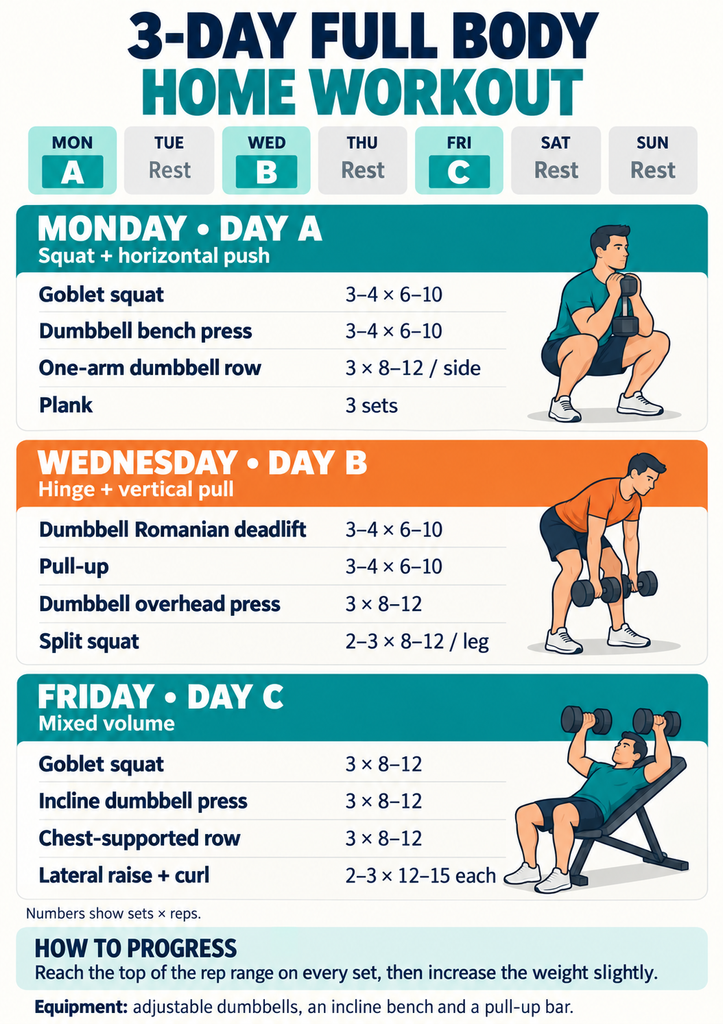
This week uses three sessions with a different emphasis each day. The main lifts get 3 to 4 hard sets, which across three sessions lands your back and quads at roughly 8 to 10 direct weekly sets, your glutes higher, and your chest, shoulders and hamstrings lower. A hard set is one you finish with only a rep or two left in the tank. If chest, shoulders or hamstrings are a priority, add a set to the bench press, overhead press or Romanian deadlift.
Start each session with a few lighter ramp-up sets of your first lift. Our guide to warming up before lifting covers how many you need.
Day A: Squat and Horizontal Push
- Barbell or goblet squat, 3 to 4 sets of 6 to 10
- Bench press or dumbbell bench press, 3 to 4 sets of 6 to 10
- One-arm dumbbell row, 3 sets of 8 to 12
- Plank or hanging knee raise, 3 sets
Day B: Hinge and Vertical Pull
- Romanian deadlift, 3 to 4 sets of 6 to 10
- Pull-up or lat pulldown, 3 to 4 sets of 6 to 10
- Overhead press, 3 sets of 8 to 12
- Split squat, 2 to 3 sets of 8 to 12 per leg
Day C: Mixed Day for Volume
- Front squat or heavy goblet squat, 3 sets of 8 to 12
- Incline dumbbell press, 3 sets of 8 to 12
- Chest-supported or barbell row, 3 sets of 8 to 12
- Lateral raise and curls, 2 to 3 sets of 12 to 15 each
Here is the whole week on one page, with the direct weekly sets each muscle group gets:

If you only have dumbbells and a bench, swap barbell lifts for dumbbell versions. Our comparison of kettlebells versus dumbbells for muscle and strength helps you decide which to buy first.
Our guide to building bench press strength at home goes deeper on the Day A press. For the curl slot on Day C, the beginner biceps exercises guide walks through five options.
How To Run the Split on Two or Four Days
On a two-day week, run Day A and Day B and add a set to each main lift so your weekly volume does not drop too far. Move the lateral raises and curls into whichever session has time left.
On a four-day week, rotate A, B, C, A and pick up with B the following week, or keep one of the four sessions lighter, as the table above suggests. Watch recovery more closely here, since the extra day trims the rest between sessions.
How To Progress a Full Body Split Over Time
Progress comes from adding reps or load in small steps. The ACSM position stand recommends a 2 to 10 percent increase in load once you can complete one or two reps over your target on the current weight in two consecutive sessions. Home lifters with small plate jumps can use the low end of that range. The position stand also suggests the smaller increases for small-muscle exercises such as curls and lateral raises, and the larger ones for squats and deadlifts.
A simple version is double progression. Pick a rep range such as 6 to 10, stay at the same weight until you hit 10 reps on every set, then add the smallest load jump available and start again at 6 to 8 reps. Our guide to progressing with limited equipment covers what to do when your plate jumps are too big.
Save this flow for your training log:

Plan an easier week every 6 to 8 weeks if lifts stall or joints ache: keep the same exercises, cut sets by about a third and leave a rep or two in reserve. Add sets to lagging muscles only after your lifts have stopped climbing for several weeks at the current volume.
What Equipment Does a Home Full Body Split Need?
A pair of adjustable dumbbells, a sturdy bench and a pull-up bar cover every movement in the sample week. A barbell and rack open up heavier squats and presses, and a pair of kettlebells add hinge and carry variety without much floor space. If you are shopping for the bench, the best weight benches for a home gym roundup is a good starting point, and a flat-to-incline model handles both pressing days.
Frequently Asked Questions
Can Advanced Lifters Use a Full Body Split?
Yes. Lifters with years of experience can run full body sessions three or four days a week by lowering the sets per exercise and rotating which lifts are heavy each day. Expect to add exercise variety as you advance, since the same weekly volume spread over more movements is easier on the joints.
Is a Full Body Split Better Than Push Pull Legs?
Neither wins on muscle growth when weekly sets and effort are equal. Full body suits three or fewer training days, while push pull legs suits lifters who can train five or six days a week and prefer shorter sessions per muscle group. A 2024 meta-analysis of 14 studies comparing split and full body routines found no significant difference in strength or muscle growth when volume was matched.
How Long Should a Full Body Workout Take?
Most sessions with four to six exercises and three to four sets each take 45 to 75 minutes, depending on how long you rest between sets. Resting two to three minutes on heavy compound lifts keeps performance up across all sets.
Is a Full Body Workout 3 Days a Week Enough To Build Muscle?
Yes, for most lifters. Three sessions train each muscle two or three times a week and can reach about 10 weekly sets per muscle, the top category in the 2016 volume meta-analysis. The ACSM position stand also recommends 3 total body days a week for intermediate lifters.
Can You Do a Full Body Workout Every Day?
You can, but it is not a good default. The ACSM frequencies pair total body training with 2 to 3 days a week for novices and 3 for intermediates, and daily sessions leave no full rest day for any muscle, so each workout would need to be very short.