
Increasing your bench press at home starts with a training plan and equipment that support steady, repeatable progress. The American College of Sports Medicine’s March 2026 Position Stand recommends heavier loads and two to three sets per exercise for strength, while emphasizing consistent participation.
First, identify what is holding your press back. Then compare barbell and dumbbell setups, check bench and rack compatibility, and choose a progression approach you can recover from. Accessories can wait until those basics are covered.
Quick answer: what the evidence supports for a home bench press
- Load and sets: ACSM’s 2026 Position Stand recommends loads around 80% of 1RM for 2 to 3 sets per exercise to build strength, and training every major muscle group at least twice a week.
- Weekly volume: A 2022 umbrella review found at least 10 weekly sets per muscle group optimal for muscle growth, with as few as 4 sets still producing meaningful gains.
- When to add weight: ACSM’s progression guidance is to increase the load by 2 to 10% once you can perform one or two repetitions beyond your target on two consecutive sessions. On a 135 lb bench, that is roughly 2.5 to 13.5 lb.
- Effort: Stopping 1 to 3 repetitions short of failure produces less fatigue and faster perceived recovery than training to failure, according to a 2023 bench press study.
- Rest: ACSM recommends at least 2 to 3 minutes between heavy sets of core lifts such as the bench press.
- Equipment: Buy for safe solo practice and small loading increments first: a stable bench, a rack with correctly set safeties, and plates that allow 5 lb (or smaller) total jumps.
How To Increase Bench Press: Identify Your Bottleneck First
A stalled bench press does not automatically mean you need new equipment. Review your recent sessions for missed workouts, inconsistent technique, overly ambitious weight increases, and repeated sets that end in failed repetitions.
Be clear about what you want to improve. These goals overlap, but each calls for different priorities:
- A stronger barbell one-repetition maximum: Prioritize practicing the barbell bench press and gradually developing the ability to handle heavier loads. Your one-repetition maximum, or 1RM, is the most weight you can lift once with the intended technique.
- More muscle: Track the total challenging work your chest, shoulders, and triceps receive throughout the week.
- More repetitions at a fixed weight: Track repetition performance at that load while keeping technique and range of motion consistent.
The ACSM guidance identifies loads around 80% of 1RM as useful for maximizing strength. That is a programming reference for healthy adults, not a requirement to test your maximum before starting. Use a manageable training load while learning the movement.
For muscle growth, an umbrella review found support for around ten weekly sets per muscle group. That does not mean you should immediately add ten bench-press sets. Account for your other pressing exercises and current workload first. The same review noted that most of its underlying studies used untrained participants, so treat ten sets as a reference point rather than a ceiling or a floor for an experienced lifter.
When Does Equipment Become the Limitation?
A purchase has a clear purpose when your setup prevents safe practice, forces loading jumps you cannot manage, or no longer provides enough resistance. If your bench shifts, your rack lacks suitable safeties, or you cannot position the equipment correctly, fix those problems before adding weight.
If your setup already supports your training, keep a log of load, sets, repetitions, and effort. That record gives you a better basis for changing the program than one disappointing workout.
Choose a Barbell or Dumbbell Setup for Your Goal
A barbell-and-rack setup is the more direct choice when your goal is a stronger barbell bench press. Dumbbells provide another way to build pressing strength and muscle, particularly when a full rack does not fit your room or training preferences.
| Consideration | Barbell and Rack | Dumbbells and Bench |
|---|---|---|
| Main Use | Practicing and progressing the barbell bench press | General pressing strength and varied exercises |
| Solo Training | Requires a suitable rack and correctly positioned safeties | Requires a manageable setup, controlled handling, and a clear area |
| Load Progression | Check available plate increments | Check increments per hand and maximum weight |
| Space | Allow for the rack, full bar length, plate loading, and access | Allow for bench placement, handling weights, and storage |
| Main Trade-Off | More components to match and accommodate | Getting heavier dumbbells into and out of position can become limiting |
When a Barbell Setup Makes Sense
Choose a barbell setup when you want regular access to the exact lift you are trying to improve. Budget for the complete system: bench, rack, compatible safeties, bar, plates, and collars.
Check the smallest total increase your plates allow. Even a large plate collection can leave you with awkward progression jumps if it lacks small plates. Confirm that the bar’s usable shaft length fits the rack and that the plates and collars match its sleeves. Our guide to barbell types can help you compare bar options before buying.
When Dumbbells Make Sense
Dumbbells suit a home gym that needs pressing, rows, and other exercises without dedicating space to a full barbell station. Adjustable models can consolidate several loads into one pair, but check their adjustment method, weight increments, and handling requirements before choosing.
Look at the starting weight, maximum weight per dumbbell, and the manufacturer’s restrictions on dropping or storage. Our adjustable dumbbell buying guide gives you options to compare against those requirements.
Dumbbell pressing still puts weights above your torso and face. Stay within your handling ability, and plan how you will start and finish each set. Dropping the weights should not be your routine exit strategy.
Flat vs. Adjustable Benches: What Should You Buy?
A flat bench is enough if flat pressing is the main reason for buying it. An adjustable bench adds incline positions for other exercises and makes sense when those exercises already belong in your training. Our home gym weight bench guide can help you compare options in both categories.
Stability is essential with either design. Check the specific bench’s base, assembly, pad support, and adjustment mechanisms. A flat design does not automatically mean good build quality, and a long list of positions does not guarantee useful versatility.
Check Fit and Dimensions
- Pad height: Can you establish secure foot contact in your intended pressing position?
- Pad width and length: Can you support your head and torso while moving your arms comfortably? For a model to compare for back support, see our REP Fitness FB-5000 wide-pad review.
- Base layout: Do the feet interfere with your stance, rack crossmembers, or bench placement?
- Flat position: On an adjustable bench, check the pad gap and how the seat and backrest align.
- Handling and storage: Check overall dimensions, moving handles, wheels, and whether upright storage is expressly permitted.
If incline work is part of your plan, the REP AB-3000 adjustable bench overview shows the features worth comparing in that category. Check any model against the manufacturer’s current documentation and your room measurements.
Read Capacity Ratings Carefully
Confirm what the stated capacity includes. Does the manufacturer define it as combined lifter and external load, external load alone, or another condition? Read any separate limits listed for different positions or attachments.
Apply the same scrutiny to the rack, J-cups, and safeties. A static weight rating does not automatically authorize catching a dropped bar. Choose equipment expressly intended for your planned use, and follow its assembly, anchoring, and inspection instructions.
Check Rack Compatibility and Solo-Training Safety
Before buying a rack, confirm that you can position the bench correctly, reach the bar without losing your setup, and set the safeties appropriately. Rack dimensions alone will not answer all three questions. For an example of how a full-size rack handles bench placement and safety options, see our REP PR-5000 V2 power rack review.
- Attachments: Verify compatibility with the exact rack model. Similar-looking holes and uprights are not enough.
- Safety adjustment: Check whether the available heights accommodate your bench and pressing position.
- Safety coverage: Confirm that the manufacturer-approved bars, straps, or arms cover the intended lifting area.
- Installation: Follow requirements for anchoring, supporting feet, flooring, and attachment use.
- Working space: Measure the assembled footprint, full bar length, plate-loading access, ceiling clearance, and room for a spotter.

Set the safeties to allow your intended repetition while providing a catch position that keeps a failed bar off your neck and torso. Test the arrangement with an unloaded bar, including what happens when you relax your pressing position. If you cannot achieve both suitable clearance and protection, change the setup before loading it.
Safeties provide a mechanical backup within their coverage and rated use, but they cannot guarantee protection against every loss of control. A competent spotter can help with a handoff or failed repetition, provided you communicate clearly about when and how to assist. When training solo, avoid maximum attempts and stop before you lose control of the movement.
Make Your Bench Press Technique Repeatable
Choose a load that allows a stable position and controlled repetitions. Consistency makes your training log useful: adding weight while shortening the movement or bouncing the bar does not give you a clear comparison with earlier sessions. For more setup guidance, our bench press and shoulder-health guide covers technique cues and equipment considerations.
- Establish support. Position your head, upper back, and buttocks securely on the pad, with stable foot contact. Avoid an exaggerated position you cannot comfortably maintain.
- Choose a manageable grip. Use a closed grip with your thumbs around the bar. Choose a width that lets you control the bar and keep your wrists supported over your forearms.
- Unrack without reaching excessively. Adjust the J-cups and bench position so the handoff does not pull you out of your setup.
- Brace before you lower. Take a breath into your torso, keep your shoulder blades pulled back and down against the pad, and press your feet into the floor so the whole body stays rigid. Exhale as the bar passes the sticking point.
- Lower under control. Use a consistent, comfortable range of motion without bouncing the bar off your chest or forcing painful depth.
- Finish before control breaks down. End the set if your position shifts substantially or you cannot complete another clean repetition.
A qualified strength coach can help with recurring setup or bar-path problems. Stop pressing through sharp or worsening pain, and consult a qualified healthcare professional for persistent pain. Equipment changes alone are not a reliable way to diagnose the cause.
Use a Manageable Bench Press Progression
Progressive overload means gradually increasing training demands as your ability improves. Adding weight is one method. Completing more controlled repetitions at the same load is another useful way to track progress.
For a conservative starting framework, consider two pressing sessions on nonconsecutive days, beginning with a workload you can perform consistently. Keep the bench press early in the session when it is your main priority, and use progressively heavier warm-up sets before your working sets. Two sessions also satisfies the ACSM’s baseline of training each major muscle group at least twice a week.
- Choose a repeatable workload. For example, use two working sets within a range of five to eight repetitions. This is a practical starting option, not a universal prescription.
- Keep repetitions in reserve. Finish when you estimate that another two or three controlled repetitions remain possible.
- Add repetitions gradually. Keep the load steady as you work toward the top of your chosen range.
- Add a small amount of weight. Once all working sets reach the target with consistent technique, use the smallest manageable increase.
- Repeat or reduce when needed. Hold the load if technique deteriorates. If performance repeatedly declines, reassess total pressing work, sleep, food intake, and recovery before adding more sets.
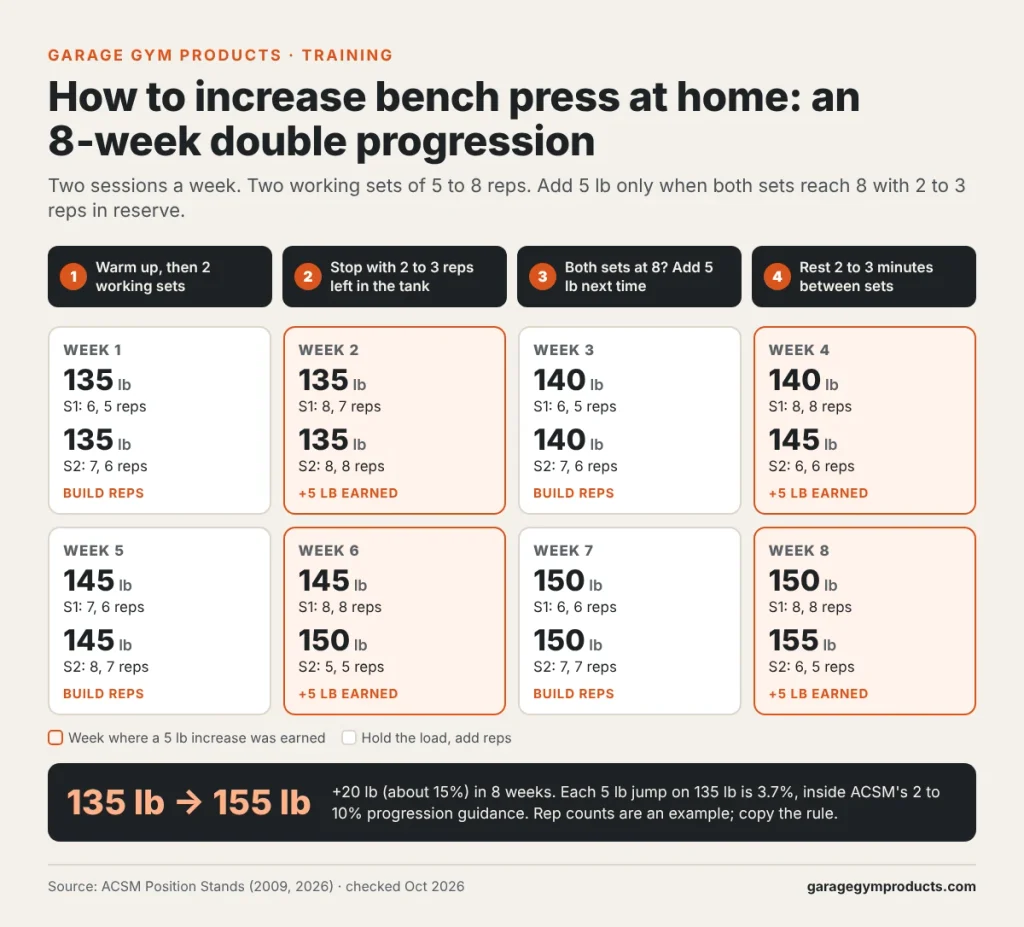
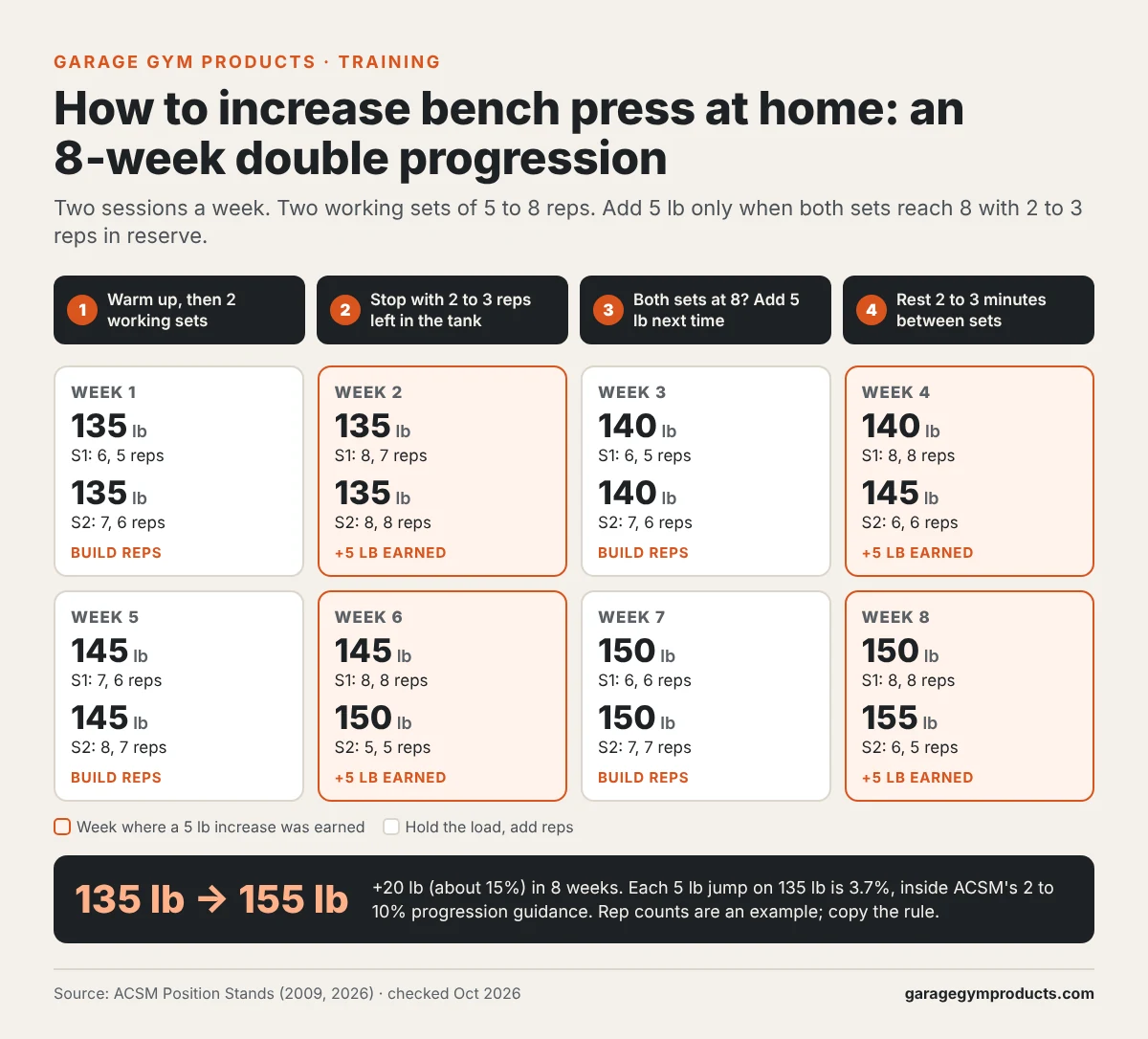
Here is what that framework looks like on paper for a lifter starting at 135 lb, adding 5 lb only after both working sets reach eight repetitions. The repetition counts are illustrative; the rule for adding weight is the part to copy.
| Week | Session 1 (load, reps) | Session 2 (load, reps) | Decision |
|---|---|---|---|
| 1 | 135 lb: 6, 5 | 135 lb: 7, 6 | Hold the load, build repetitions |
| 2 | 135 lb: 8, 7 | 135 lb: 8, 8 | Both sets hit 8: add 5 lb |
| 3 | 140 lb: 6, 5 | 140 lb: 7, 6 | Hold the load |
| 4 | 140 lb: 8, 8 | 145 lb: 6, 6 | Add 5 lb after session 1 |
| 5 | 145 lb: 7, 6 | 145 lb: 8, 7 | Hold the load |
| 6 | 145 lb: 8, 8 | 150 lb: 5, 5 | Add 5 lb after session 1 |
| 7 | 150 lb: 6, 6 | 150 lb: 7, 7 | Hold the load |
| 8 | 150 lb: 8, 8 | 155 lb: 6, 5 | Add 5 lb: up 20 lb (about 15%) in 8 weeks |
Leaving repetitions in reserve also helps manage fatigue. In a study of 24 resistance-trained adults performing six bench-press sets, training closer to failure increased fatigue and worsened several measures of perceived recovery. The study examined short-term responses; it does not establish one ideal effort level for every lifter. Its sets were performed at 75% of 1RM, and participants who stopped three repetitions short of failure reported better recovery at 24 and 48 hours than those who trained to failure.
Rest long enough between working sets to regain control of your breathing and feel ready to repeat your technique. The ACSM’s progression guidance puts that at a minimum of two to three minutes between heavy sets of core lifts such as the bench press. Experienced lifters with persistent stalls may benefit from individualized programming, especially when repeating the same workload no longer produces progress. If equipment availability limits your options, our guide to progressing with limited equipment can help you plan around those constraints.
Bench Press Equipment Questions
Do You Need To Test Your One-Rep Maximum?
You do not need a maximum attempt to start a bench-press progression. Track improvements through controlled working sets, adding repetitions or small load increases as your performance allows.
How Often Should You Bench Press To Get Stronger?
Twice a week on nonconsecutive days is a sound default for most home lifters. It meets the ACSM’s recommendation to train each major muscle group at least twice weekly, and it leaves 48 to 72 hours for recovery, which the bench press fatigue study found was enough for performance to return to baseline.
How Much Weight Should You Add to the Bench Press?
Use the smallest increase your plates allow once every working set reaches the top of your repetition range with consistent technique. The ACSM’s progression guidance is 2 to 10% of the current load, which for most home benchers means 2.5 to 5 lb per jump. Fractional or change plates make the smaller end of that range possible.
Can You Bench Press Safely Without a Spotter?
Yes, if your rack’s safeties are set to catch a failed bar above your neck and torso, you keep repetitions in reserve, and you avoid maximum attempts when alone. Test the safety height with an empty bar first, and never use collars that prevent you from tilting the bar to slide plates off in an emergency.
Are Bumper Plates Necessary for Bench Press?
Bumper construction is not required for bench pressing. Prioritize plates that fit your bar, offer useful loading increments, and leave enough sleeve space for your intended load and collars. If you already own bumpers for other lifts, a set like the Rogue Color Echo bumper plates works fine on the bench; the limitation is sleeve space at heavier loads, not the plate material.
Should You Buy Wrist Wraps or a Specialty Bar First?
Start with a stable bench, suitable safety provisions, and manageable load increments. Consider wraps or a specialty bar only when you can identify a specific training need. If pain is driving the purchase, seek professional guidance. When wraps do earn a place, our Rogue White Series wrist wraps review explains what to look for in stiffness and length.
What To Buy First for a Stronger Home Bench Press
Build around safe practice and gradual progression. For barbell training, that means a compatible bench, rack, safeties, bar, plates, and collars. For dumbbell training, prioritize a stable bench and weights you can handle throughout the setup and set.
Put small loading increments ahead of optional accessories. Skip incline positions you will not use, measure your working area before choosing a rack, and do not treat repeated failed lifts as a progression plan. Once the essentials support consistent training, let a clear limitation, not a longer shopping list, determine your next purchase.

