
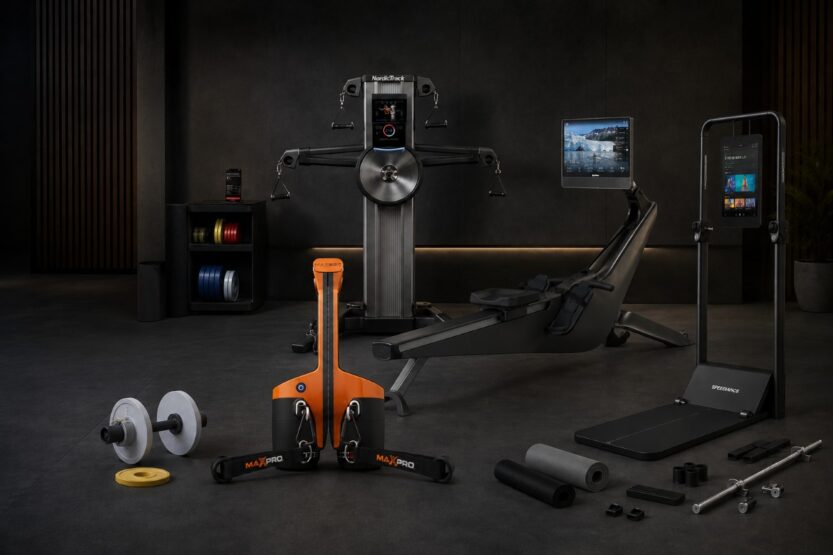
Smart home gym equipment stopped being a novelty somewhere around the point when motors got good enough to load a lift more precisely than a weight stack ever could. The category now splits into three real groups: digital-resistance strength systems that generate load with electromagnets or direct-drive motors, connected cardio machines whose trainers control speed, incline, and resistance for you, and screen-first platforms that coach form using cameras or depth sensors. All three belong in the same conversation, because most people building a home gym in 2026 are choosing between them rather than within them.
Every machine on this list had to clear the same bar. First, the hardware has to still be worth owning if you cancel the app. That single filter eliminates a surprising amount of the category. Second, the smart layer has to do something a phone propped on a shelf cannot: adjust load automatically, capture per-rep data, drive incline and resistance without you touching a button, or give real corrective feedback while you move. Third, the footprint has to be honest about what it needs, including the clearance you need around it, not just the box dimensions. Fourth, total cost of ownership over three years has to make sense, because a mandatory membership at $50 or $60 a month quietly doubles the price of the machine. And fifth, the thing has to hold up. Warranty terms, cable life, screen coverage, and the company’s track record of supporting hardware it already sold all counted.
What follows is organized by category rather than by rank, because the best smart home gym equipment for you depends entirely on whether you want to lift, run, row, or all three. Prices move constantly in this category, and several of these brands discount aggressively around holiday windows, so treat the figures below as a snapshot rather than a quote.
Here our our top fourteen picks for connected machines that earned their place on strength, data, footprint, and what they actually cost you three years in.
Best Overall: Tonal 2

Tonal earned its reputation by solving a problem free weights structurally cannot: the load you can move at your weakest joint angle is the load you’re stuck with for the whole rep. Electromagnetic resistance breaks that ceiling, and the second-generation unit pushes the maximum to 250 pounds in one-pound increments, up from 200 on the original. For the overwhelming majority of home lifters, including experienced ones, that range is no longer the limiting factor it was on version one. The one-pound granularity matters more than the headline number, because it means progressive overload actually happens in increments your body notices rather than in the 5 and 10 pound jumps a dumbbell rack forces on you.
The arms are the reason the machine works. Both pull independently, adjust through a wide arc, and support more than 300 movements between the smart handles, the bar, and the rope. That covers presses, rows, pulldowns, deadlifts, hip thrusts, split squats, and the entire accessory catalog most people never get around to on a barbell. The unit mounts flat to a wall like an oversized TV, which is why it remains the small-space benchmark: it needs about seven feet of unobstructed wall and roughly seven by seven feet of floor to train in, and nothing needs storing when you finish.
What separates Tonal from the machines that copied its form factor is the software layer. A short strength assessment establishes your baseline, and from there the system sets weight for you on every movement and raises it when its model decides you’re ready. Drop sets lower the load automatically as you fatigue. Burnout sets, eccentric emphasis, and spotter mode all run without you touching a screen mid-set. The built-in camera analyzes your movement and delivers coaching cues live, then lets you review clips afterward. Household accounts mean everyone in the home gets their own progression rather than sharing yours.
The specialty features worth calling out are the adaptive weight toggle on the smart handles, which lets you turn resistance on and off at the press of a button and unlocks single-arm work that would otherwise require a partner, and Aero HIIT, a cardio mode that uses the cables for conditioning work instead of sending you to a separate machine.
The honest tradeoffs are the price and the lock-in. Hardware runs $4,295 before the accessory bundle, which you genuinely need, and installation starts around $295. The 12-month membership commitment at $59.95 per month is not optional, and most of the machine’s intelligence lives behind it. It also has to mount into wood studs spaced 16 or 24 inches apart, which rules out a lot of garages and every cinderblock wall.
| Specification | Detail |
|---|---|
| Category | Best Overall |
| Training focus | Strength, mobility, cardio conditioning |
| Resistance system | Electromagnetic, two independent arms |
| Max resistance | 250 lb total, 1 lb increments |
| Display | Built-in touchscreen with Smart View camera |
| Subscription | $59.95/mo, 12-month commitment required |
| Footprint | Approx. 50.9″ H x 21.5″ W x 5.25″ D; needs 7 ft wall and 7 x 7 ft floor |
| Unit weight | Approx. 150 lb |
| Installation | Professional wall mount, from $295 |
| Warranty | Limited manufacturer warranty; extended coverage available |
| Price | $4,295 hardware, accessory bundle extra |
| Standout feature | Adaptive weight with mid-set load adjustment and live form cues |
Why Users Say They Like It
Owner sentiment on Tonal 2 clusters hard around one theme: it removes decisions. The people who love it talk less about the machine and more about the fact that they no longer plan sessions, calculate loads, or talk themselves out of training because setup felt like a chore. Long-term owners who came from the original unit consistently describe the second version as smoother and quieter, with faster weight changes and a noticeably better interface, and several say the added resistance headroom is what finally made it viable as their only strength equipment.
The second recurring note is consistency. Owners who have logged multiple years on the platform tend to credit the automatic progression rather than motivation, describing it as the thing that keeps them from stalling at the same weights for months. Families point to per-user accounts as a bigger deal than they expected, since the machine adapts separately for each person instead of averaging everyone together.
The criticism is just as consistent. Owners flag occasional weight-adjustment inconsistencies, wish the ceiling were higher for heavy compound work, and describe the membership as the part that stings every month. Installation and support experiences vary considerably by region, and buyers upgrading from an original Tonal are split on whether the improvements justify replacing a machine that still works.
Check Out Tonal 2 Official Page For More Info And Reviews
Best No-Subscription All-In-One: Speediance Gym Monster 2
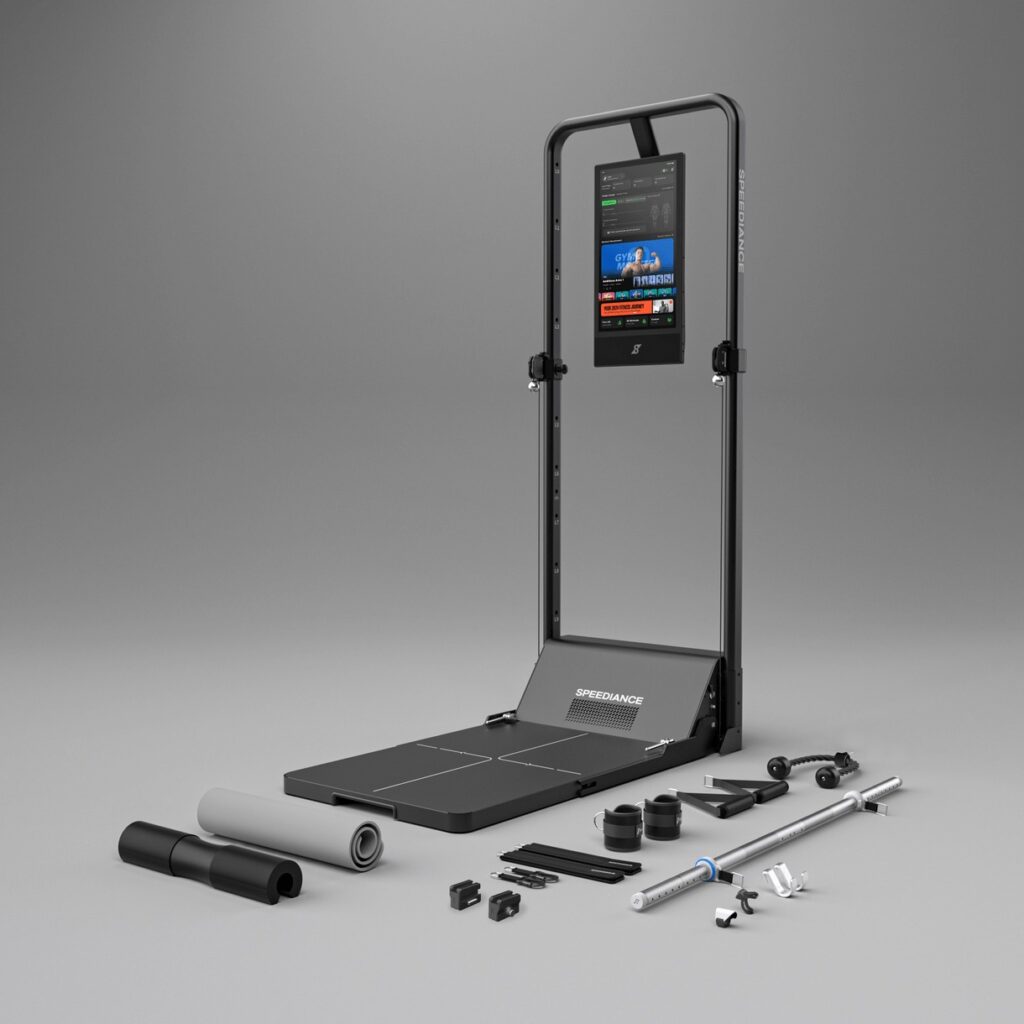
The Speediance Gym Monster 2 answers the single loudest complaint about this category. Core AI coaching, the movement library, and the training modes come with the hardware. There is no mandatory membership, which over a three-year ownership window is the difference between paying for the machine once and paying for it twice.
Mechanically it is a freestanding platform with a vertical frame and two direct-drive motors producing up to 220 pounds of digital resistance, 110 per arm. Nothing gets drilled into a wall, nothing gets assembled, and the whole unit rolls on wheels and folds when you’re done. The pulley mechanism locks at ten distinct heights, which is what makes the exercise catalog credible rather than theoretical: with the barbell, smart handles, tricep rope, ankle straps, ski handles, and rowing rail, you can run squats, bench, deadlifts, flyes, pulldowns, rows, ski intervals, and several hundred other movements from one station.
The resistance modes are where it gets interesting, and they are the machine’s real specialty. Standard mode holds a consistent load. Chain mode ramps resistance as you approach lockout, mimicking the accommodating load of a chain-loaded barbell. Eccentric mode isolates the lowering phase and adds resistance on the way down, which is the training stimulus most home setups simply cannot produce. Constant mode holds speed steady rather than load, which makes it genuinely useful for rehab and controlled tempo work. Layer in velocity-based training data and Bluetooth-ring weight adjustment mid-set, and you have a feature set that competes directly with machines costing more and charging monthly.
The compromises are real but manageable. Processing is a step slower than Tonal’s, so weight changes between sets take a beat longer. The 220-pound ceiling is enough for most people but will eventually cap a strong lifter on lower-body compounds, which is why the GM2S variant exists with extra headroom. Accessories drive a meaningful share of the versatility, so the base configuration is not the whole machine.
| Specification | Detail |
|---|---|
| Category | Best No-Subscription All-In-One |
| Training focus | Full-body strength, rowing, ski, HIIT |
| Resistance system | Dual direct-drive electromagnetic motors |
| Max resistance | 220 lb total, 110 lb per arm |
| Display | Built-in HD touchscreen with 2.1-channel audio |
| Subscription | None required for core AI coaching |
| Footprint | Approx. 49″ L x 28″ W x 73″ H; folds for storage |
| Unit weight | Approx. 187 lb |
| Installation | None; freestanding, rolls on wheels |
| Warranty | Manufacturer warranty plus in-home service plan on some configurations |
| Price | $3,849 list, frequently discounted |
| Standout feature | Chain, eccentric, and constant-speed resistance modes with no membership fee |
Why Users Say They Like It
The no-subscription math is the first thing owners bring up, and it comes up constantly. People who compared this against membership-locked systems describe the decision as straightforward once they projected three years of monthly fees. The second theme is the absence of installation anxiety. Renters and anyone unwilling to drill into a load-bearing wall treat freestanding as a hard requirement, and this satisfies it without giving up the digital-weight advantages.
Owners also report that the resistance modes get used rather than ignored. Chain and eccentric modes in particular draw comments from people who came from barbell training and recognize what those settings are simulating. Several long-term users credit the machine with measurable body composition changes over a year or more, attributing the result to how little friction there is between deciding to train and actually training.
Complaints center on the pulleys occasionally hitching under load, especially with the bar, and on programming depth that is thinner than what the subscription platforms offer. Customer service response times draw criticism in a meaningful minority of reports. Owners who go heavy note that they hit the resistance ceiling on squats and deadlifts sooner than on upper-body work.
Check Out Speediance Gym Monster 2 Page For More Info And Reviews
No products found.
Best Budget Entry Point: Tempo Move
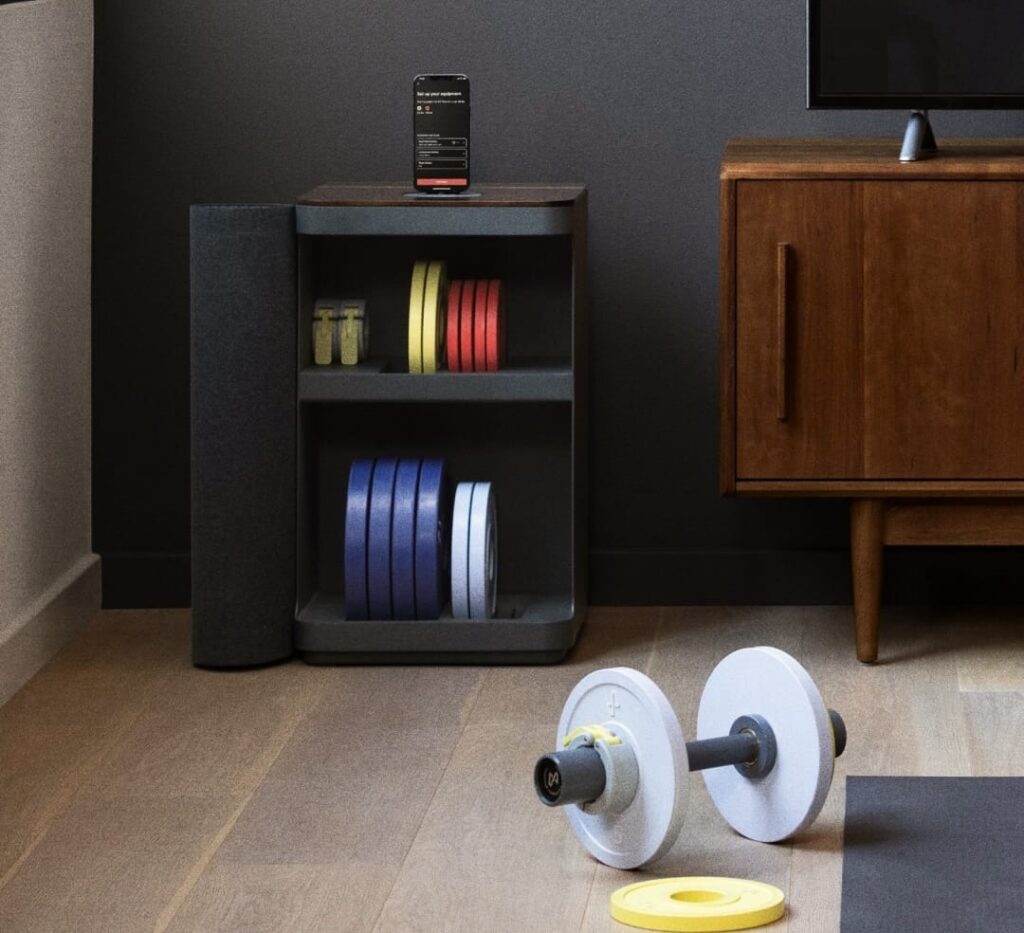
The Move exists because most people are not going to spend four figures to find out whether they’ll stick with home training. It strips the screen out of the Tempo concept and uses hardware you already own: your iPhone provides the depth sensing, your TV provides the display, and a compact cabinet about the size of a mini fridge holds the weights. At $395 to $495 depending on configuration, it is the least expensive way onto a genuinely smart strength platform.
What you get is a storage core, adjustable dumbbells built from mix-and-match plates, a phone dock, and the same class library the Studio runs. The iPhone’s depth sensor handles rep counting and pace tracking, casting to the television so you are watching a coach on a big screen rather than a handset. Setup takes minutes, and the whole thing weighs about 25 pounds, so it moves between rooms without a second person.
The specialty here is what happens if you quit. Cancel the membership and you still own a good adjustable dumbbell set, an attractive storage cabinet, and a phone stand. Nothing bricks. That is not true of most machines in this category, and for a first purchase it removes essentially all of the downside risk.
The limits are exactly what you’d expect at the price. There is no built-in cable resistance, no eccentric or adaptive load, and no smart-weight features. Form feedback is coarser than the Studio’s dedicated sensors. The class catalog available to Move users has historically lagged the Studio’s full archive. And it requires a compatible iPhone, so Android households are out.
| Specification | Detail |
|---|---|
| Category | Best Budget Entry Point |
| Training focus | Strength, HIIT, boxing, yoga |
| Resistance system | Adjustable dumbbells built from weight plates |
| Max resistance | Determined by plate package |
| Display | Your TV, driven by iPhone depth sensor |
| Subscription | From $39/mo for classes |
| Footprint | Compact cabinet, roughly mini-fridge sized |
| Unit weight | Approx. 25 lb |
| Installation | None |
| Warranty | Manufacturer warranty on cabinet and weights |
| Price | $395 to $495 |
| Standout feature | Hardware retains full value as a dumbbell set if you cancel |
Why Users Say They Like It
The Move’s fan base is made up of people who wanted to test the concept without committing thousands of dollars, and they say so directly. Owners consistently describe the value proposition as hard to argue with, and the point they return to most often is that the weights and cabinet remain useful whether or not the subscription continues.
Ease of use draws steady praise. Owners like that every session lists its exercises before it starts, that casting from phone to television takes seconds, and that rep counting and pace tracking work well enough to be worth having. Several describe it as the piece of equipment that finally got them lifting consistently at home, specifically because there was no setup ritual standing in the way.
The gripes are about the ceiling. Owners outgrow the available weight, wish the form feedback were sharper, and note that rep detection fails often enough to be occasionally annoying. Anyone expecting the Studio’s experience at a fifth of the price reports being recalibrated quickly, and iPhone dependency is a hard stop for some buyers.
Check Out Tempo Move Official Page For More Info And Reviews
Highest Resistance Ceiling: Vitruvian Trainer+
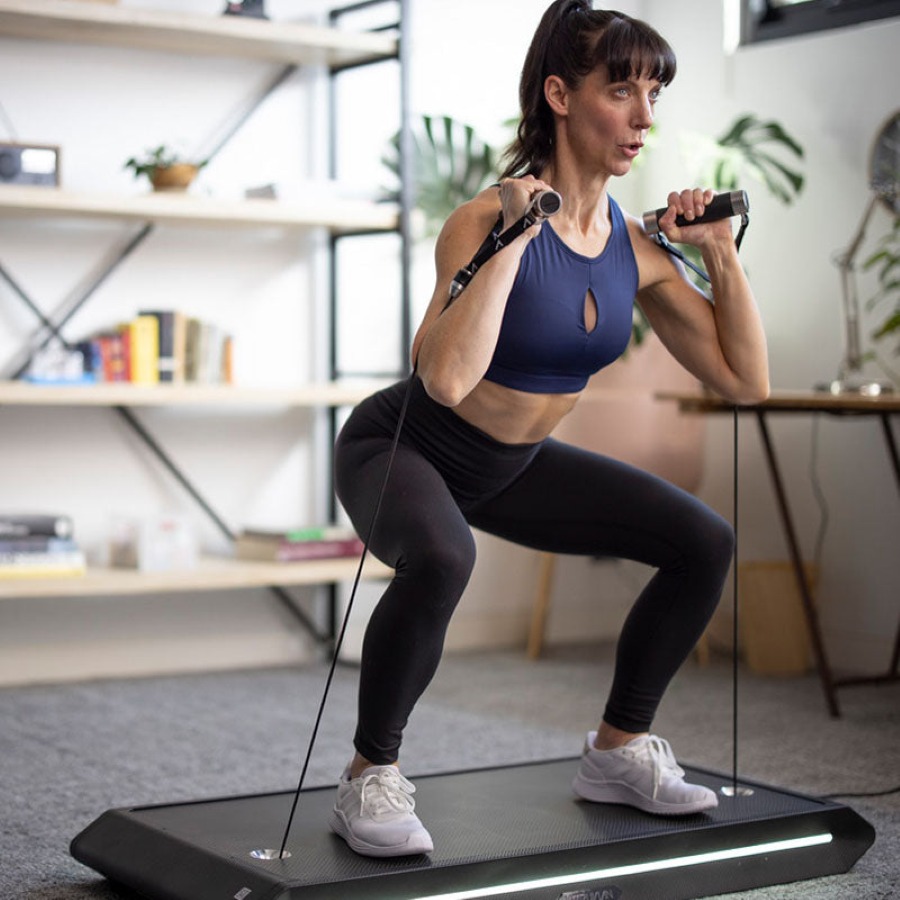
No other machine on this list loads a lift like the Vitruvian Trainer+. The platform generates up to 440 pounds of adaptive digital resistance, roughly double what most of its wall-mounted competitors manage, and because digital load resists momentum in a way plates do not, owners consistently report it feels heavier still at any given setting. If your limiting factor with smart gyms has been that you can already lift more than the machine can produce, this is the answer to that specific problem.
The form factor is the other half of the appeal. It is a slim platform, roughly 44 by 20 inches and five inches tall, wrapped in a reinforced carbon fiber shell over an extruded aluminum frame. It rolls on built-in wheels and slides under a bed or couch. There is no assembly and no wall mounting. You plug it in, stand on it, attach handles, straps, or the barbell, and lift.
The intelligence runs deep. The system reads your motion up to a thousand times per second and adjusts load continuously within the rep, increasing when you have more to give and backing off when you fatigue. Training modes include Time Under Tension, Pump, Old School, and Eccentric Only, and the Echo mode adjusts weight nearly instantaneously rep to rep against your actual output. Safety was designed in: before each lift the system has you perform unloaded reps to map your range of motion, then uses that map to count reps accurately and cut load if you leave the expected path. The barbell accessory includes safety cables.
The caveat is not about the product. Vitruvian’s commercial history has been turbulent, with a period during which the company stopped selling new units, pulled its storefront, and went quiet before restructuring and committing to support existing hardware, apps, firmware, parts, and service. The machine is excellent and the platform is being maintained, but anyone buying should confirm current new-unit availability and support terms directly before committing, and should factor in that the refurbished and secondary markets are a real part of how these change hands now.
| Specification | Detail |
|---|---|
| Category | Highest Resistance Ceiling |
| Training focus | Strength, hypertrophy, tempo and eccentric work |
| Resistance system | Adaptive digital resistance, platform-based |
| Max resistance | 440 lb |
| Display | None onboard; app-driven with LED movement cues |
| Subscription | $39/mo optional for full data and programming |
| Footprint | 44″ L x 20″ W x 5″ H; slides under furniture |
| Unit weight | Approx. 80 lb |
| Installation | None; plug and play |
| Warranty | Confirm current terms directly with the manufacturer |
| Price | Around $2,890 at last general availability |
| Standout feature | 440 lb ceiling with per-rep adaptive loading and Eccentric Only mode |
Why Users Say They Like It
Owners talk about the Trainer+ the way strong lifters talk about equipment that finally stopped holding them back. The resistance ceiling is the headline, and people who deadlift and squat seriously describe it as the first digital system that did not force them to modify their programming downward. The sensation of constant force unaffected by momentum comes up repeatedly as something that has to be felt to be understood.
Build quality earns real affection. The carbon fiber shell and aluminum frame read as premium to owners, and the plug-and-play setup gets cited as a major advantage over anything requiring wall mounting or assembly. Renters in particular describe it as the only high-resistance option that did not require permission from a landlord. The range-of-motion calibration and automatic load cutoff also get called out as safety features people came to trust when training alone.
The frustration is almost entirely about the company rather than the machine. Owners who lived through the silent period describe genuine anxiety about being left with expensive hardware and no software, and while support has resumed, the experience left a mark on community sentiment. Owners also flag occasional tech hiccups and note that the subscription gating of deeper data analysis felt unwelcome given the purchase price.
Check Out Vitruvian Trainer+ Official Page For More Info And Reviews
Best Rack-Mounted Smart Cable: Beyond Power VOLTRA I
The VOLTRA I is the most surprising piece of equipment in this category, because it produces up to 200 pounds of resistance from a unit smaller than a shoebox that weighs roughly 13 pounds, most of which is battery. It is not trying to replace your gym. It is trying to make the gym you already have significantly more capable, and it succeeds at that better than anything else in its price class.
You mount it to a rack post, a wall, a strap around a tree, or a pillar, and it becomes a cable station wherever you put it. That flexibility is the point: the same unit gives you high pulls off the top of a rack, low rows off the base, belt squats, and single-arm work at any angle you can rig. The cable is heavier duty than what some full-size cable machines ship with, and the magnesium shell has held up under multi-year testing.
The mode list is what elevates it from clever to genuinely useful. Weight training with eccentric overload lets you load the lowering phase heavier than the lift, which is the stimulus almost no home setup can produce. Resistance band mode increases load as the cable extends. Damper mode applies resistance proportional to force, so sprints and jumps meet something like a parachute. Isokinetic mode holds speed constant. Isometric testing measures force output without movement. Custom curves let you draw your own resistance profile in the app. Rowing and skiing modes round it out. There is no subscription for any of it, and firmware updates have consistently added capability rather than paywalling it.
The obvious limits are that you need something to mount it to, that mounts are sold separately, and that certain movements require creativity to set up. Bench press and leg extensions in particular take some rigging. At around $2,100 plus a mount, it is expensive for what looks like an accessory, which is why it makes the most sense as the smart component of a minimalist barbell gym rather than as a standalone solution.
| Specification | Detail |
|---|---|
| Category | Best Rack-Mounted Smart Cable |
| Training focus | Strength, power, rehab, conditioning |
| Resistance system | Direct-drive electronic cable |
| Max resistance | 5 to 200 lb |
| Display | Onboard screen plus companion app |
| Subscription | None |
| Footprint | 12.71″ L x 5.49″ W x 3.94″ H |
| Unit weight | Approx. 13 lb |
| Installation | Requires a separately sold rack, wall, or strap mount |
| Warranty | 1 year standard, extendable to 3 years |
| Price | Around $2,100 plus mount |
| Standout feature | Eight training modes including eccentric overload and isometric force testing |
Why Users Say They Like It
Owners describe the VOLTRA I as the piece of equipment that changed how they use the rest of their gym. The recurring comment from long-term users is that it started as a cable machine and became the centerpiece, largely because firmware updates kept adding modes and features rather than leaving the hardware static. Several make the explicit comparison that their plate stack and tower will never get better while this one does.
Trainers and clinicians are unusually enthusiastic about it. Physical therapists and coaches cite the isokinetic and isometric modes as tools they previously needed clinic-grade equipment to access, and the ability to load the eccentric phase independently draws praise from people programming for hypertrophy and return-to-play work alike. Portability comes up constantly, including from owners who bring it through airport security and train in hotel rooms.
The complaints are price, price, and mounts. Owners consider it expensive for the footprint and note that the mount purchase is effectively mandatory rather than optional. Some movements require workarounds, and a few owners wish accessories like functional ropes were more consistently in stock. Battery management is a small ongoing chore for anyone traveling with it.
Check Out Beyond Power VOLTRA I Official Page For More Info And Reviews
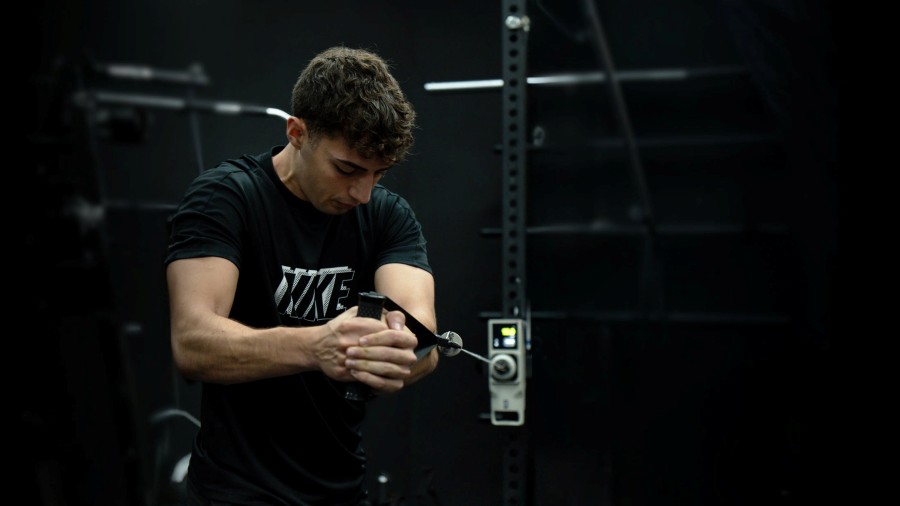
Best Portable: MAXPRO SmartConnect
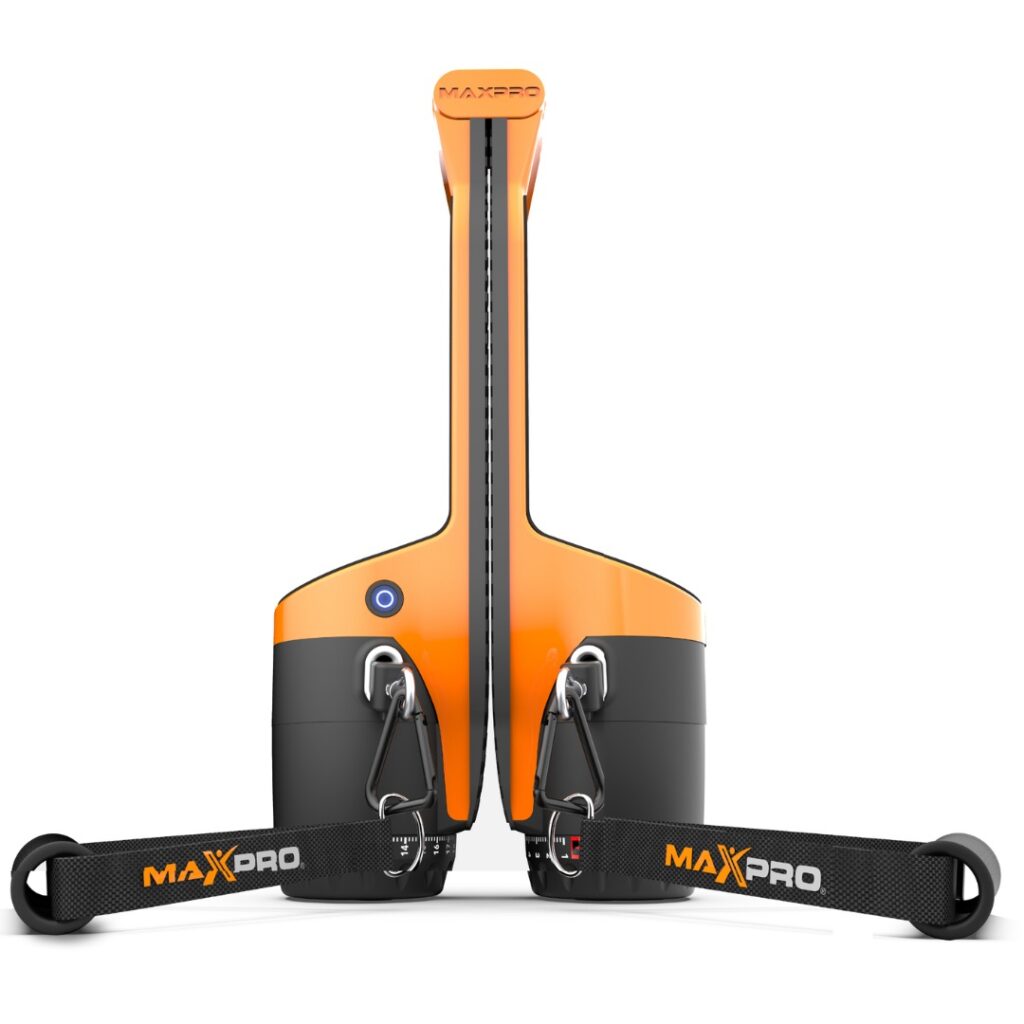
If your training has to happen in hotel rooms, driveways, backyards, and apartments the size of a parking space, the MAXPRO SmartConnect is the machine that solves it. The unit weighs under 10 pounds, folds into a backpack, and produces 5 to 300 pounds of cable resistance adjusted with a turn of a dial. There is nothing else in the category that puts that much load into that little hardware.
Setup is genuinely minimal. Unfold it, stand on it or clip it to the included door mount, attach handles, the three-piece quick-connect bar, or ankle and wrist straps, and train. Nine feet of high-strength cable gives you enough travel for full-range pulls. Add the optional wall track and the exercise count expands substantially, because you gain fixed anchor heights instead of working from the floor or a door frame. The main body is aluminum alloy with high-impact composite components and a non-marking bottom pad, so it survives being thrown in a car repeatedly.
Two details make it more practical than the spec sheet suggests. Battery life runs about a month on daily use and up to three months on standby, so charging is not a constant concern. And the app is free at the base tier, with a $19.99 monthly premium option for deeper data and additional classes, meaning the machine works fully out of the box without a paid account.
The significant technical limitation is that resistance is concentric only. You get loaded on the way up and unloaded on the way down, which means you are leaving the eccentric stimulus on the table compared with machines that resist both directions. Pressing movements are awkward without the bench, since you need something anchoring the unit while you get into position. Cables have a break-in period before they feel smooth and a service life of roughly 18 months to two years, with replacement kits sold separately. The app connection is not always reliable.
| Specification | Detail |
|---|---|
| Category | Best Portable |
| Training focus | Full-body strength, HIIT |
| Resistance system | Internal power clutch cable system, concentric only |
| Max resistance | 5 to 300 lb |
| Display | None onboard; Bluetooth app with onboard sensors |
| Subscription | Free app tier; $19.99/mo premium optional |
| Footprint | 16″ L x 10″ W x 4″ H |
| Unit weight | Under 10 lb |
| Installation | None; door mount included, wall track optional |
| Warranty | Manufacturer warranty; 30-day return window |
| Price | Around $725 to $850 |
| Standout feature | 300 lb of resistance in a unit that fits in a backpack |
Why Users Say They Like It
The single most common owner sentiment is disbelief at the ratio. People who have trained for decades describe being skeptical that something this small could produce usable load and then revising that opinion in the first session. Frequent travelers are the most vocal group, describing it as the thing that ended the cycle of losing progress every time work put them on the road.
Smoothness and coverage both draw praise once the cables break in. Owners report being able to work every major and minor muscle group from a standing or seated position, and several specifically credit it with letting them keep training around injuries because load is adjustable in fine increments and there is nothing to drop. Apartment dwellers point out that it makes a real gym possible in a space where a rack was never an option.
Criticism starts with price relative to size, which owners acknowledge while generally concluding it was worth it. The concentric-only resistance is the most substantive technical complaint from experienced lifters. Accessories draw mixed reviews, the app is described as clunky with intermittent connection drops, and the recommendation to buy the wall track up front comes up often enough that it should probably be part of the base purchase.
Check Out MAXPRO SmartConnect Page For More Info And Reviews
MAXPRO SmartConnect Portable Gym System 450+ Exercises, 300 lbs Resistance | Smart Cable Machine, Exercise Anywhere, 30s Setup, Free App & Bluetooth Connection, Wellness Equipment As Seen on Shark Tank
Best Fitness Mirror: Echelon Reflect 50 SE
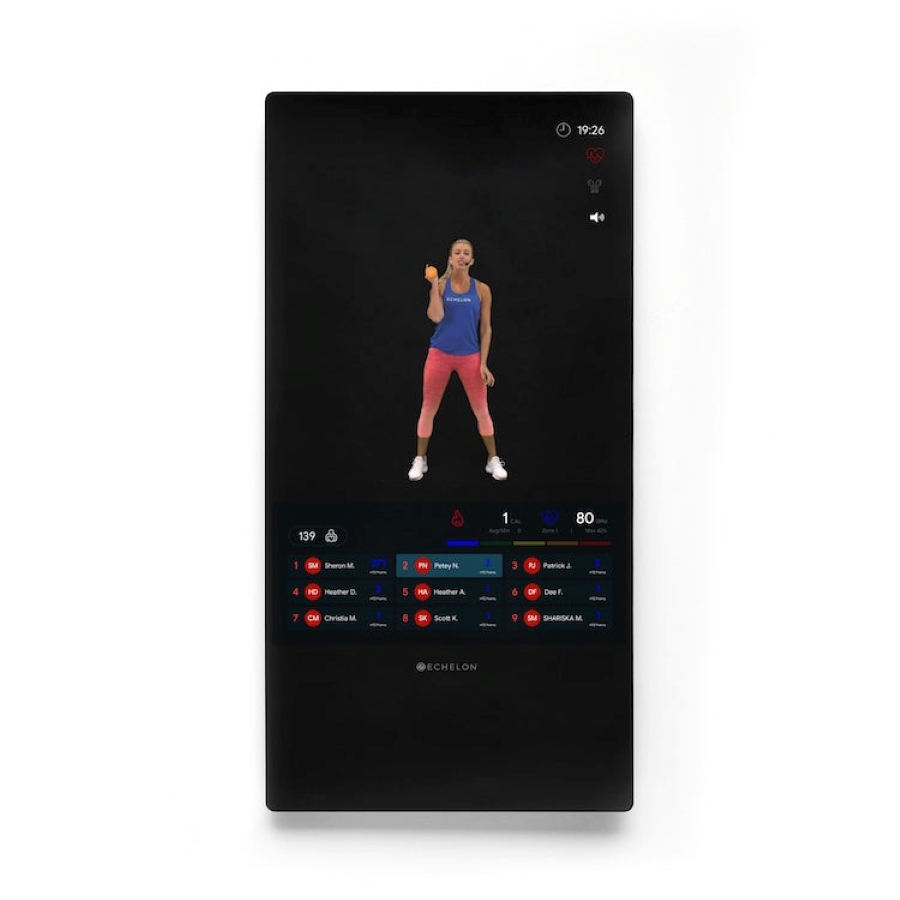
The fitness mirror is the right answer for a specific person: someone who wants coached classes in a room that cannot look like a gym. The Reflect occupies zero floor space, mounts flush to a wall, and reads as a full-length mirror when it’s off. That’s the entire value proposition, and Echelon executes it more affordably than anyone else selling a comparable screen.
The build quality holds up better than the price suggests. A 50-inch mirrored surface with an embedded HD touchscreen, fingerprint-resistant glass, and substantial wall brackets. Navigation happens directly on the display, so you’re not fumbling with a phone mid-class. The library runs several thousand instructor-led sessions across strength, HIIT, yoga, Pilates, barre, kickboxing, Zumba, cardio, and meditation, with live classes daily and community features including shared results and class leaderboards.
The specialty worth knowing about is the mirror itself as a coaching tool. Because you can see your own movement against the instructor’s in real time, self-correction happens naturally in a way it does not when you’re watching a screen and guessing at your own position. Higher-tier configurations add real-time heart rate display and an optional camera for one-on-one coaching sessions, which closes some of the gap with the sensor-equipped systems.
Where it falls short is smart features in the strict sense. There is no adaptive resistance, no automatic weight selection, and no computer-vision form correction on the base configuration. Audio and video quality trail the premium platforms, with occasional fuzziness and an imbalance between music and instructor. Delivery is not white-glove, so you or two people are hoisting a 52-pound mirror onto brackets. And warranty coverage is tied to maintaining an active Premier membership, which means the subscription is doing double duty.
| Specification | Detail |
|---|---|
| Category | Best Fitness Mirror |
| Training focus | Cardio, strength, yoga, Pilates, HIIT, mobility |
| Resistance system | None; bring your own weights |
| Max resistance | Not applicable |
| Display | 50″ mirror with embedded HD touchscreen |
| Subscription | Premier membership required for classes |
| Footprint | Approx. 50″ H x 20″ W x 2″ D; zero floor space |
| Unit weight | Approx. 52 lb |
| Installation | Wall mount, self-install; stand sold separately |
| Warranty | Up to 5 years with active Premier membership |
| Price | Around $1,500 |
| Standout feature | Full-length mirror aesthetics with thousands of live and on-demand classes |
Why Users Say They Like It
The aesthetic argument wins people over first. Owners in apartments, bedrooms, and shared living spaces describe it as the only piece of fitness equipment their household agreed to look at every day, and the fact that it disappears into the decor when off comes up in nearly every positive account. Several note it displays local weather when idle, which sounds trivial and turns out to be the kind of small thing that makes hardware feel integrated rather than parked.
Class variety is the other consistent positive. Owners who came from weight-focused training report enjoying a surprising share of the catalog, and the range across yoga, barre, kickboxing, and Pilates gets credit for keeping households with different preferences on one platform. The community layer, including shared results and leaderboards, gets specific mentions from owners who need external accountability.
The negatives are consistent too. Owners describe the audio and video as noticeably behind premium competitors, with instructor volume and music balance being the specific irritation. The absence of real-time form feedback disappoints buyers who expected mirror to mean smart. Self-installation is a two-person job that catches people off guard, and tying warranty coverage to an active membership strikes owners as a policy that should be disclosed more prominently.
Check Out Echelon Reflect 50 SE Official Page For More Info And Reviews
Best Smart Treadmill: NordicTrack Commercial 1750
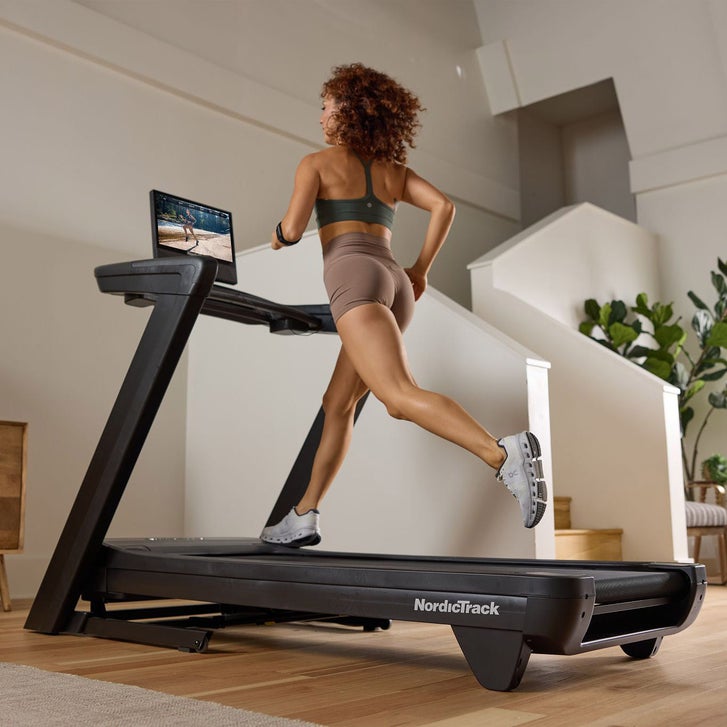
The 1750 has been the default answer for connected running for years, and the reason is that it does not compromise on the treadmill part in order to be smart. A 3.5 continuous-horsepower motor, a 20 by 60 inch deck, cushioning tuned to either soften impact or simulate road feel, a 0 to 12 mph speed range, and an incline range that runs from a negative 3 percent decline up to 12 percent. Decline is the spec worth noticing, because almost nothing at this price offers it, and downhill running is a training stimulus most home runners never get.
The connected layer is iFIT, and it is the strongest reason to buy this specific machine. During a workout the trainer controls speed, incline, and decline directly, so a hill session actually climbs when the coach says climb. ActivePulse takes it further by using a paired heart rate monitor to adjust speed and grade automatically to keep you in a target zone, which turns zone training from a manual chore into something that just happens. The pivoting 16-inch touchscreen turns away from the deck so off-treadmill strength, yoga, and HIIT sessions are usable rather than theoretical.
The specialty features that matter day to day are less glamorous. EasyLift Assist folds the deck up with minimal effort, which is what makes a 339-pound treadmill livable in a shared room. The built-in fan is genuinely effective. And the warranty structure is among the best in the category, with lifetime frame coverage, a decade on the motor, and two years of parts and labor.
The limitations are physical and contractual. It is large and heavy, and folding reduces the footprint without making it portable. iFIT at $39 per month is technically optional but removes essentially everything that distinguishes this from a generic treadmill. And the warranty is voided if the machine is used or stored in a garage, which is a meaningful restriction for a lot of home gyms.
| Specification | Detail |
|---|---|
| Category | Best Smart Treadmill |
| Training focus | Running, walking, incline and decline training, off-deck strength |
| Resistance system | 3.5 CHP motor, motorized incline and decline |
| Max resistance | 12% incline to -3% decline, 0 to 12 mph |
| Display | 16″ pivoting HD touchscreen |
| Subscription | iFIT, $39/mo |
| Footprint | Approx. 80″ L x 38″ W x 65″ H; folds |
| Unit weight | Approx. 339 lb |
| Installation | Assembly required; delivery and assembly available |
| Warranty | Lifetime frame, 10-year motor, 2-year parts and labor |
| Price | $1,999 to $2,499 |
| Standout feature | ActivePulse automatic heart rate zone control with decline capability |
Why Users Say They Like It
Owners who replaced older treadmills are the most positive group, and their comments follow a pattern: the deck feels closer to road running than they expected, the cushioning options actually change the feel, and the machine has held up under daily use. Several describe still looking forward to sessions months in, which they credit to iFIT rather than the hardware.
The automatic trainer control is what owners single out as the feature that changed their training. Having speed and grade shift with the coach removes the mental overhead of managing a workout, and people describe following global route workouts as the thing that made indoor running tolerable. The 16-inch screen and improved speakers on recent revisions both draw favorable comparisons to the earlier 10-inch configuration.
Complaints center on size, moving difficulty, and support. The footprint surprises buyers even when they measured, and getting it into a basement or upstairs room is a real project. Customer service and warranty experiences draw the sharpest criticism, with owners reporting slow resolution on parts issues. The garage-use warranty exclusion frustrates people who assumed a treadmill this heavy was built for a garage.
This smart treadmill also make our list of the best treadmills of 2026 for a home gym.
Check Out NordicTrack Commercial 1750 Page For More Info And Reviews

NordicTrack Commercial 1750 Treadmill with iFIT
Best Incline Trainer: NordicTrack Commercial X22i
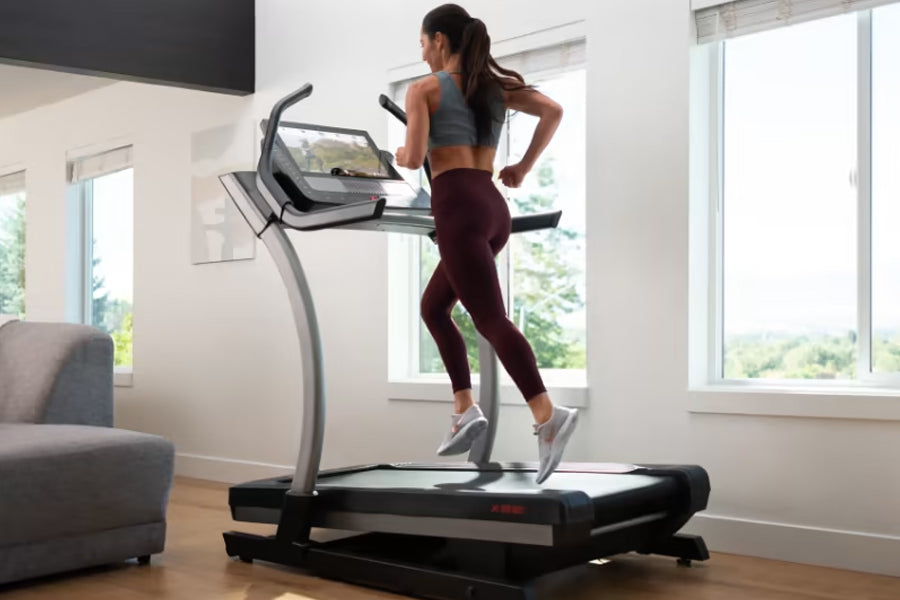
The X22i exists for people who want to climb, and its headline number has no real competition: 40 percent incline, roughly double what a standard treadmill offers, with a negative 6 percent decline at the other end. At that grade, walking becomes a legitimate strength and conditioning stimulus with almost no impact cost, which is why it appeals to two very different groups, runners doing low-impact volume and people who cannot tolerate running at all.
The 22-inch touchscreen tilts and pivots, giving you a usable display for off-deck work, and the iFIT integration brings thousands of cardio, strength, and mobility sessions with the same automatic trainer control that makes the 1750 worth owning. Bootcamp-style sessions that alternate between the deck and the floor are where this machine turns into an actual home gym rather than a cardio appliance, assuming you supply your own dumbbells and a mat.
The feature nothing else offers at this price is sled push mode. The belt can be driven by your own leg drive against resistance rather than by the motor, which gives you a genuine push stimulus without owning a sled or having a driveway to push it on. Combined with the extreme incline, it makes the machine a legitimately different training tool rather than a treadmill with a bigger screen.
The costs are size, weight, and money. At 417 pounds with no folding capability, this is a permanent installation in whatever room you put it in, and moving it is a multi-person job. There are no pulse sensors on the handlebars, so heart rate training requires your own strap. iFIT is again the thing that makes it worthwhile, at an additional monthly cost.
| Specification | Detail |
|---|---|
| Category | Best Incline Trainer |
| Training focus | Incline walking and running, sled push, off-deck strength |
| Resistance system | Motorized belt with powered incline and decline |
| Max resistance | 40% incline to -6% decline |
| Display | 22″ tilting and pivoting HD touchscreen |
| Subscription | iFIT, $39/mo |
| Footprint | Approx. 70″ L x 39″ W x 72.5″ H; does not fold |
| Unit weight | Approx. 417 lb |
| Installation | Assembly required; permanent placement recommended |
| Warranty | 10-year frame, 2-year parts, 1-year labor |
| Price | Around $3,499 |
| Standout feature | 40% incline plus a self-powered sled push mode |
Why Users Say They Like It
Owners describe the steep incline as a completely different sensation from a normal treadmill, most often comparing it to a stair climber without the steps. The recurring theme is that it delivers a hard session at low speed, which makes it usable for people managing joint issues and useful as a finisher for people who train hard elsewhere. Several describe it as the machine that let them keep building capacity when running was off the table.
Stability earns unusually strong praise. At maximum incline, owners report no shifting or shaking, and they connect that directly to the mass of the frame. Sled push mode draws enthusiastic comments from owners who did not expect to use it and now build sessions around it. The 22-inch screen and pivot range make off-deck programming genuinely practical rather than a checkbox.
The complaints are predictable. The footprint and weight dominate negative feedback, and owners consistently warn that this needs a dedicated space and help to position. The absence of handlebar pulse sensors annoys people who did not plan on buying a chest strap. Price draws criticism relative to the 1750, and the same customer service concerns that follow the brand show up here.
Check Out NordicTrack Commercial X22i Official Page For More Info And Reviews
Best iFIT Studio Bike: NordicTrack Commercial S22i
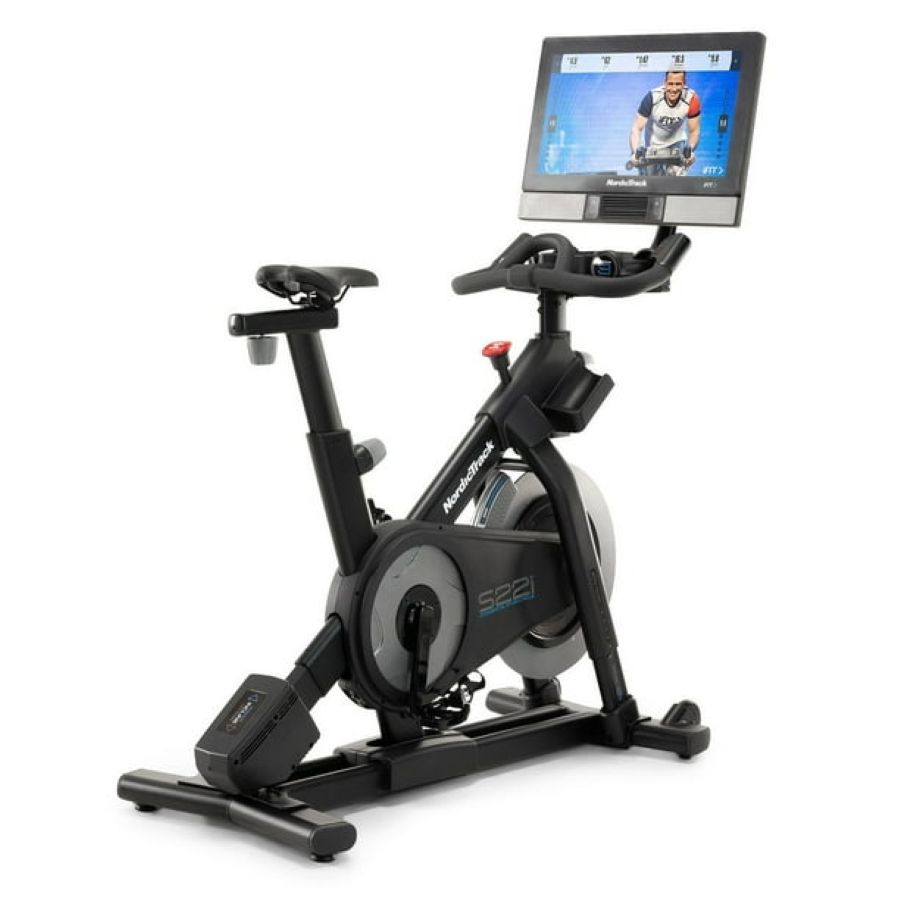
The S22i is the studio bike for people who want their cardio to include terrain. It tilts from a negative 10 percent decline to a 20 percent incline while you ride, controlled automatically by the iFIT trainer, which means a climb in the Alps actually pitches the bike up and a descent drops it. That single feature is why it competes with more famous bikes rather than being an also-ran.
The rest of the specification is solid rather than exotic. Twenty-four levels of silent magnetic resistance that adjust smoothly and quietly, a 22-inch touchscreen that tilts and rotates a full 360 degrees for off-bike work, a padded saddle built for longer sessions, dual-sided pedals with toe clips and straps, small dumbbells included for on-bike arm work, and a 350-pound weight capacity that runs well above the 250 to 300 pound ratings common on competing bikes.
The library is the strongest argument for the platform. Well over sixteen thousand interactive workouts covering studio cycling, global route rides filmed on location, strength, yoga, and Pilates, with automatic resistance and incline adjustment throughout. Google Maps Street View integration lets you ride actual roads. For riders who get bored on a leaderboard, the scenic and destination content is a meaningfully different experience.
The friction points are assembly, movement, and the subscription. Building it is genuinely difficult alone, particularly running wiring from the base up to the 22-inch console, which is heavy and awkward. There is no rear transport handle, so repositioning is more annoying than it should be on a 205-pound machine. And the software draws real criticism: owners report slow startup, a clunky interface, and occasional restarts, with iFIT again being both the reason to buy and the recurring source of complaint.
| Specification | Detail |
|---|---|
| Category | Best iFIT Studio Bike |
| Training focus | Studio cycling, global route rides, off-bike strength and yoga |
| Resistance system | Silent magnetic resistance with powered incline and decline |
| Max resistance | 24 resistance levels; -10% to 20% grade |
| Display | 22″ rotating and tilting HD touchscreen |
| Subscription | iFIT, $39/mo |
| Footprint | Approx. 61″ L x 22″ W x 58″ H |
| Unit weight | Approx. 205 lb |
| Installation | Self-assembly; help strongly recommended |
| Warranty | 10-year frame, 2-year parts, 1-year labor |
| Price | Around $1,999, frequently discounted |
| Standout feature | Automatic incline and decline tilt synced to route terrain |
Why Users Say They Like It
Incline is the feature owners bought it for and the feature they talk about. People who compared it against flat studio bikes describe the terrain simulation as the deciding factor, and the immersion of riding actual routes through Japan or Italy with the bike pitching underneath them comes up repeatedly as the thing that keeps sessions from feeling like a chore.
Stability and capacity draw solid marks. Owners report no wobble during high-intensity efforts and specifically appreciate the 350-pound rating as above average for the category. Households already running a NordicTrack treadmill describe the shared iFIT experience as a genuine advantage, since one membership covers multiple machines and multiple profiles. The rotating screen gets used for floor work more than owners expected.
The negatives are pointed. Software speed is the loudest complaint, with owners describing multi-minute waits to start a session and interface behavior they consider poor for the price. Support experiences skew negative, including accounts of screens failing and taking the machine out of service. Assembly difficulty and the missing transport handle round out the list.
Check Out NordicTrack Commercial S22i Official Page For More Info And Reviews
Best Class Experience On A Bike: Peloton Bike
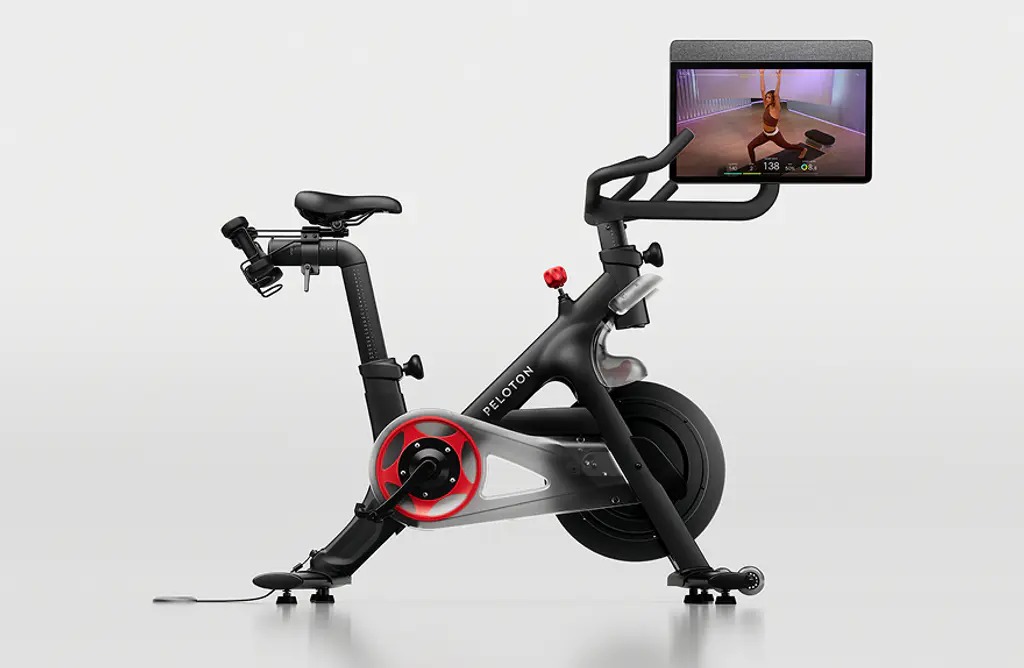
Peloton makes any list of the best smart home gym equipment for a reason that has almost nothing to do with the bike. The hardware is good: a 21.5-inch touchscreen that swivels for floor work, 100 microadjustable resistance levels controlled by a physical knob, smooth and quiet magnetic resistance, an adjustable seat and handlebars, a front-facing camera, Bluetooth connectivity, and a compact footprint that fits where most equipment does not. But what you are actually buying is the content operation behind it, and nothing else in connected fitness has matched it.
The instructor bench is the product. A decade of building a roster of coaches who can hold a room through a screen has produced something competitors can spec-match on hardware and cannot replicate on delivery. The class catalog runs into the thousands across cycling, strength, yoga, HIIT, Pilates, meditation, and more, with live sessions daily. The leaderboard remains the most effective motivational mechanic in the category, and having your name called mid-class is a small thing that demonstrably keeps people riding.
The access structure is more flexible than its reputation suggests. A free tier offers limited classes. App One at around $13 per month covers three monthly cardio equipment classes plus unlimited strength work, programs, and challenges. App Plus at around $24 per month unlocks unlimited cardio and strength classes. All-Access, which is what you need to use the bike as intended, runs around $44 per month for the whole household. The 100-level microadjustable resistance also deserves specific mention, because it allows far finer effort targeting than the 24-level systems on competing bikes.
The complaints are consistent and worth taking seriously. The saddle is uncomfortable and most riders replace it. It requires Delta-compatible cycling cleats rather than accepting normal shoes. The warranty is thin relative to the price. Membership is effectively mandatory. Shipping is not included. And there is no incline, so terrain simulation is purely visual.
| Specification | Detail |
|---|---|
| Category | Best Class Experience On A Bike |
| Training focus | Studio cycling, strength, yoga, HIIT, Pilates |
| Resistance system | Magnetic resistance, manual knob |
| Max resistance | 100 microadjustable levels |
| Display | 21.5″ swiveling touchscreen with front camera |
| Subscription | All-Access around $44/mo; app-only tiers from around $13/mo |
| Footprint | Approx. 59″ L x 53″ H x 23″ W |
| Unit weight | Approx. 135 lb |
| Installation | Delivery and setup available; shipping not included |
| Warranty | Limited; shorter than most competitors |
| Price | Roughly $1,100 to $1,500 depending on promotion |
| Standout feature | The deepest live class library and the leaderboard community |
Why Users Say They Like It
Owners are unusually direct that they bought the community and got a bike with it. The instructors are described as the reason sessions happen, and long-term riders regularly credit specific coaches with pulling them through weight loss and fitness turnarounds. The leaderboard and shoutouts get cited as effective in a way owners find slightly embarrassing and completely reliable.
The hardware earns quieter praise. Riders describe the magnetic resistance as smooth and genuinely quiet, appreciate that the bike is light enough to reposition without help, and like that the compact footprint fits into apartments and shared rooms. The swiveling screen makes off-bike strength classes practical, which owners point to as the thing that turned a bike into a general fitness platform.
The criticism is specific and repeated. The saddle draws near-universal complaints and frequent replacement. Cleat requirements annoy people who did not budget for shoes. Riders consider the warranty inadequate for the price and object to membership being mandatory rather than optional. Owners of the original bike also carry forward wariness from the seat post recall, which is worth knowing if you are shopping the used market.
Check Out Peloton Bike Official Page For More Info And Reviews
Best Cardio And Cable Hybrid: NordicTrack Fusion CST
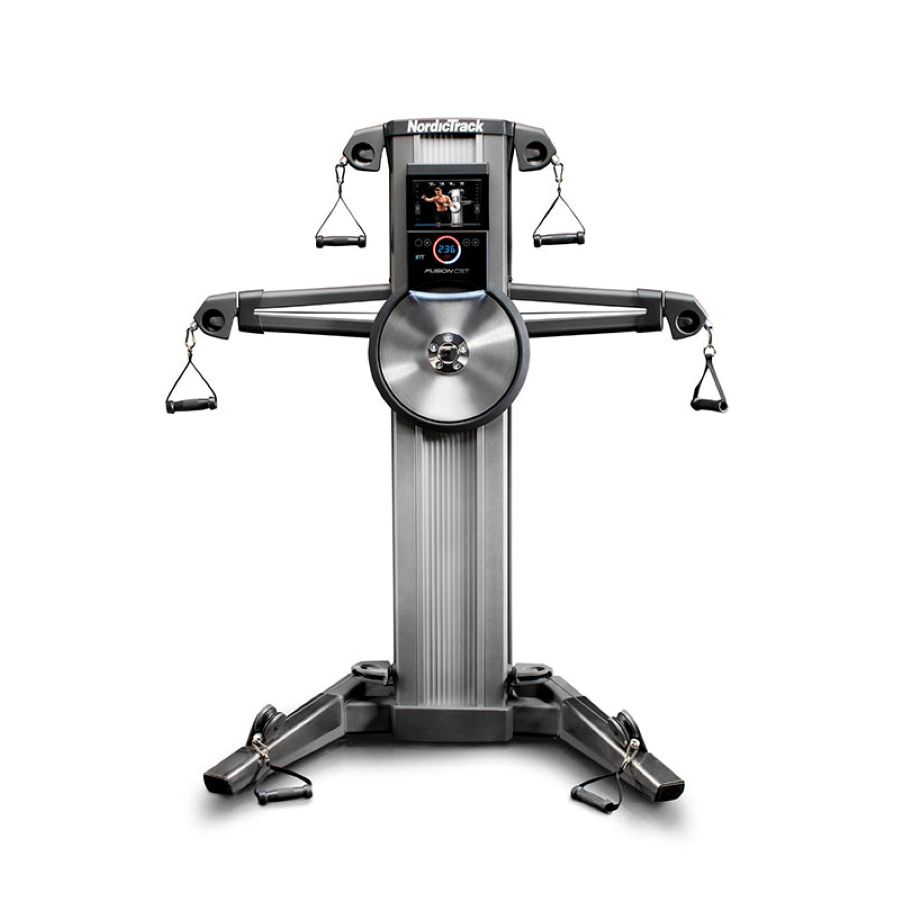
The Fusion CST is the machine for people who do not want to choose between a cable station and a cardio machine. It combines a functional trainer layout with an attached flywheel and iFIT integration, and puts a mirror in the middle of the frame so you can watch your own mechanics through a movement. For a household with one room and two competing priorities, it is a genuinely sensible compromise.
The cable system runs 20 levels of quiet magnetic resistance from 10 to 100 pounds, with cables that travel up to 95 inches for full range of motion on pulldowns, presses, and overhead work. The package includes six ergonomic handles, two squat pulleys, two ankle straps, a Bluetooth chest strap, and a device stand, so you get a usable movement library out of the box rather than a shopping list.
The smart layer works the same way it does on NordicTrack’s cardio machines. You place a phone or tablet on the ledge, follow iFIT programming, and the trainer adjusts resistance for you during the session through automatic trainer control. Combined with the flywheel, that means a single machine can run a strength circuit and a conditioning block back to back without you reconfiguring anything. The 10-year frame warranty is generous for a cable machine at this price point.
The constraints are the resistance ceiling and the mass. One hundred pounds maximum is fine for accessory and conditioning work but will not support heavy pressing or pulling, so this is not a replacement for a rack if you lift seriously. At 378 pounds it is a permanent fixture. There is no built-in screen, so you supply the display. And the brand’s customer service reputation applies here as much as anywhere in the lineup.
| Specification | Detail |
|---|---|
| Category | Best Cardio And Cable Hybrid |
| Training focus | Full-body cable strength plus flywheel conditioning |
| Resistance system | Magnetic resistance with attached flywheel |
| Max resistance | 10 to 100 lb across 20 levels |
| Display | Device stand for your own tablet or phone |
| Subscription | iFIT, $39/mo |
| Footprint | Approx. 73.5″ H x 60.5″ W x 41.5″ D |
| Unit weight | Approx. 378 lb |
| Installation | Assembly required; permanent placement recommended |
| Warranty | 10-year frame |
| Price | Check current pricing |
| Standout feature | Center mirror for form monitoring with iFIT automatic trainer control |
Why Users Say They Like It
Owners describe the appeal as consolidation. Buying one machine instead of a cable station and a cardio machine solves both a budget problem and a space problem, and people who made that trade generally report being satisfied with the compromise for general fitness purposes. The included accessory set draws favorable comments for making the machine immediately usable.
The mirror turns out to be more useful than owners expect. Being able to check your own position mid-set, particularly on pressing and overhead work, gets called out as a practical coaching aid that costs nothing and requires no software. Automatic trainer control adjusting resistance during a session draws the same praise it earns on the treadmills and bikes, since it removes the need to manage load manually.
The limitations show up quickly for stronger users. One hundred pounds of maximum resistance is the most frequent complaint, and owners who lift heavily describe outgrowing it on compound movements. The weight makes placement a one-time decision. Customer service concerns and the lack of an onboard screen round out the negatives.
Check Out NordicTrack Fusion CST Official Page For More Info And Reviews
Best Smart Rower: Hydrow Arc
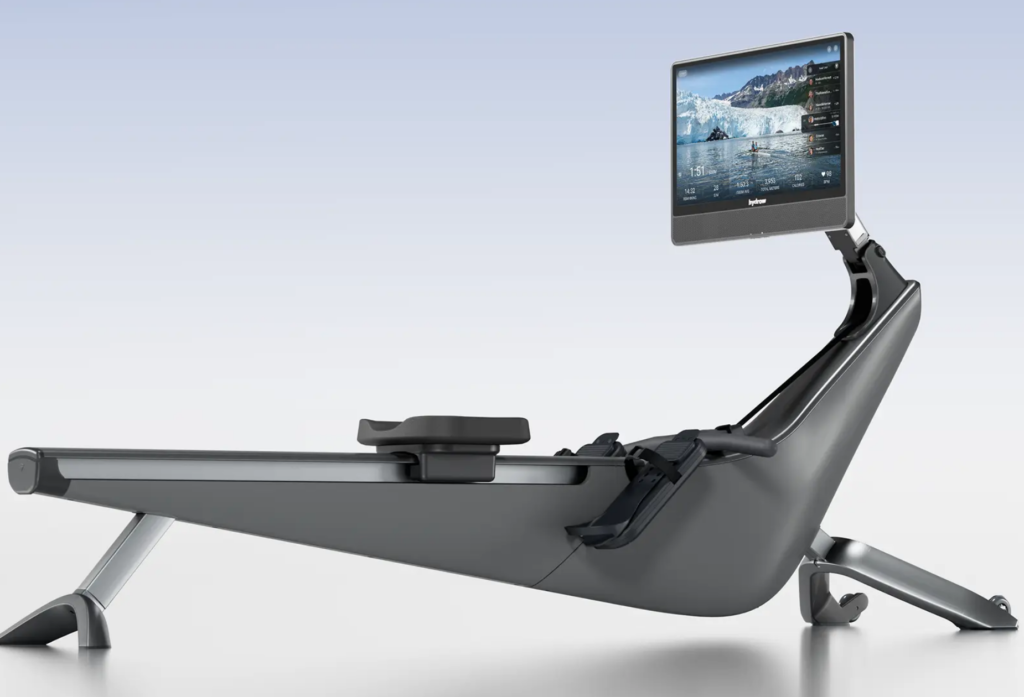
Rowing is the most efficient full-body low-impact cardio available, and Hydrow builds the machine that makes it feel least like exercise equipment. The Arc is the current flagship, sitting above the Origin, formerly sold as the Pro, and the compact Wave. Electromagnetic drag produces a stroke that is quieter and smoother than the air or water systems most rowers use, which matters enormously in an apartment or a shared room.
The design intent is a racing scull rather than a gym machine. Clean lines, rounded edges, a steel and aluminum monorail frame, adjustable footplates, and a seat owners consistently describe as more comfortable than competitors’ offerings. Weight capacity runs to 375 pounds. It stores vertically with the separately sold upright storage kit, which brings the stored footprint down to roughly 25 inches wide by 33 deep, smaller than anything that stands on its own.
The content is the differentiator. Hydrow films its coached sessions on actual water in locations around the world, with professional rowing athletes leading, and the effect is closer to following someone through a place than watching a class in a studio. The 22-inch display pivots for off-rower strength, yoga, and mobility work, so the machine anchors a full program rather than just cardio. Circuit training has been added to the platform, and the brand has been building toward a broader strength offering.
The costs are the membership and the vertical storage kit. All-access programming runs around $50 per month, the highest in the rowing category, and the machine is substantially less useful without it. Upright storage requires a wall anchor kit sold separately, unlike competitors that stand freely. At 145 pounds it is heavier than the main alternative and correspondingly harder to reposition. And while the electromagnetic stroke is exceptionally smooth, some experienced rowers find it less faithful to on-water feel than air or water resistance.
| Specification | Detail |
|---|---|
| Category | Best Smart Rower |
| Training focus | Rowing, off-rower strength, yoga, mobility |
| Resistance system | Electromagnetic drag |
| Max resistance | Variable drag; 375 lb user capacity |
| Display | 22″ pivoting HD touchscreen |
| Subscription | Around $50/mo all-access |
| Footprint | Approx. 86″ L x 25″ W x 47″ H; 25″ x 33″ stored upright |
| Unit weight | Approx. 145 lb |
| Installation | Minimal assembly; upright storage kit sold separately |
| Warranty | Limited home-use warranty |
| Price | $2,295 for Arc; $2,195 Origin, $1,995 Wave |
| Standout feature | On-water filmed coaching with near-silent electromagnetic resistance |
Why Users Say They Like It
Quiet is the word that appears most often in owner accounts. People rowing in apartments, early mornings, or shared spaces describe the electromagnetic system as the reason the machine is usable at all, and they connect it directly to how often they actually train. The stroke itself gets described as smooth and consistent, with owners noting the machine feels built from good materials in a way that justifies the price.
The filmed-on-water content is the emotional hook. Owners describe being pulled through sessions by the location and the coaching rather than by a metric on a screen, and several say it is the only cardio programming that has held their attention long term. The seat, footplate adjustability, and general ergonomics draw praise from owners who found other rowers uncomfortable, and the vertical storage option gets credited with making a nearly seven-foot machine livable.
The complaints are cost and storage. The monthly fee is the sharpest criticism, with owners noting it sits well above what competing rowing platforms charge. Having to buy a wall anchor kit for upright storage strikes people as something that should be included. Owners also report it is harder to move than lighter alternatives, and a subset of experienced rowers say the resistance does not fully replicate on-water feel.
Check Out Hydrow Arc Official Page For More Info And Reviews
Best Gamified Rower: Aviron Strong Go
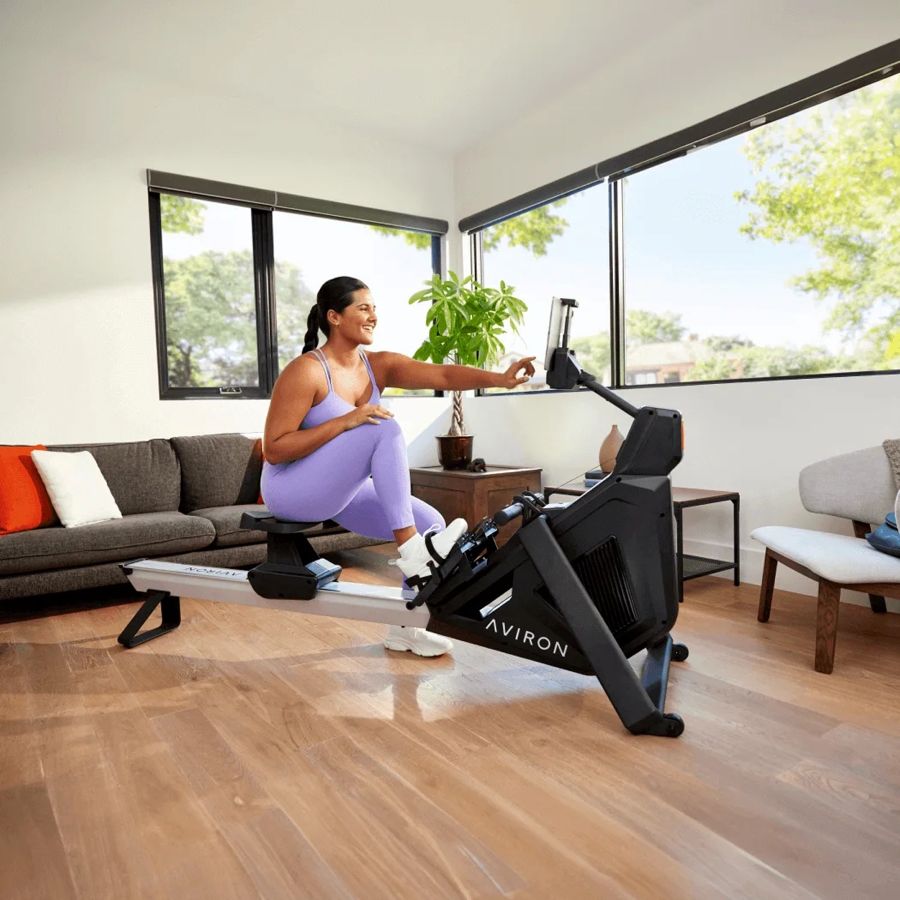
Aviron built its platform around a blunt observation: most people quit cardio because it is boring, not because it is hard. The Strong Go is the most affordable expression of that philosophy, starting around $999 by moving the screen off the machine and onto your iPad, which cuts several hundred dollars off the price without touching the hardware quality.
The resistance system is dual air and magnetic across 16 levels reaching past 100 pounds, which gives it a more traditional rowing feel than purely digital systems. The frame is reinforced aluminum with a 507-pound weight capacity, the highest in this roundup by a wide margin. Two ergonomic details matter more than they sound: the seat sits 20 inches off the ground on a low frame, so getting on and off does not require crouching, and the patent-pending footplates adjust for both foot and hip width, which accommodates body types and shoe sizes other rowers do not. It stands upright on its own with no wall mount required and rolls on transport wheels.
The programming is genuinely different from everything else here. Eight workout categories spanning solo and team games, coached sessions, community and guided games, scenic rows, live competition against other users, guided programs on and off the rower, and racing against professional athletes. More than a thousand programs total. The platform also streams Netflix, Hulu, Prime Video, Disney Plus, Paramount Plus, YouTube, and Spotify directly, which no major competitor allows. Membership runs around $34 monthly or $29 billed annually, with unlimited profiles on one subscription, and the structural warranty is 10 years on the frame.
The compromises are the missing screen and the platform requirement. You need an iPad, and the Aviron software does not support Android, which is a hard stop for some households. The machine is bulky and does not fold, though it does stand upright. And while the games are the point, buyers who want disciplined periodized rowing rather than entertainment may find the emphasis misplaced.
| Specification | Detail |
|---|---|
| Category | Best Gamified Rower |
| Training focus | Rowing, games, live competition, off-rower guided work |
| Resistance system | Dual air and magnetic, 16 levels |
| Max resistance | Past 100 lb; 507 lb user capacity |
| Display | None onboard; pairs with your iPad |
| Subscription | Around $34/mo, or $29/mo billed annually |
| Footprint | Approx. 84″ L x 27″ W x 48″ H; 35″ x 27″ x 83″ stored upright |
| Unit weight | Approx. 105 to 114 lb |
| Installation | Approx. 45 minutes of user assembly |
| Warranty | 1-year parts, 10-year structural frame |
| Price | From $1499 |
| Standout feature | Game-based programming plus direct streaming of Netflix, Spotify, and more |
Why Users Say They Like It
Owners say the games work, and they say it with a little surprise. The recurring account is someone who owned a rower before, stopped using it, bought this one, and now rows five days a week because the competitive and game modes hold attention in a way scenic footage did not. Making cardio fun is a phrase owners use almost verbatim, usually followed by an admission that they did not expect to.
Build quality and accessibility both draw strong marks. Owners describe the frame as rock solid and stable through hard efforts, and the low frame with elevated seat gets specific credit from older users and anyone with mobility limitations. Adjustable footplates earn appreciation from owners with larger feet who have struggled on other machines. Upright freestanding storage without a wall mount is repeatedly cited as a deciding factor against competitors.
The complaints are the iPad requirement and the bulk. Android households are simply excluded, and owners who did not own a tablet had to factor that into the real price. The machine is large even when standing, and the absence of a built-in screen bothers some buyers despite the savings. Support experiences are generally positive in owner accounts, with the parts warranty being shorter than the frame coverage suggests.
Check Out Aviron Strong Go Page For More Info And Reviews

Aviron StrongGo Rowing Machine -Compatible with iPad—Dual Air & Magnetic Resistance Up to 100 lbs | Game-Based Workouts, Compact Storage Design
The Best Smart Home Gym Equipment For 2026 At A Glance
| Category | Model | Why It Made The List | Subscription | Price (approx.) |
|---|---|---|---|---|
| Best Overall | Tonal 2 | Highest resistance ceiling among wall-mounted systems plus the best coaching software | $59.95/mo, 12-mo commitment | $4,295 |
| Best No-Subscription All-In-One | Speediance Gym Monster 2 | Full digital-weight gym with core AI coaching included, not gated | None required | $3,849 |
| Best Budget Entry Point | Tempo Move | Smart coaching for the price of a dumbbell set | From $39/mo | $395 to $495 |
| Highest Resistance Ceiling | Vitruvian Trainer+ | 440 pounds of adaptive load from a platform that slides under a bed | $39/mo optional | Around $2,890 |
| Best Rack-Mounted Smart Cable | Beyond Power VOLTRA I | Shoebox-sized unit with eight training modes and true eccentric overload | None | Around $2,100 |
| Best Portable | MAXPRO SmartConnect | 300 pounds of cable resistance in under 10 pounds of hardware | Free app, $19.99/mo optional | Around $849 |
| Best Fitness Mirror | Echelon Reflect 50 SE | Zero floor footprint with a genuinely deep class library | Premier membership required | Around $1,500 |
| Best Smart Treadmill | NordicTrack Commercial 1750 | The most complete connected running deck at a mainstream price | iFIT, $39/mo | $1,999 to $2,499 |
| Best Incline Trainer | NordicTrack Commercial X22i | 40 percent incline and a sled-push mode nothing else offers | iFIT, $39/mo | Around $3,499 |
| Best iFIT Studio Bike | NordicTrack Commercial S22i | Automatic incline and decline on a bike, plus a screen that pivots off-bike | iFIT, $39/mo | Around $1,999 |
| Best Class Experience On A Bike | Peloton Bike | The instructor bench and leaderboard nothing has replicated | All-Access, $44/mo | $1,100 to $1,500 range |
| Best Cardio And Cable Hybrid | NordicTrack Fusion CST | Functional trainer with iFIT automatic trainer control built in | iFIT, $39/mo | Check current pricing |
| Best Smart Rower | Hydrow Arc | The most convincing on-water feel with the strongest coached library | $50/mo | $2,295 |
| Best Gamified Rower | Aviron Strong Go | Game-based programming that fixes the boredom problem | $29 to $34/mo | From $999 |
Choosing Between The Best Smart Home Gym Equipment For Your Needs
Choosing the best smart home gym equipment for your space comes down to four questions, in this order.
What do you actually want to do? If the answer is lift, the choice is between digital resistance and real weight, and that is a philosophical question as much as a practical one. Digital load adapts, measures, and takes up almost no space. Real weight teaches stabilization and bar path in a way cables do not. If the answer is cardio, pick the modality you will still be doing in three years and buy the best version of it rather than the machine with the biggest screen.
How much are you willing to pay every month, indefinitely? A $59.95 membership over three years adds roughly $2,150 to the cost of a machine. Over five years it approaches the price of the hardware. The no-subscription options, Speediance, VOLTRA, MAXPRO, and the base Tempo Move, are not cheaper on day one but change the arithmetic considerably by year three.
What does the space actually allow? Wall-mounted systems need studs and permission. Platform systems need clearance around them to train safely, not just the footprint on the spec sheet. Treadmills and rowers need length that surprises people even when they measured. And anything that lives in a garage should be checked against the warranty terms before purchase, because more than one manufacturer voids coverage for garage use.
And what happens if you stop? The machines that hold their value are the ones where the hardware remains useful without the software. That is worth weighing before you sign a twelve-month commitment on a platform whose intelligence is the entire point.
Two things worth adding to any of these setups rather than choosing between them: a dedicated virtual coaching service if what you actually lack is accountability from a human being, and a wearable that tracks recovery rather than just activity, since the training decision most people get wrong is not what to do on a good day but whether to train at all on a bad one.

