

User Review
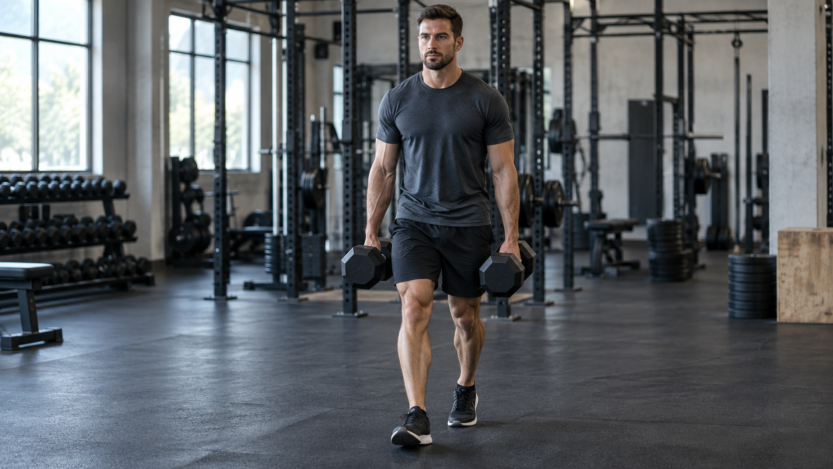
( votes)A farmer’s walk is performed by picking up a load in each hand, standing tall, and walking under control for a set distance or time. The exercise trains grip, upper back, core, hips, and legs at once, making it one of the most efficient conditioning and strength movements available to a home or garage gym.
A recent Fitness Volt guide to the farmer’s walk has renewed attention on the movement’s wide-ranging use. It needs very little equipment, but it does demand sound bracing, sensible loading, and enough clear floor space to walk safely. Dumbbells, kettlebells, trap-bar handles, and purpose-built farmer’s walk handles can all do the job.
How To Do a Farmer’s Walk With Proper Form
The goal is to carry the weights without allowing them to pull your posture out of position. Start lighter than your grip suggests; maintaining control through the entire walk is more useful than turning every carry into a wobbling max-effort attempt.
- Set two implements beside your feet. Dumbbells and kettlebells are the most accessible choices. Place them evenly and leave a clear path ahead.
- Stand between the weights with feet about hip-width apart. Push your hips back, bend your knees, and grip the handles firmly.
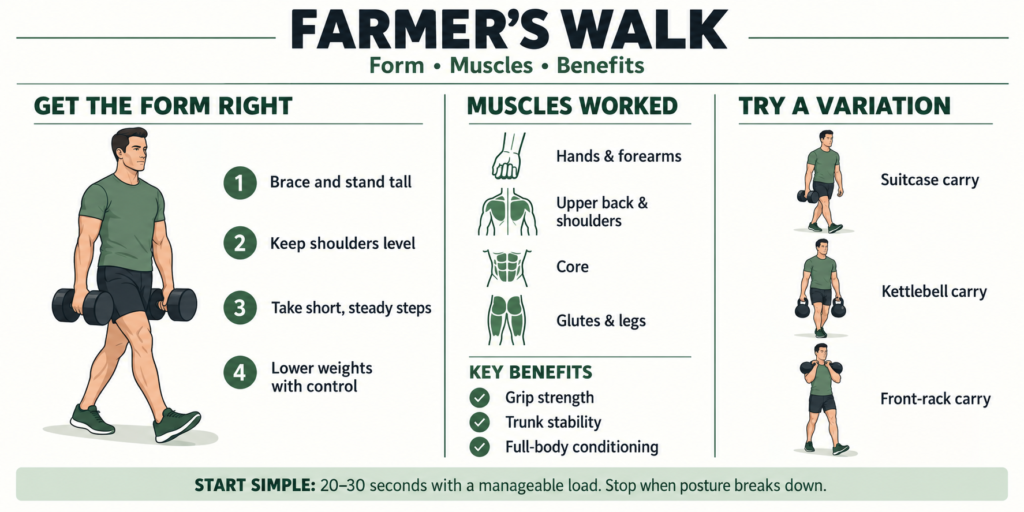
- Brace your midsection and stand by driving through the floor. Keep your chest tall, shoulders level, and arms long at your sides.
- Walk with short, deliberate steps. Look ahead, keep the weights close to your body, and avoid rushing.
- Stop when your posture starts to collapse or when the planned distance or time is complete. Lower both weights with the same controlled hip hinge used to pick them up.
Your shoulders should stay down and controlled, not shrugged toward your ears. A small amount of natural movement is normal, especially with heavy loads, but leaning sharply to one side, taking uncontrolled steps, or rounding the back are signals to end the set or reduce the weight.
What Muscles Does the Farmer’s Walk Work?
The farmer’s walk is a full-body exercise because the body must hold a load, resist side-to-side movement, and propel itself forward at the same time. It does not isolate a single muscle group, which is precisely why it earns a place in many strength programs.
- Hands and forearms: The finger flexors and forearm muscles maintain the grip throughout the carry.
- Trapezius, rhomboids, and upper back: These muscles help hold the shoulder girdle in a stable position while the weights pull downward.
- Core: The abdominals, obliques, spinal erectors, and deeper trunk muscles brace the torso and resist unwanted bending or rotation.
- Glutes, quads, hamstrings, and calves: The lower body supports the load and produces each controlled step.
- Shoulders: The rotator cuff and surrounding shoulder muscles work largely to stabilize the arm and shoulder joint.
Carrying an equal load in both hands emphasizes overall bracing and posture. Carrying one weight on one side increases the anti-lateral-flexion demand on the trunk, which is why suitcase carries feel much harder than their lighter-looking setup suggests.
Benefits of Adding Farmer’s Walks to Training
Farmer’s walks combine loaded strength work with movement. They can fit at the end of a lifting session, within a conditioning circuit, or as a brief stand-alone session when time and equipment are limited.
Grip Strength That Carries Over to Lifting
The hands must hold the implement for the entire set, which makes the movement useful for lifters whose grip gives out on deadlifts, rows, pull-ups, or heavy dumbbell work. Straps can be useful for certain pulling sets, but farmer’s walks are generally more productive when the hands are allowed to do their share of the work. When straps do make sense, weigh the trade-offs between extending a pulling set and training the grip directly.
Trunk Stability Under Load
The core’s job during a carry is to keep the rib cage, pelvis, and spine controlled while the load tries to shift them. That differs from crunch-based abdominal training and pairs well with direct core work, such as hanging leg raise variations that build core strength and control.
Practical Conditioning
Moderate-load carries performed for longer distances can raise the training demand quickly without the impact of sprinting or jumping. Muscle-strengthening activity belongs in a balanced weekly routine, and loaded carries can be one useful part of that work.
Simple Home-Gym Setup
A pair of dumbbells or kettlebells and a safe 20- to 40-foot lane are enough for productive carries. Kettlebells are often easier to store in compact spaces, while dumbbells may be easier to load in smaller jumps. The better choice depends on available space, budget, and the weight increases you expect to need.
How Heavy Should a Farmer’s Walk Be?
Use a weight that lets you walk with a steady gait, level shoulders, and a braced torso for the full work interval. There is no universal load because body size, hand strength, equipment type, and training experience vary too much for a single number to be useful.
Beginners can start with a load they can carry for 20 to 30 seconds while keeping clean posture. Experienced lifters can use heavier weights for shorter trips, often 10 to 30 seconds, or lighter loads for longer conditioning-focused walks. Add weight, distance, time, or total sets gradually, not all in the same session.
Farmer’s Walk Variations To Try
Changing the implement or load position changes the challenge without requiring an entirely new exercise. Choose the variation that addresses the weakness or training goal in front of you.
Suitcase Carry
Carry one dumbbell, kettlebell, or farmer’s handle on one side. The uneven load makes the obliques and lateral trunk stabilizers work hard to prevent leaning. Walk equal distances on both sides.
Kettlebell Farmer’s Walk
Two kettlebells are a practical option for a garage gym and work well for moderate-distance carries. Keep the bells from bumping into your legs by walking with controlled steps and enough space between the implements.
Trap-Bar Carry
A trap bar lets you stand inside the load, giving it a centered position that many lifters find comfortable. The larger load potential makes it a strong option for heavier carries, though it needs more turning room than dumbbells or kettlebells.
Farmer’s Walk Handles
Dedicated handles sit lower than most dumbbells and can be loaded with plates, allowing heavy carries without requiring a large dumbbell collection. They are particularly useful for strongman-style training, but users need a clear, level surface and collars that keep plates secure.
Overhead Carry
Holding one or two weights overhead adds substantial shoulder-stability and trunk-control demands. Use a lighter load than a standard farmer’s walk and reserve this version for trainees who can hold an overhead position without back extension or shoulder discomfort.
Front-Rack Carry
Holding kettlebells or dumbbells at the shoulders shifts the demand toward the upper back, arms, and anterior core. The front rack can be uncomfortable if wrist or shoulder mobility is limited, so keep the load light enough to maintain a solid rack position.
How To Program Farmer’s Walks
Farmer’s walks work best when the loading scheme has a clear purpose. Heavy carries build grip and whole-body tension; longer carries add a stronger conditioning element. Start with one approach per session so you can judge progress without turning the exercise into a random finisher.
| Goal | Suggested Starting Approach |
|---|---|
| Grip and strength | 3 to 5 sets of 10 to 20 seconds with a challenging load and full rest. |
| General fitness | 2 to 4 sets of 20 to 40 seconds with a moderate load and controlled pace. |
| Conditioning circuit | Shorter carries with a light-to-moderate load, paired with exercises that do not compromise walking mechanics. |
| Core stability | Suitcase carries on each side for controlled distances, using a load that does not cause leaning. |
Place heavy carries near the end of a strength session, after the main barbell lifts but before grip-intensive accessory work. On a conditioning day, keep enough rest to preserve foot placement and posture. Fatigue has a way of making a straight walking lane feel oddly complicated.
Common Farmer’s Walk Mistakes
- Starting too heavy: If the load forces a rounded back, a side bend, or frantic steps, it is too heavy for the planned distance.
- Shrugging constantly: Keep the shoulders organized and the neck relaxed. The load will challenge the upper back without an exaggerated shrug.
- Taking long strides: Shorter steps keep the load from swinging and make turns safer.
- Skipping the brace: Breathe behind a firm trunk and reset between trips when needed.
- Turning carelessly: Slow down, take several small steps, and avoid sharp pivots with heavy weights.
- Training through pain: Stop for sharp pain, numbness, dizziness, or a sudden loss of grip. Persistent joint or back symptoms deserve assessment from a qualified health professional.
Who Should Use Caution With Farmer’s Walks?
Loaded carries place meaningful stress on the hands, shoulders, spine, hips, knees, and ankles. Anyone returning from an injury, managing balance limitations, or dealing with a condition that affects grip should get individualized guidance from a qualified clinician or coach before progressing load or distance.
Set up the lane before lifting: remove loose plates and cords, use stable equipment, and avoid slick floors. In a busy commercial gym, pick a route that does not cross traffic. In a garage gym, check for uneven concrete, open doors, vehicles, and other obstacles before starting the carry.
Frequently Asked Questions
How Far Should You Walk for a Farmer’s Walk?
Beginners can begin with 20 to 30 seconds of controlled walking or a short, repeatable lane. The best distance is one you can complete without leaning, rushing, or losing a secure grip.
Can You Do Farmer’s Walks With Dumbbells?
Yes. Dumbbells are one of the easiest ways to perform farmer’s walks at home, provided they have secure handles and enough room between them to walk naturally.
Are Farmer’s Walks Good for Abs?
Farmer’s walks train the abdominals and deeper trunk muscles to brace and resist movement under load. Suitcase carries increase the challenge to the obliques because the weight pulls the torso toward one side.
Should Farmer’s Walks Go Before or After Deadlifts?
Most lifters should perform farmer’s walks after deadlifts because hard carries can fatigue the grip and upper back needed for deadlift work. If carries are the main training priority, place them earlier and reduce other grip-demanding volume.
How Often Can You Do Farmer’s Walks?
One to three sessions per week is a practical range for many training plans, depending on the load and total pulling volume. Give the hands, forearms, and upper back time to recover when heavy carries are used.

