
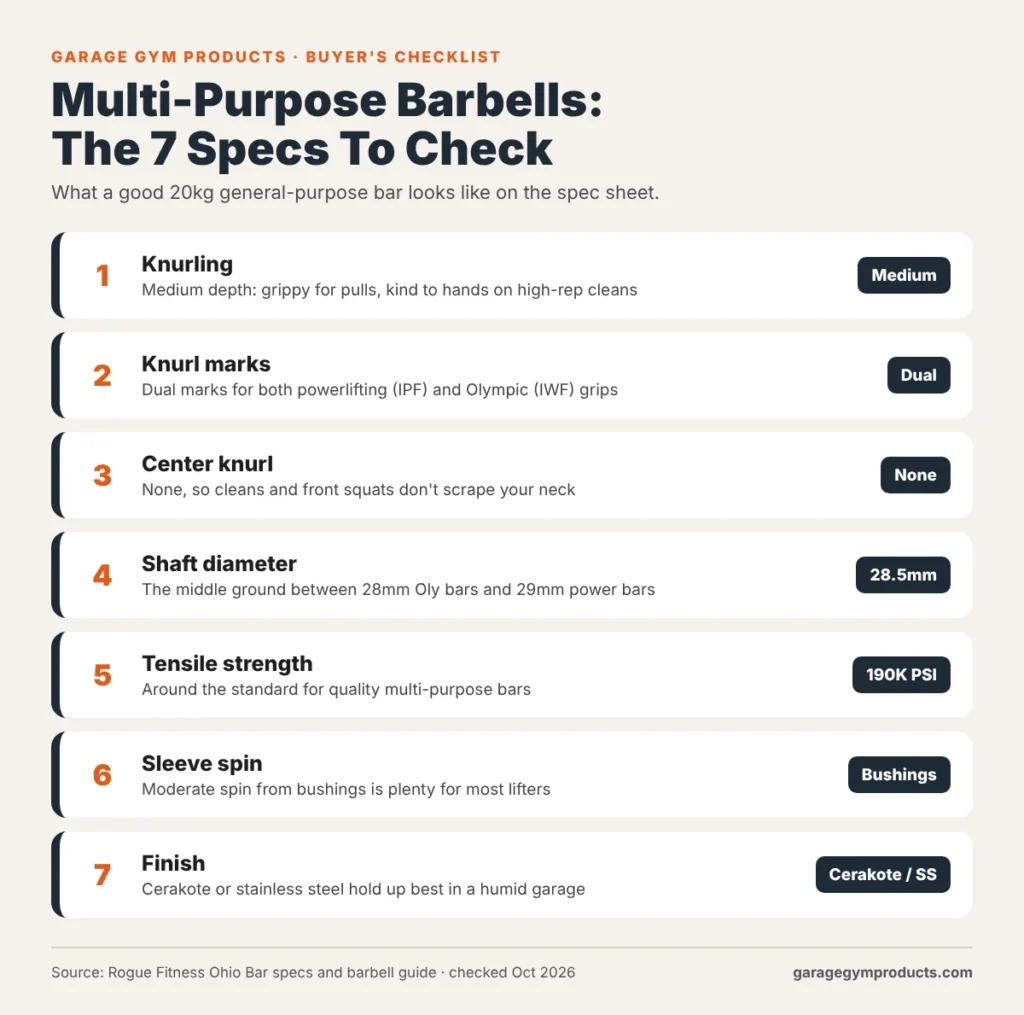
The best multi-purpose barbells for most people are 20kg bars with a 28.5mm shaft, a medium knurl, dual knurl marks, no center knurl and a tensile strength of around 190,000 PSI. That one bar can handle your squats, presses, deadlifts and Olympic lifts in a garage gym without forcing you to buy three specialty bars.
Here’s the quick version of what to look for before you scroll through our top-rated picks:
- Shaft: 28.5mm, the middle ground between 28mm Olympic weightlifting bars and 29mm power bars.
- Knurl: medium depth with dual (IPF and IWF) knurl marks and no center knurl.
- Tensile strength: around 190,000 PSI for a quality bar.
- Sleeves: bushings with moderate spin are plenty for most lifters.
- Finish: Cerakote or stainless steel if your garage gets humid.
Specs checked against manufacturer pages in October 2026.
A multi-purpose or “general purpose” barbell is exactly what the name sounds like, a barbell that can be used for various exercises and exercise-types in the gym.
Whether you want to deadlift, squat, clean, jerk, curl, snatch, perform Romanian deadlifts, or anything in-between, a multi-purpose barbell will help you reach your goals.
While you may require a Power Bar for heavier weights or a specialty bar for squats (especially with shoulder issues), these bars are a great starting point for most people.
Not sure which style of bar you actually need? Our guide to the different barbell types breaks down every option side by side.
When we examine the top-rated multi-purpose barbells we look for a few must-have features.
- They must have decent knurling (Not too light or heavy).
- The barbell needs knurl markings for consistent grip points.
- A good whip at heavier weights is a big plus.
- Sleeves that offer a moderate to high spin.
- A decent finish that will last in a garage gym setting.
- A relatively good tensile strength of at least 190K.
- Easy maintenance (preferably with snap rings but this is not always required).
Barbell Knurling
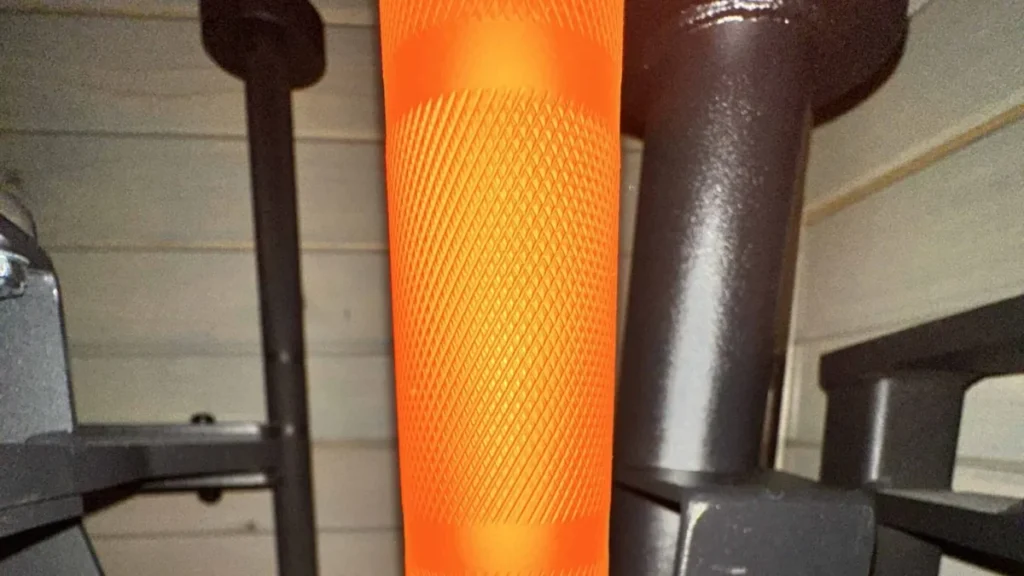
The knurling is a big factor when choosing this type of barbell for our home gym. We like a medium-knurl for several reasons. First, it allows us to maintain a fairly strong grip during lighter weighted deadlifts. Second, we don’t lose track of the bar during jerk presses, clean and snatches, and other movements that are not as static in nature.
The bar shaft knurling for multi-purpose barbells is also accompanied by dual knurl marks. These markings help us set up for the perfect lifts every time whether we’re focused on powerlifting, Olympic lifts, or Crossfit movements. The powerlifting (IPF) marks sit a little closer to the center of the bar than the Olympic (IWF) marks, which line up with a wider snatch grip.
Whip And Spin Is Hugely Important
Whip is hugely important when it comes to this type of barbell. Experienced lifters incorporate the bounce from the bar’s whip to move the bar off the chest while the bend coming upward helps push the bar into the jerk position.
The bar’s whip also helps propel the weight upward, offering additional assistance throughout the entire movement.
How much whip you get comes down mostly to shaft diameter. According to Rogue’s barbell guide, Olympic weightlifting bars use a 28mm shaft for more whip, power bars use a stiffer 29mm shaft, deadlift bars go as thin as 27mm, and multi-purpose bars split the difference at 28.5mm.
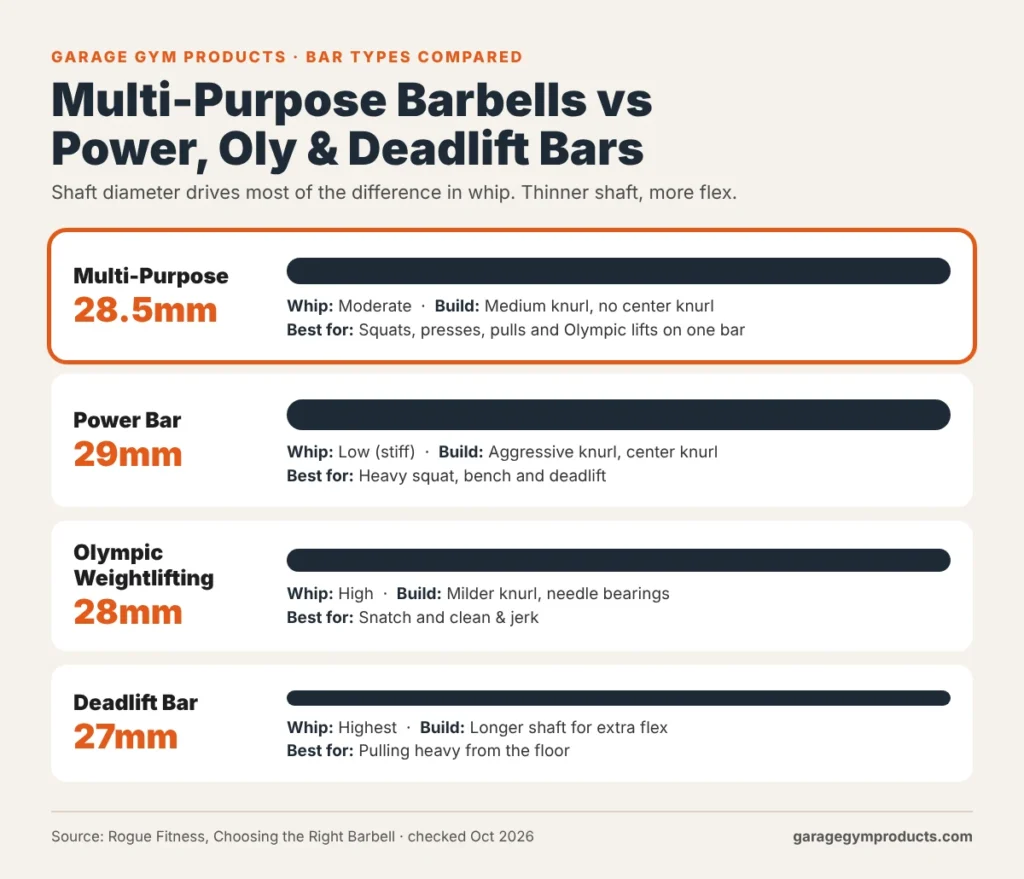
While whip is important, it can actually hinder heavier squats, bench presses and other movements where you want a stable bar, and that’s why we only recommend this type of barbell at lower weights. If you need to jump up to heavier lifts a powerlifting bar is the way to go.
Spin is also important and is aided by the bearings used with the bar. A higher rate of spin helps reduce the force produced by the inertia of weight plates. If your sleeves are providing a good amount of spin it can greatly reduce pain and injury to your wrists and elbows. That matters even more when you’re dropping bumper plates on cleans and snatches.
We have to note that when it comes to composite bushing versus bronze bushings we don’t have a big preference. We’ve gone back and forth on this issue with other experts and the difference is negligible in our opinion. One thing we will say is that bushing maker igus says its engineered composite plastic bushings deliver a longer service life than oil-impregnated sintered bronze bearings, mainly because they don’t rely on an oil film that can dry out. Plenty of great bars still use bronze, including the Rogue Ohio Bar.
Multi-Purpose Barbell Finishes
The shaft and sleeves of barbells can be coated in various different finishes. Bare steel barbells are the hardest to maintain while stainless steel and cerakote finishes are considered high-end options that are the most likely to withstand the test of time.
While we routinely rate barbells with Cerakote and Stainless Steel finishes higher than other bars, that typically comes down to the fact that high-end bars are the most likely to utilize those finishes. If you want Cerakote without paying top dollar, the Bells of Steel Cerakote Utility Bar is worth a look.
Multi-Purpose Barbell Tensile Strength
The tensile strength of a barbell is measured in PSIs or pounds per square inch. The stronger the tensile strength the more weight your bar can take before it fails, and a higher-strength steel is also less likely to take a permanent bend. Whip, on the other hand, comes mostly from the shaft diameter rather than the tensile number. Because these bars need to provide good spin and whip for various uses, we typically find a PSI of around 190,000 to be standard on the bars.
The Rogue Ohio Bar, for example, is rated by Rogue at 190,000 PSI with a 28.5mm shaft. While there’s a standard PSI, keep in mind that cheaper bars may feature a lower tensile strength and therefore be able to support less weight on the bar.
Multi-Purpose Barbell FAQs
What is the best barbell for a home gym?
For most home gyms, a 20kg multi-purpose barbell with a 28.5mm shaft is the best first bar. It handles squats, bench, deadlifts and Olympic lifts well enough that you won’t need a second bar until your lifts get very heavy or very specialized. Something like the Vulcan Standard 28.5MM bar is a good example of the format.
Can you deadlift with a multi-purpose barbell?
Yes. A multi-purpose bar is fine for deadlifts at most strength levels. Very strong pullers often switch to a 27mm deadlift bar for extra flex, or a 29mm power bar if they want a stiffer, grippier bar.
What tensile strength should a barbell have?
Look for around 190,000 PSI on a quality multi-purpose bar. Cheaper bars often come in lower, which means they can take less weight before they bend permanently.
Does a multi-purpose barbell have a center knurl?
Usually not. Most multi-purpose bars, including the Rogue Ohio Bar, skip the center knurl so it doesn’t scrape your neck during cleans and front squats.
Is a 28.5mm or 29mm barbell better?
A 28.5mm bar is better if you want one bar for everything because it has a little more whip and is easier to grip. A 29mm power bar is better if you mainly squat, bench and deadlift heavy and want the stiffest bar possible.
How much does a multi-purpose barbell weigh?
A standard men’s multi-purpose barbell weighs 20kg (about 44 lbs) and is roughly 7 feet long. Women’s versions weigh 15kg and usually have a thinner 25mm shaft.
Our multi-purpose barbell ratings shown above will continue to auto-adjust as we add more barbells and with help from our readers whose aggregated reviews auto-adjust our current ratings.


